
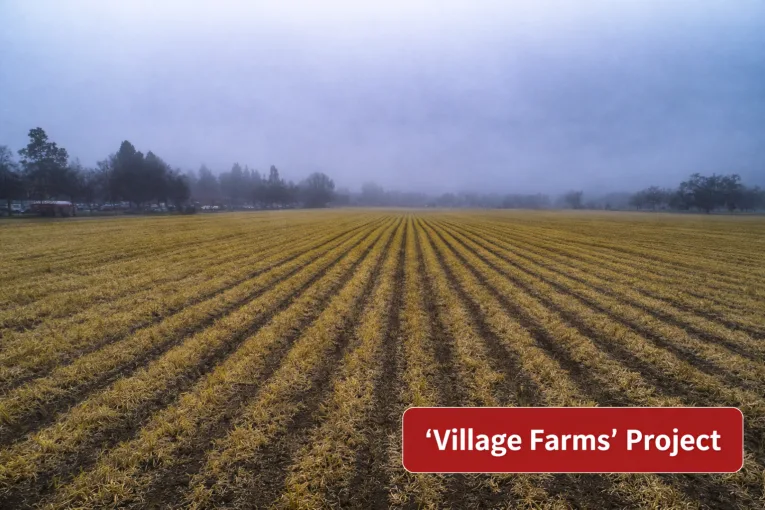
DAVIS, CA — After long hours of discussion, the votes by the council was almost anti-climatic as the Davis City Council voted unanimously Tuesday night to advance the Village Farms development to a citywide ballot, approving a series of entitlements, amendments and agreements that together set the framework for one of the largest housing proposals in city history.
The council also voted unanimously to place the project before voters in a special election scheduled for June 2, 2026, sending the final decision on land-use changes to the electorate under Measure J/R/D.
Every major vote related to the project passed without dissent.
Council members approved amendments to the city’s General Plan and baseline project features, adopted pre-zoning and preliminary planned development approvals, approved a development agreement with the project applicants, called the special election and requested that Yolo County consolidate the election with other scheduled contests. Each motion passed on a unanimous voice vote.
The votes capped a lengthy public hearing marked by pointed questions, policy disagreements and repeated expressions of unease about risk, timing and implementation, even as councilmembers said they ultimately believed the decision belonged with voters.
Mayor Donna Neville framed the evening as a necessary step rather than an endorsement of every project detail, emphasizing the council’s role in shaping a proposal that now must withstand public scrutiny. As motions came forward one by one, Neville repeatedly underscored that the council’s task was to determine whether the proposal met the legal and policy thresholds to move forward.
When final votes were taken, Neville called for approval and each councilmember responded “Aye,” with no no votes and no abstentions.
Much of the council’s discussion focused on the tension between discomfort with aspects of the project and a shared belief that the community, not the council alone, should decide the future of the 230-acre site north of Covell Boulevard.
Councilmember Bapu Vaitla directly addressed his earlier opposition and explained why he ultimately supported advancing the project to the ballot.
“I just want to be clear just to make a public statement because last week I voted against a motion because I was uncomfortable with in real time deciding to make that number of permits, 150,” Vaitla said.
He said subsequent revisions resolved those concerns, adding, “I just want to make it very clear that I’m supportive of the developer’s affordable housing proposal. I think it’s great.”
Vaitla credited the project team for responding to feedback over time, saying, “I do appreciate your work that you’ve done over two years returning to the city, returning to all the stakeholders and saying, ‘How can we improve this offer again and again?’”
Councilmember Josh Chapman likewise emphasized the importance of voter participation while pressing hard on details related to affordability and long-term commitments. Chapman repeatedly returned to the question of moderate-income homeownership, arguing that for-sale affordable housing deserved special attention.
“We know that home ownership is a path to generating wealth,” Chapman said. “We know that that’s the biggest barrier for folks.”
Chapman raised concerns about how commitments would be memorialized, expressing frustration with vague promises that might not be realized. While recognizing legal constraints, he argued that signaling intent mattered. “I think it signals to the community that we are serious about this,” he said.
Councilmember Gloria Partida focused much of her questioning on clarity and accountability, particularly around the city’s obligations under the development agreement and what would happen if affordable housing commitments proved difficult to fulfill. At multiple points, she sought to understand how land dedications, funding and construction responsibilities would interact over time.
“I had bigger questions about how the mechanism works,” Partida said, adding that parts of the agreement were “not as clear as I would like for it to be.”
Still, Partida ultimately supported moving the project forward, including the decision to let voters decide. During the final round of motions, she joined her colleagues in voting yes on each action, including the resolution calling the special election.
Councilmember Linda Deos expressed caution about binding the city too tightly in contractual language, particularly when circumstances decades into the future were unknowable. She stressed the importance of flexibility for future councils while still signaling policy priorities.
“I don’t want to bind the city beyond that,” Deos said, referring to proposals that would have guaranteed specific outcomes in the development agreement. “It’s all on the city to be doing this.”
Despite those reservations, Deos supported advancing the project to the ballot, aligning with the broader consensus that the public should weigh the trade-offs inherent in a development of this scale.
Throughout the evening, councilmembers emphasized that their votes did not represent blanket endorsements. Instead, they reflected a judgment that the proposal, as revised, warranted voter consideration.
One of the central themes was affordable housing, particularly the project’s baseline features that link building permits to the production of lower-income units. Under the approved framework, the developer must ensure the construction of 100 lower-income affordable units before receiving the final 150 market-rate building permits. The city also retains land and funding dedicated to affordable housing, with options to either build units itself or, under certain conditions, require the developer to do so.
City staff repeatedly emphasized that the agreement was structured to preserve future flexibility while maintaining enforceable commitments. The city attorney explained that language was intentionally crafted to allow future councils to respond to market conditions.
“We cannot predict exactly how that will play out,” staff said during the discussion, referring to the possibility of economic downturns or funding constraints.
In addition to lower-income rental housing, the council debated how to address moderate-income ownership opportunities. Ultimately, the council agreed on language stating that the city would strive to make all 80 moderate-income units deed-restricted for sale, a goal rather than a binding guarantee.
Mayor Neville signaled her discomfort with locking future councils into rigid outcomes through a development agreement. “As much as I’m very, very supportive of the ultimate goal, the mechanism, putting it in the DA, is kind of troubling as a binding guarantee,” she said. Still, she agreed to support language expressing clear intent.
Beyond housing, councilmembers discussed a range of baseline project features, including sustainability commitments, landscaping standards and solar design. The council approved amendments prohibiting irrigated turf in front, side and street-side residential yards and requiring a solar capacity study designed to optimize power generation.
Neville described the landscaping changes as part of a broader shift in state policy. “We’re all trying to move there,” she said. “Brown is the new green.”
Councilmembers also approved sustainability provisions encouraging the use of local carbon offset programs when available and ensuring that energy infrastructure could be transferred to public or regional utilities in the future.
Vaitla praised those provisions as forward-looking. He said the commitments served as “the seed of a effective climate resilience plan that this project offers.”
As the meeting neared its conclusion, the council formally approved the development agreement and then turned to the procedural steps necessary to place the project on the ballot. A resolution calling for a special election on June 2 passed unanimously, followed by another unanimous vote requesting consolidation with other elections.
When asked whether the council was comfortable with the ballot question language, staff noted that the city was limited to 75 words. No councilmember proposed changes, and the resolution moved forward as written.
With the votes complete, Neville formally closed the public hearing. “We have now completed the hearing on the Village Farms project,” she said.
The decision sends the Village Farms proposal into its next and most consequential phase, a citywide campaign ahead of the June election. While councilmembers expressed a range of views on project details, the unanimous votes reflected a shared conclusion that the ultimate choice rests with Davis voters.
Follow the Vanguard on Social Media – X, Instagram and Facebook. Subscribe the Vanguard News letters. To make a tax-deductible donation, please visit davisvanguard.org/donate or give directly through ActBlue. Your support will ensure that the vital work of the Vanguard continues.

What did they do about access to the Cannery roundabout?
From what I can see, it didn’t come up
Some guy threatened litigation about access during public comment.
Access to Cannery Round About was brought up during deliberation. Gloria Partida was in favor of Bike, Pedestrians and Emergency Vehicles access between the proposal and Cannery. I stayed up past midnight watching the political “sausage” being made. The lack of a complete study of a grade separated path across Covell meant certification of the EIR would need to be postponed or made without the inclusion of the crossing. Because the board had to make an 11th hour decision to either certify or postpone the June J/R/D vote. Not surprisingly, a crossing was left out of the final decision. Hopefully I haven’t mischaracterized anything here.
John,
You are correct on everything. On the Cannery access to the Cannery Loop, the decision was to allow access only to bike/ped and emergency access for now. But it was made clear that this could be changed in the future to allow car access to Village Farms. So, it would appear that this was to garner favor with Cannery residents concerned about this issue, but it was made clear that there is nothing permanent about this. I would not count on it being permanent given all the other uncertainties, unresolved issues and unanswered questions about Village Farms and its grossly inadequate EIR.
Yet, the Council made last minute decisions on-the-fly from the dais on critical issues that are not even thoroughly thought through. Like the affordable housing “plan” debacle and debate that occurred at the last Council meeting and this meeting, yet they all agreed to it despite all of its short-comings, numerous undefined conditions and loose ends. But they barreled ahead to accommodate the developers wishes for a premature vote in June and approved a half-baked project and its inadequate EIR when we don’t even know what the map looks like because the developers are still trying to figure that out.
There was absolutely no reason for the Council to push this project forward now given the mess it and its EIR still is, but the community and its concerns apparently come second to the developers wishes. Simply astonishing…
I’m being told…. Council directed that the Cannery Loop would only be open to bikes, pedestrians and emergency vehicles and we took action to reflect that in the DA. No change needed to the EIR. So no thru car traffic at the Cannery Loop.
Yes, but it is concerning that it was made clear at the meeting that this could be reversed in the future to have vehicular through traffic from Village Farms to the Cannery Loop.
The Council exceeded expectations for professionalism, demeanor, organization and compromise. The leadership of Mayor Neville has been both refreshing and outstanding. Now we need to win in June.
Now prepare for the ugliest development campaign to date, with outrageous, contentious claims from both sides, sprinkled with pointed personal insults. It should glorious to watch from the sidelines.
I’m not so sure about that, especially since some of the “usual supporters” of these type of proposals apparently have significant, unresolved concerns. As such, it doesn’t seem likely that there’s anyone to “fight with”, so to speak – other than perhaps the Vanguard, a couple of leaders on the local development branch of the Sierra Club, etc.
Perhaps some of those associated with the school district might be some of the fiercest remaining supporters, though the district itself is now essentially forced to abandon its campaign.
“Councilmembers also approved sustainability provisions encouraging the use of local carbon offset programs when available and ensuring that energy infrastructure could be transferred to public or regional utilities in the future.”
Unfortunately, that decision cannot be made at a later date without squandering most of the financial and economic benefits that might accrue to a municipal utility. Once PG&E gains control of those utilities, the developer has no say in future dispensation of those assets. Instead the City would have to buy those back from PG&E at great expense. Another missed opportunity.
The proposal most likely will lose at the ballot box in its current configuration and we’ll have to start over again at this location. Instead of hastening housing construction, its probably that we’ve thrown up another delay.
The definition of insanity: Trying the same thing over and over again hoping for different results.
You mean killing projects?
I agree with Ron O., Richard and Tim,
There was absolutely no excuse for this incomplete mess of a project and its seriously flawed and adequate EIR to be approved by the City Council rushed to the ballot this June, However the Council prioritized the developers demand to place this on the June ballot, rather than prioritizing the needs of the community for a fair and thorough process and to propose a better project.
Also, this is just another set-up to place an unacceptable project on the Measure J/R/D ballot, and when it gets voted down, then they will try to blame Measure J/R/D. That really is insanity and appalling to say the least.
I don’t think anyone can argue that this proposal was rushed to get it on the ballot without addressing some important elements. (The type of elements that are important to those who might otherwise support it.)
I’m sure that we’ll hear more about that between now and June.
Not sure why that date was so important to the owner/developer, after sitting on it for years/decades (and farming it – after getting it for a bargain price).
Perhaps he was concerned about the “competing” development appearing on the ballot, before his was presented to voters.
You guys are so funny
It’s not people like “us” that you need to be concerned with.
Not sure I understand the context in your “so funny” comment.
It’s funny because I’ve been doing this now for 20 years and every single project has been “rushed” according to opponents of the project. Moreover, that complaint is usually, though not always, leveled by people who are never going to support the project anyway.
What’s funny to me is that after McCann has complained for years about Ron O’s residence they now find kindred spirit where the enemy of the good is laying down with the Malthusian troll in a coalition of obstruction made in hell.
For the most part there was a stark generation gap with young people speaking in favor of the project and most old people speaking against it.
Alan C Miller writes “Now prepare for the ugliest development campaign to date, with outrageous, contentious claims from both sides, sprinkled with pointed personal insults. It should glorious to watch from the sidelines.”
I agree the lead up to this election will be contentious. I argue it doesn’t need to be “ugly” if those on both sides of the issue strive to tell “truths” and refrain from personal “”insults” . Perhaps that makes me seem naive. But I’m about as versed on the Village Farms project as an average citizen could be. No, I’m not a Development or City Planning professional, but I’ve tried to stay as informed as possible. I’ve been to several meetings on this proposal. From early scoping meetings, planning commission and city council meetings and a “meet the developers” presentation at Lamppost Pizza. As I
sat at last night’s final council meeting’s final certification of the Environmental Impact Report. I recognized I finally felt versed in the intricacies of the Staff and Applicants viewpoints on Village Farms. An so the June 2nd election has been triggered. Now it’s time for both sides to present an honest argument for or against Village Farms. I recognize that one side has the money to produce slick multicolored fliers that I imagine will be landing in our mailboxes. I hope the argument of the less monetarily endowed side will reach each citizen of Davis. I imagine the very costly voter pamphlets will have the standard Argument and Rebuttal options for both the Yes or No votes. Anyone who votes in this measure J/R/D owes it to themselves and their neighbors to be educated as to the potential beneficial and negative effects a vote in either direction could mean.