
Originally published by EdSource
A day after Fresno State removed a statue of César Chávez, signs appeared nearby highlighting sexual abuse allegations against him — part of a broader reckoning unfolding across California schools.
The signs displayed a statement issued by Dolores Huerta, a civil rights leader who founded labor union United Farm Workers alongside Chávez, saying she was one of several people, including girls, whom Chávez sexually abused decades ago.
They were the result of “a marathon texting conversation” among faculty and staff from the university’s Women’s, Gender and Sexuality Studies department, said professor Larissa M. Mercado-López, who “wanted to find a way to respond” just days after the campus had held an annual Chávez celebration.
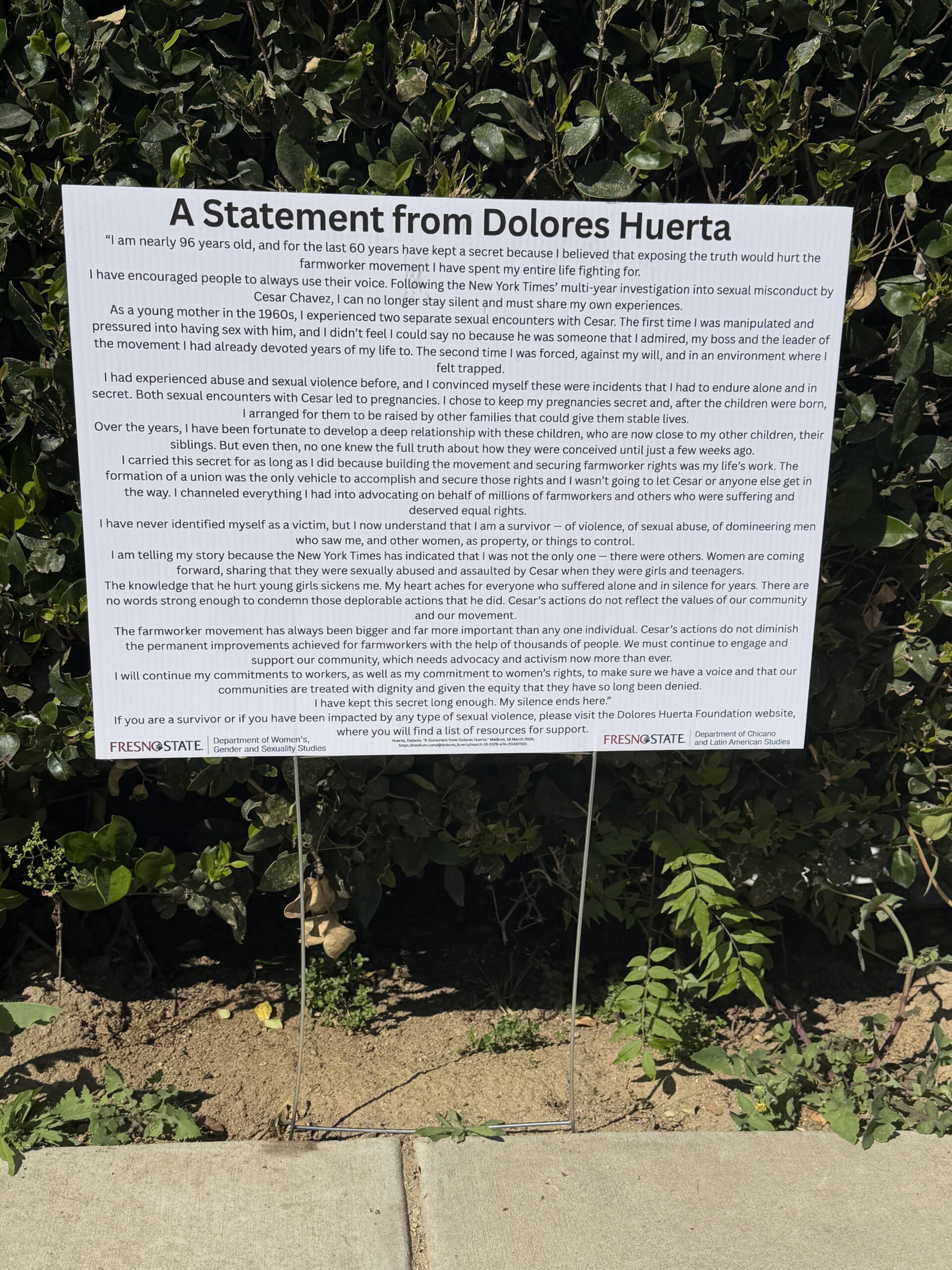
“We really wanted to center her voice and story, and shift the focus of the conversation to violence against women, because it is ongoing,” Mercado-López, who also chairs the department, said in an email.
This was just one of many responses in the two weeks since the sexual abuse allegations were revealed. Now, educators and students will celebrate Farmworkers Day on Tuesday, March 31, which until last week was formally recognized by the state as César Chávez Day.
For many educators, however, the swift changes around Chávez raise a deeper question: whether removing symbols is enough or if schools must also confront the underlying issues of power, violence and historical legacy.
“To me, I’m less concerned about the speed with which we are responding, and more concerned about what we are doing afterward. Removing a statue is simply removing a symbol of someone whose actions don’t align with our values,” Mercado-López said. “What next? Now that we have this information, what will we do in accordance with our values?”
Classroom discussions on Chávez
Equating Chávez’s actions of alleged sexual abuse with the larger labor movement he co-led would be a mistake, said Miroslava Chávez-García, history professor at UC Santa Barbara.
“It could be a really easy excuse to say this whole movement was for nothing, or this whole movement was based on a lie or abuse of power,” said Chávez-García. The rights won by farmworkers, she said, are far bigger than one individual.
How the Farmworkers’ movement began
- In 1965, Filipino farmworkers initiated a strike to protest low wages in California’s grape fields
- Mexican farmworkers joined the strike weeks later, under the leadership of Dolores Huerta and César Chávez
- While the farmworkers’ strike and eventual boycott of grapes had several leaders, Chávez became synonymous with the labor movement
- Chávez’s face and name has for decades been immortalized on school buildings, scholarships, murals, statues and street signs
Jeff Duncan-Andrade, professor at the San Francisco State Latina/o Studies and Race and Resistance Studies departments, said this moment presents an opportunity for educators to engage students and the school community in deeper conversations about difficult issues, including sexual violence.
Making decisions on curriculum changes or name removal without involving students puts schools at risk of addressing symptoms rather than root causes.
“What we effectively end up doing is handing out aspirin,” said Duncan-Andrade, who co-founded a community school in 2015 that has since merged into Oakland Unified’s Oakland Academy of Knowledge. “The thing about aspirin is it will temporarily relieve the symptoms of a headache, but it won’t stop you from getting headaches.”
It’s an analogy borrowed from human rights lawyer Bryan Stevenson, who argues the path toward equality and less bigotry requires confronting painful history. Diving into the difficult conversations — whether it be allegations of sexual abuse against the country’s founding fathers, slave owners, the current president or Chávez — is part of what helps to “create critically engaged democratic citizens.”
Last week, one of Duncan-Andrade’s graduate students, who is training to become a teacher, asked how to address the allegations against Chávez with her students.
Duncan-Andrade advised her that educators should avoid telling students what to think and instead be honest about not having all the answers. He suggests presenting the full complexity of historical figures, both good and bad, so students can practice thinking through tough subjects they will encounter as they grow older.
“It’s more incumbent on us to have the courage and the integrity to just tell the truth to children,” Duncan-Andrade said.
At Fresno State, a student reporter echoed a similar sentiment.
“Students aren’t satisfied with simplified versions of history anymore. They expect institutions to be honest, especially when that honesty is uncomfortable,” Manjot Dhanda, a senior majoring in electrical engineering, wrote for The Collegian, Fresno State’s student publication.
Discussions on sexual abuse require thoughtful guidance and support
Peace Over Violence, a nonprofit that advocates against sexual, domestic and interpersonal violence, is prepared to answer youths’ questions about the allegations against Chávez, said Luke O’Quinn, who manages the organization’s violence prevention division.
Their work includes hosting an annual summer institute where about 25 students ages 14 to 19 from Los Angeles schools learn to prevent teen dating violence, recognize power and control in relationships and build healthy relationships. During the school year, staff also support students who are in campus-based Students Together Organizing Peace (STOP) clubs.
O’Quinn said the topics can bring up a range of emotions in students, which is why lessons include guidance on emotional regulation.
Conversations on the Chávez allegations “could bring up past experiences that are uncomfortable for them, so we want to be very mindful of how this is landing, give them time and space to process and heal, but also give them the knowledge and information to learn and help identify what these behaviors are,” he said.
Some of the students they work with are aware of the allegations but have yet to begin asking questions about what it all means, and will likely take some time to process the news, O’Quinn added. They attend a school in Boyle Heights, where a main boulevard is named after Chávez. It’s a heavy topic, plus the students regularly deal with several challenges, including immigration raids and exposure to gang violence.
What comes after name and statue removals?
Changes have also been swift at San Diego County’s Southwestern College.
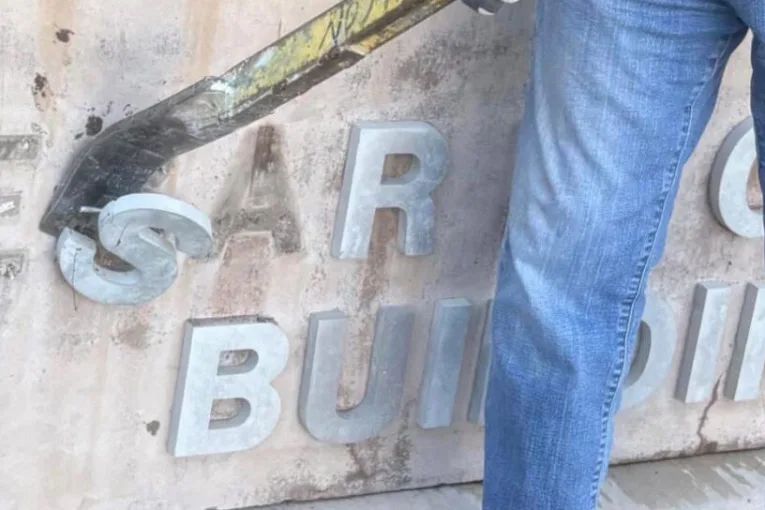
“César E. Chávez” signage was torn off from the student services center within two days and the campus canceled the annual event honoring Chávez’s legacy, which includes raising the United Farm Workers flag. The college’s board of trustees plans to rescind a resolution, adopted two days before the allegations being publicized, recognizing César Chávez Day at its April meeting.
“Chávez’s reputation — that’s irrelevant to me. It’s the people that we protect,” said Robert Moreno, trustee of the college’s governing board. “We want students to walk away from this moment not discouraged but reassured that the institution will act when it matters, and we are choosing to use this as a learning opportunity even though we wish it hadn’t come to us this way.”
The speed of the changes has drawn praise from some and skepticism from others, especially as other high-profile cases of sexual abuse remain unresolved.
“We might not feel that we have the power and numbers that we need to do something that requires an act of Congress, but we do have the ability to remove a physical object from our campus grounds or take a vote to rename a school,” Fresno State’s Mercado-López said. “I think that some see it as an opportunity to deliver justice in a context where justice for others may be extremely slow or not coming at all.”
It may be precisely because those other cases exist that the response has been swift and largely uniform, said Chávez-García from UC Santa Barbara.
“There’s precedent, because this has happened so many times. It’s not like we’re fumbling in the dark,” she said. “We know what we need to do, because it’s happened in the Catholic Church, it’s happened in sports, there’s many other spaces where these allegations and this abuse has happened.”
And after the removal of statues and signage, discussions must continue, several educators said.
“Our responsibility as the institution is to first listen and acknowledge those concerns directly and prioritize and reaffirm that student safety is not negotiable,” said Moreno, from Southwestern College. “We are also creating safe space for dialogue, because policy has to start with trust.”
Follow the Vanguard on Social Media – X, Instagram and Facebook. Subscribe the Vanguard News letters. To make a tax-deductible donation, please visit davisvanguard.org/donate or give directly through ActBlue. Your support will ensure that the vital work of the Vanguard continues.

I suppose that schools could focus on the skills that students need to function (I’ve heard that they’re not doing so well regarding that), rather than engaging in self-inflicted hand-wringing over the idols that they created in the first place.
Those of us who ignored the idolatry are less-bothered when the idols fall.
Probably also why I couldn’t care less about what Bill Cosby was supposed to represent, either. (Other than a terribly-unfunny comedian in the latter part of his career.)
He sold a lot of Jello
Including “puddin pops”, as I recall.
I think that’s right around the time I started disliking him.
At least Jared had a logical connection (weight loss) regarding “his” product. Pretty sure that Jared is still in prison, but Cosby is not.