
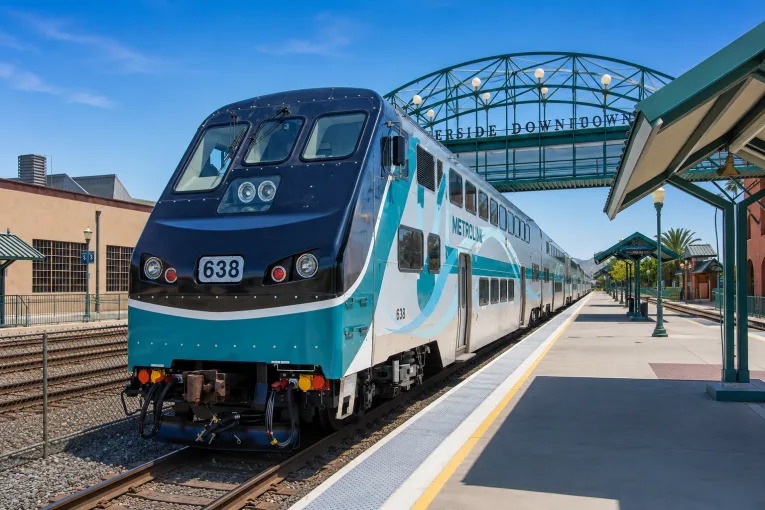
As Metrolink expanded rail service for the 2026 FIFA World Cup, agency officials were simultaneously grappling with a projected $34.8 million budget shortfall that could reshape the commuter railroad’s future service while preparing Southern California for the 2028 Olympic and Paralympic Games.
To accommodate soccer fans traveling to matches in Los Angeles, Metrolink added supplemental trains on five rail lines, coordinated with Los Angeles Metro shuttle service to SoFi Stadium and extended service on select match days. The agency said the special schedule was designed to reduce traffic congestion while giving riders a transit option to reach World Cup events.
In a written response to questions for this story, Metrolink spokesperson Meredith Yeoman said the agency operated 48 supplemental World Cup trains and recorded a 15% increase in ridership during the tournament’s first 25 days compared with the same period in 2025.
Yeoman said the additional trains were operated using existing resources and did not disrupt regularly scheduled service.
“The operational lessons, coordination efforts and customer experience enhancements from FIFA World Cup 2026 will directly inform Metrolink’s planning for the LA28 Olympic and Paralympic Games,” Yeoman wrote.
While the tournament demonstrated Metrolink’s ability to expand service for major international events, agency officials spent much of the spring warning that long-term financial pressures could force difficult decisions affecting everyday riders.
During the June 26 Board of Directors meeting, Chief Financial Officer Tom Schamber described the agency’s fiscal outlook as the result of a “perfect storm” of declining revenue expectations, increasing operating costs and reduced financial support from member agencies.
“There are several factors that have created what I call the perfect storm we find ourselves in today,” Schamber told the board.
Schamber said Metrolink originally budgeted for 26% year-over-year ridership growth, but actual growth reached 24%. Although ridership continued recovering from the COVID-19 pandemic, he said the agency’s original projections proved overly optimistic. After Metrolink hired its forecasting consultant to revise its methodology, projected ridership for fiscal year 2027 fell by 27%, reducing expected fare revenue by $14.8 million.
The agency also projected approximately $10.6 million in higher operating costs because of contractual obligations and inflation. In addition, two member agencies informed Metrolink they would reduce their operating support below fiscal year 2026 levels, contributing to a projected $34.8 million budget gap, Schamber said.
Schamber told board members the problem extended beyond a single budget cycle.
“This is not a trend unique to Metrolink,” he said while discussing flattening fare revenue. “This pattern shows up in commuter railroads across the country.”
He explained that many of Metrolink’s expenses remain fixed regardless of how many trains operate.
“The tracks must still be maintained regardless of how many trains Metrolink runs,” Schamber said, noting that large service reductions would be necessary to generate enough savings because maintenance-of-way and other core expenses remain largely unchanged.
Budget development began in September 2025 using Metrolink’s optimized operating schedule. In January, the Orange County Transportation Authority notified the agency it intended to reduce operating support. Shortly afterward, Metrolink revised its ridership forecast after concluding earlier projections were unrealistic.
By early April, Los Angeles Metro also confirmed it expected to reduce its contribution, forcing staff to restart budget development and prepare multiple service scenarios for member agencies to consider. On June 24, one of the remaining operating scenarios was removed from consideration, and by June 26 finance staff focused entirely on a single budget based on maintaining Metrolink’s current service levels.
Agency officials simultaneously considered changes intended to increase revenue while minimizing impacts on riders.
During a public hearing later on the June 26 meeting, Metrolink staff recommended making the agency’s simplified fare structure permanent while increasing fares to help offset the projected budget deficit.
Henning Eichler, Metrolink’s senior manager of marketing insights and analytics, told the board more than 1,500 people completed surveys during the public comment period. Eichler said the fare pilot, introduced in July 2025, increased monthly pass sales, simplified ticket options and generated additional revenue while ridership continued to grow.
“Metrolink customers are more sensitive to service frequency than to higher fares,” Eichler told the board.
Based on survey responses, staff recommended preserving the agency’s 50% student discount, increasing one-way fares by 14%, raising the weekday SoCal Day Pass from $15 to $19 and increasing the weekend pass from $10 to $12. Eichler said riders consistently indicated they preferred modest fare increases over reductions in train service.
Although staff supported the fare proposal, many public speakers urged the board to avoid reducing train frequency, arguing reliable service remained the agency’s most valuable asset.
Tom Janowitz, transportation and parking manager at California State University, Northridge, (CSUN) said the university spends approximately $50,000 each year operating a shuttle between the Northridge Metrolink Station and campus. He told board members the shuttle carries more than 1,250 passengers each week, with peak weeks exceeding 1,400 riders, demonstrating the importance of maintaining dependable rail service for students.
Emmanuel Compass, CSUN’s director of parking and transportation, said the university continued investing in transit partnerships because ridership had steadily increased. He praised Metrolink’s student discount program and encouraged the agency to continue investing in service rather than reducing it.
Riverside Public Works Director Nathan Mustafa acknowledged Metrolink’s financial challenges but warned that reducing service while increasing fares could discourage future ridership. As Riverside continues to grow, he said, commuter rail will play an increasingly important role in the region’s transportation network.
Several regular riders described how the reduced schedule affected their daily lives.
Juliana Lucio Hernandez, a Cal State Fullerton student, said Southern California frequently encourages residents to use public transportation while preparing to host global sporting events.
“We’re constantly encouraged to use public transportation,” Hernandez told the board. “We’re told it’s better for the environment, cheaper than driving and essential as Southern California prepares for things like the World Cup or the Olympics. But every time Metrolink or OCTA has an opportunity to encourage ridership, we’re instead faced with service cuts and higher fares.”
Leo Shahbazian, a Riverside County resident, regular Metrolink rider and transit advocate, said in an interview that the additional World Cup trains highlighted what riders were missing during everyday service.
“A single return train on game days to get you home after the game,” Shahbazian said. “You actually still have to navigate the other service cuts to get to the games.”
Shahbazian said reduced Inland Empire-Orange County Line service and limited Riverside Line schedules have made regional travel more difficult, particularly for trips toward San Diego and between Riverside and Santa Clarita. He said he believes funding for the World Cup service was separate from Metrolink’s operating budget but hoped the agency’s success during the tournament would encourage officials to restore regular service.
World Cup preparations also extended beyond train schedules.
During the June 26 meeting, labor counsel Irma Rodriguez Moisa presented an agreement between Metrolink and Amalgamated Transit Union Local 1277 allowing temporary customer relations employees to assist during the tournament.
“We reached agreement with them to cover the FIFA World Cup,” Rodriguez Moisa said. “I think this will be a very interesting process to see if it helps us with respect to the Olympics in a couple years.”
At the conclusion of the June 26 meeting, a board member requested that staff return before October with a report outlining lessons learned from the World Cup, potential federal funding opportunities and how Metrolink’s service levels could support the 2028 Olympic and Paralympic Games.
The discussion continued during the July 10 Budget, Audit and Finance Committee meeting, where Chief Executive Officer Darren Kettle said Metrolink had requested $35 million in state funding to stabilize operations while pursuing longer-term financial support through the 2028 Olympics. Kettle said the formal request covered one year, although the agency anticipated needing additional support over the next three years.
By the July 24 Board of Directors meeting, staff had narrowed budget development to a scenario that maintained the agency’s current reduced schedule, implemented after mechanical issues sidelined portions of Metrolink’s locomotive fleet. Board members acknowledged additional adjustments could still become necessary depending on funding decisions by member agencies.
Although the FIFA World Cup demonstrated Metrolink’s ability to expand rail service for one of the world’s largest sporting events, board discussions throughout the summer reflected a broader challenge: preserving reliable commuter rail service while preparing Southern California’s regional transportation network for the even greater demands expected when Los Angeles hosts the 2028 Olympic and Paralympic Games.
To comment please go to one of these social media platforms:
Facebook: https://www.facebook.com/DavisVanguard
LinkedIn: https://www.linkedin.com/company/peoples-vanguard-of-davis-inc/
Instagram: https://www.instagram.com/davisvanguard/
X: https://x.com/davisvanguard
Bluesky: https://bsky.app/profile/vanguardnewsgroup.bsky.social
Subscribe to the Vanguard News letters. To make a tax-deductible donation, please visit davisvanguard.org/donate or give directly through ActBlue. Your support will ensure that the vital work of the Vanguard continues.
