
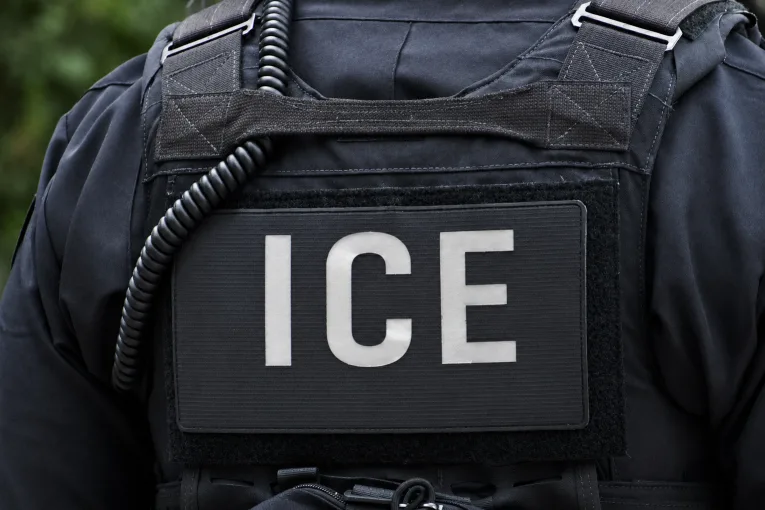
SPRINGFIELD, Ohio — A federal judge dismissed a lawsuit Oct. 2 against seven unidentified U.S. Immigration and Customs Enforcement officers accused of intimidating and retaliating against a civilian observer, despite previously finding substantial support for his First Amendment retaliation claim.
U.S. District Judge Michael J. Newman of the Southern District of Ohio ruled that Sean Moorman lacked standing to seek an injunction against the officers because he had not demonstrated a sufficient likelihood of future harm, even though the court had previously found that his constitutional claim was likely to succeed.
The ruling highlights the legal barriers facing individuals who seek protection from alleged government retaliation, particularly when courts find evidence supporting constitutional claims but conclude that the requirements for prospective relief have not been met.
According to the American Civil Liberties Union of Ohio, Moorman is a Springfield resident who volunteers as an “ICE watcher,” observing and recording immigration enforcement activities involving the Haitian community.
The lawsuit argued that observing and recording such activities “is unquestionably protected by the First Amendment.”
The ACLU of Ohio filed the lawsuit on behalf of Moorman on Sept. 1 in the U.S. District Court for the Southern District of Ohio.
The lawsuit alleged that seven ICE officers retaliated against Moorman for recording and observing them in public.
The lawsuit further alleged that ICE officers engaged in a series of intimidating actions against Moorman.
Among the allegations, officers swerved toward Moorman’s car, approached him closely to photograph his face and license plate, blocked his vehicle with their SUVs and followed him through Springfield for an extended period.
The lawsuit also alleged that the officers followed Moorman to his home while photographing his residence and his wife’s car.
The officers blasted their horns and repeatedly shouted his name, according to the ACLU.
The defendants were identified as John Does because Moorman and his attorneys were unable to determine their identities when the case was filed.
According to the court’s Sept. 4 temporary restraining order, the alleged intimidation included an encounter in which officers repeatedly blocked Moorman’s vehicle in a restaurant parking lot for approximately 10 to 15 minutes.
The order also described how Moorman warned his wife that officers were approaching their residence, prompting her to remain inside holding a baseball bat because she feared for her safety.
The couple subsequently installed a security camera at their home.
On Sept. 4, Newman granted Moorman a temporary restraining order.
The order prohibited the ICE officers from taking further threatening, intimidating or retaliatory action against Moorman without a legitimate law enforcement purpose.
In issuing the temporary order, Newman found that Moorman had presented sufficient facts to establish a strong likelihood of success on his First Amendment retaliation claim.
The court stated, “Eight circuits have expressly held that filming Government agents performing official duties in public is protected under the First Amendment.”
However, the Sixth Circuit had not definitively resolved whether such activity was protected under the First Amendment.
In examining the constitutional claim, Newman considered three elements necessary to establish First Amendment retaliation: whether Moorman engaged in protected activity, whether the officers took actions that would deter an ordinary person from exercising constitutional rights and whether those actions were motivated by Moorman’s protected conduct.
The judge found that Moorman had presented evidence supporting all three elements, including a connection between his recording activities and the officers’ alleged retaliation.
The government had not rebutted the evidence linking the alleged retaliation to Moorman’s protected conduct at that stage of the proceedings.
However, those findings were made in the context of preliminary relief and did not constitute a final determination that the officers had violated the Constitution.
Moorman later asked Newman to convert the temporary restraining order into a preliminary injunction.
Following a Sept. 16 hearing, Newman extended the temporary restraining order through Oct. 2 to allow additional legal arguments from both parties.
On Oct. 2, Newman denied the request for a preliminary injunction and dismissed the lawsuit for lack of subject-matter jurisdiction.
Rather than resolving whether the alleged conduct violated the First Amendment, the dismissal focused on Article III standing.
Because Moorman sought prospective relief, he had to demonstrate that he faced a sufficiently immediate threat of future harm.
The federal government provided evidence that six of the seven officers had left Springfield.
Newman concluded that Moorman’s intention to continue observing ICE activities was not, by itself, sufficient to establish that he would encounter the remaining officer and experience similar retaliation in the future.
The court also noted that Moorman had not presented additional evidence or witness testimony at the preliminary injunction hearing demonstrating an ongoing threat of retaliation.
The court found that Moorman had not demonstrated the likelihood of future harm necessary to maintain standing for prospective relief.
In the Oct. 2 ruling, Newman also addressed the government’s argument that a lawsuit against officers in their official capacities required evidence of an agency-wide policy, pattern or practice of retaliation.
Federal attorneys argued that Moorman could not obtain the requested relief without establishing that the alleged conduct reflected more than the actions of individual officers.
Newman declined to resolve that legal question, instead assuming for purposes of his analysis that Moorman did not need to establish such a policy.
Under that assumption, the judge stated that Moorman’s First Amendment retaliation claim would likely succeed on the merits if he could establish standing.
The court also recognized that the deprivation of First Amendment freedoms, even for a limited period, can constitute irreparable harm when considering whether preliminary relief is warranted.
However, Newman identified another obstacle to granting the requested injunction, finding that restrictions on officers’ interactions with Moorman could interfere with lawful immigration enforcement.
The judge questioned whether a proposed restriction preventing officers from approaching within 15 feet of Moorman to photograph or record him could expose officers to contempt proceedings for routine conduct, including wearing body cameras.
The court found that the competing interests presented a close question, weighing Moorman’s constitutional protections against the government’s interest in carrying out legitimate law enforcement activities.
Although Newman found that Moorman prevailed on the first two preliminary injunction factors under the court’s assumed-standing analysis, he concluded that the government prevailed on the remaining factors concerning the balance of equities and public interest.
Those considerations provided an additional reason the court would not grant the requested preliminary injunction, even under the assumptions favorable to Moorman’s constitutional claim.
The ruling also noted that Moorman sought declaratory and injunctive relief rather than monetary damages.
Because the lawsuit sought relief intended to prevent future conduct, the court’s jurisdictional analysis focused on whether Moorman faced a sufficiently likely threat of renewed retaliation rather than solely on whether the alleged past misconduct had occurred.
Newman ultimately dismissed the lawsuit without deciding whether the officers had violated Moorman’s constitutional rights, leaving the allegations of past retaliation unresolved.
Nevertheless, the court’s preliminary findings recognized that Moorman had engaged in activity protected by the First Amendment and had presented substantial evidence supporting his retaliation claim.
The case raises questions about First Amendment protections for civilians who observe federal law enforcement officers and the legal requirements individuals must meet when asking courts to prevent future government conduct.
Although Moorman’s lawsuit was dismissed, the court’s rulings recognized that recording and observing federal officers performing their official duties in public can implicate First Amendment protections.
The decision also illustrates how the legal distinction between past constitutional violations and the likelihood of future injury can determine whether individuals obtain judicial protection against alleged government retaliation.
To comment please go to one of these social media platforms:
Facebook: https://www.facebook.com/DavisVanguard
LinkedIn: https://www.linkedin.com/company/peoples-vanguard-of-davis-inc/
Instagram: https://www.instagram.com/davisvanguard/
X: https://x.com/davisvanguard
Bluesky: https://bsky.app/profile/vanguardnewsgroup.bsky.social
Subscribe to the Vanguard News letters. To make a tax-deductible donation, please visit davisvanguard.org/donate or give directly through ActBlue. Your support will ensure that the vital work of the Vanguard continues.
