
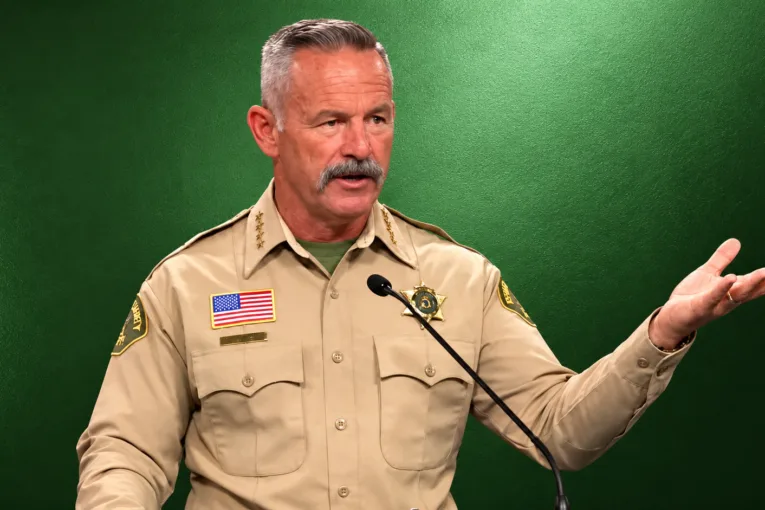
SACRAMENTO, Calif. — California has moved to strip Riverside County Sheriff Chad Bianco of his authority over investigations into deaths in his own county’s jails, with Gov. Gavin Newsom signing legislation that will dismantle Riverside’s combined sheriff-coroner system and place death investigations under an independent medical examiner.
Senate Bill 1379, authored by state Sen. Sabrina Cervantes, requires the Riverside County Board of Supervisors to separate the offices of sheriff and coroner by July 1, 2027, abolish the coroner’s office and establish an independent office of the medical examiner. The change removes from the Sheriff’s Department responsibility for determining the cause and manner of deaths occurring inside a jail system that the department itself operates.
Senate Bill 1379, recently signed by Newsom, will separate the sheriff and coroner offices, eliminate the office of coroner and transfer its employees to establish the office of medical examiners. Under the new law, only medical examiners will be authorized to sign death certificates and certify portions of postmortem examinations.
“Senate Bill 1379—which is a targeted solution to fix a long-broken system in my home county of Riverside—has been a long time coming,” said Cervantes. “The goal of this new law is simple: When an individual dies in custody in a Riverside County jail, their family and the public deserve transparency. We owe the families the truth; we owe our communities accountability; and we owe county taxpayers a system they can trust.”
While existing state law allows counties to combine the offices of sheriff and coroner, the arrangement creates a potential conflict of interest: The same department that operates the county’s jails is simultaneously responsible for investigating deaths that occur within those facilities. Critics have argued that the inherent structural conflict raises longstanding concerns about transparency, accountability and public trust.
An independent audit in 2018 resulted in San Joaquin County restructuring its Sheriff-Coroner’s Office by separating death investigation responsibilities from the sheriff’s direct authority. Another audit was conducted in March 2024 by Riverside County’s Executive Office to evaluate whether separating the Sheriff’s Department from the Coroner’s Bureau would reduce conflicts of interest in medicolegal death investigations for individuals in custody.
Although academics have concluded that San Joaquin County’s decision to adopt a medical examiner model was supported by more comprehensive and transparent evidence and analysis, the Riverside County Board of Executives decided against these audits, according to the Carceral Ecologies Lab.
Despite constituting only 6% of California’s population, Riverside County accounts for approximately 10% of the state’s in-custody deaths, with Latinos representing at least 43% of those deaths from 2005 to 2024. A CalMatters investigation subsequently described Riverside jails as “some of California’s deadliest jails.” With more than 40 deaths in four years, a 2025 article published by The New York Times described the Riverside jails as “the second deadliest in the nation” from 2020 to 2023.
From drug trafficking and wrongful detentions to sexual harassment and excessive force, deputies at Riverside County jails have faced civil lawsuits alleging egregious misconduct. Lawsuit settlement payouts between 2014 and 2024 reached $100 million, paid by taxpayers, according to the report published by the Care First California Coalition.
The Riverside Sheriff’s Department has been under a consent decree since 2014 over inadequate access to medical and mental health care in county detention facilities. A consent decree is a court-enforced agreement that requires jurisdictions to remedy unlawful practices and comply with constitutional requirements. Meanwhile, advocates across California have continued to demand greater law enforcement accountability for in-custody deaths.
“Thank you to Senator Sabrina Cervantes and Governor Gavin Newsom for standing with Riverside County residents by enacting SB 1379,” said Chani Beeman, a member of the Riverside Sheriff Accountability Coalition. “Removing the conflict of interest created when the Sheriff also oversees in-custody death determinations is a significant victory for transparency, accountability, and justice—and a vital step toward supporting families seeking answers after the death of a loved one in custody.”
To comment please go to one of these social media platforms:
Facebook: https://www.facebook.com/DavisVanguard
LinkedIn: https://www.linkedin.com/company/peoples-vanguard-of-davis-inc/
Instagram: https://www.instagram.com/davisvanguard/
X: https://x.com/davisvanguard
Bluesky: https://bsky.app/profile/vanguardnewsgroup.bsky.social
Subscribe to the Vanguard News letters. To make a tax-deductible donation, please visit davisvanguard.org/donate or give directly through ActBlue. Your support will ensure that the vital work of the Vanguard continues.
