
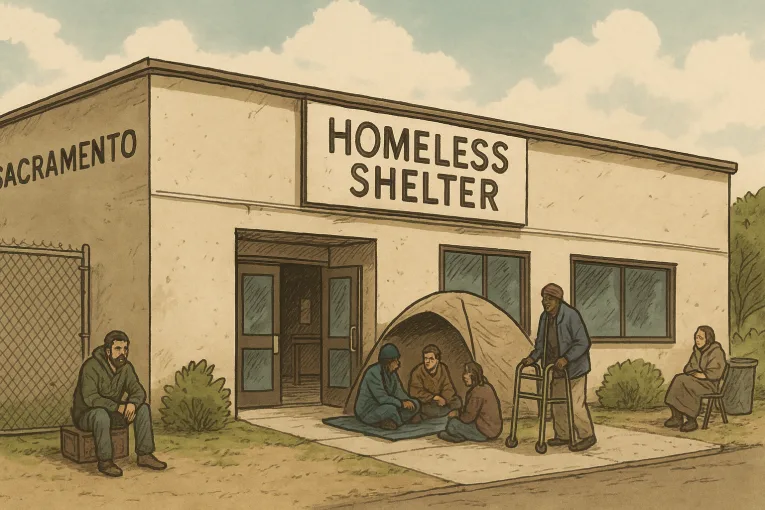
SACRAMENTO, CA – In a landmark effort to address the intersection of incarceration and homelessness, Sacramento County will begin reserving 70 shelter beds for individuals recently released from the county’s main jail. The initiative, aimed at providing immediate housing and reducing recidivism, is expected to launch in July 2025, The Sacramento Bee reports.
The program will operate out of the Salvation Army’s Center of Hope on North B Street and will be funded through Proposition 47, the 2014 voter-approved measure that reallocates prison savings to support mental health, substance abuse treatment, and reentry services.
County officials confirmed the launch in an interview with The Sacramento Bee, noting that this marks the first time the region has created a dedicated jail-to-shelter pathway tailored to the reentry population.
“This is significant and just something that doesn’t currently really exist,” said Sacramento County spokesperson Janna Haynes. The program was developed in response to years of advocacy from reentry organizations and community leaders, who have long identified the lack of immediate housing as a key driver of chronic homelessness and repeat incarceration.
Earlier this year, The Bee reported that roughly one-third of individuals booked into Sacramento County jails were experiencing homelessness at the time of their arrest. Without coordinated discharge planning, many are released in the middle of the night with no shelter or support.
To close this gap, the County and the Salvation Army are developing a communication system to notify the shelter in advance of a person’s release. This coordination will allow shelter staff to arrange transportation—via rideshare or volunteer drivers—to ensure a direct transition from jail to shelter. Haynes emphasized that this logistical planning is central to the program’s success.
Major Rio Ray, Metro Coordinator for the Salvation Army, issued a written statement to The Bee, calling the initiative “an important step toward breaking the cycle of incarcerated individuals returning to the streets.”
The Center of Hope, one of Sacramento’s largest shelters, has a 140-bed capacity serving both men and women. Previously, the 70 reentry-designated beds were supported through a one-time $2.4 million grant from the American Rescue Plan Act, which expires in June. To maintain the program, the County secured a new $3.4 million Proposition 47 grant to fund operations for the next three years.
Proposition 47, passed by California voters in 2014, reclassified certain nonviolent felonies as misdemeanors and redirected the resulting cost savings to local rehabilitation and prevention efforts. Counties have used these funds for initiatives such as school-based mental health services, trauma recovery centers, and housing for formerly incarcerated individuals.
“This is a textbook example of how Proposition 47 was meant to work,” said a county official quoted by The Bee. “We’re taking savings from reduced incarceration and investing them in reentry solutions that help people succeed outside of jail.”
To prepare for the funding transition, the Center of Hope has temporarily paused new referrals through the Coordinated Access System (CAS), which typically connects people to shelter beds or supportive housing. Haynes said the pause is expected to end in July following final approval from the Sacramento County Board of Supervisors.
Currently, 47 of the 70 designated reentry beds are occupied. According to Ray, those residents will be offered alternative housing or transitional shelter placements by June. “We want to emphasize that individuals will not be exited to the street,” he added.
Once the program officially restarts in July, the reentry-designated beds will be prioritized for individuals released from jail, rather than general shelter referrals through CAS.
The shelter bed program is part of a broader regional effort to improve reentry services and reduce homelessness among formerly incarcerated individuals. As The Bee also reported, a new supportive housing development in South Sacramento is set to open this month, offering permanent housing for 59 individuals with criminal records.
Formerly incarcerated individuals face some of the nation’s highest rates of housing discrimination due to background checks and public housing restrictions. According to the Prison Policy Initiative, they are 10 times more likely to experience homelessness than the general population, with rates even higher among Black and Indigenous communities.
Stable housing combined with structured reentry support has been shown to dramatically reduce reoffending. A 2022 study in the Journal of Urban Affairs found that people provided with transitional housing after incarceration were 40% less likely to return to jail within two years.
Advocates hope Sacramento’s new program will serve as a model for counties across California struggling with jail cycling and street homelessness.
“This is how you stop the revolving door,” a community advocate told The Sacramento Bee. “You don’t just release people and hope they make it. You meet them at the door with shelter, dignity, and a chance.”
As the Board of Supervisors prepares to finalize funding and the Salvation Army transitions to the new grant model, both county officials and service providers expressed optimism that the pilot will address urgent needs while influencing broader policy on reentry housing.
