
By Vanguard Staff
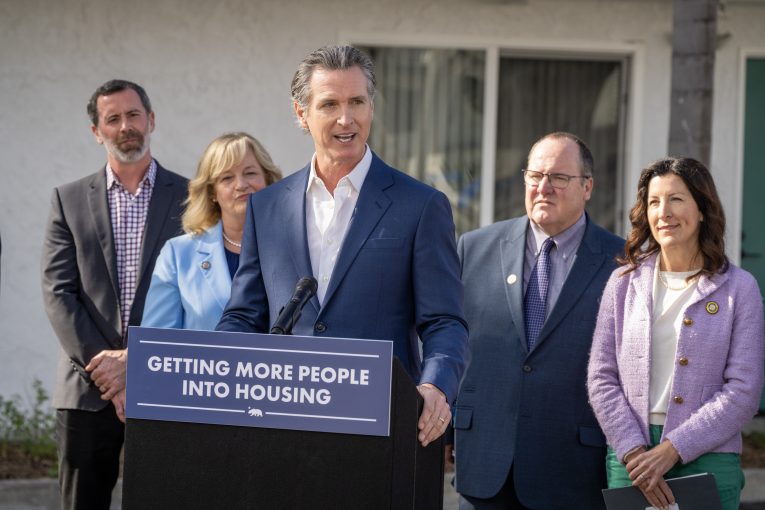
SACRAMENTO — Governor Gavin Newsom this week highlighted new data showing that California is making progress in reducing homelessness across the state, attributing the improvements to historic investments, stronger state-local partnerships, and policy reforms aimed at reversing decades of inaction. But while the administration celebrated early signs of success, county officials and advocates raised urgent concerns that recent budget cuts could threaten continued progress.
According to preliminary 2025 point-in-time count data, California communities are beginning to show measurable reductions in homelessness. In contrast to national trends that saw unsheltered homelessness rise by nearly 7% in 2024, California held its increase to just 0.45%. The state also limited overall growth in homelessness to 3%—a rate lower than 40 other states—and reported the largest decrease in veteran homelessness in the country.
The city and county of Los Angeles, often seen as the epicenter of the state’s homelessness crisis, posted some of the most promising numbers. Preliminary 2025 data indicates that Los Angeles County experienced a 4% drop in total homelessness, including a 9.5% decline in unsheltered homelessness. The city of Los Angeles reported a 3.4% overall decrease and a 7.9% drop in unsheltered homelessness. Officials say these reductions reflect a concerted effort to expand outreach, shelter, and permanent housing options.
Other communities also reported positive movement. In San Diego County, total homelessness declined by 7%, with the city of San Diego reporting a 13.5% drop and a 3.9% decrease in unsheltered homelessness. Riverside County saw a 19% drop in its unsheltered population. In San Bernardino County, total homelessness declined by 10.2%, and in the Bakersfield region, homelessness decreased by 2.3%.
Governor Newsom described the improvements as evidence that California’s homelessness response is gaining momentum. Since taking office in 2019, Newsom has made homelessness a top priority, pushing for structural reforms, building accountability systems into state funding, and directing unprecedented levels of support to local governments. Key initiatives have included the creation of the Homeless Housing, Assistance and Prevention (HHAP) program, streamlining housing approvals, and expanding mental health services through programs like CARE Court and Proposition 1’s behavioral health bond.
Between 2014 and 2019—before Newsom took office—California’s unsheltered homeless population rose by approximately 37,000 people. Since then, the state has slowed the rate of increase significantly, even as many other states have experienced worsening trends. In 2024, while national homelessness increased by over 18%, California’s more modest increase underscored the impact of targeted state investments and coordination with cities and counties.
However, while the Governor celebrated the data as a turning point, local governments cautioned that continued progress is far from guaranteed. In a sharp rebuke of the newly enacted state budget, the California State Association of Counties (CSAC) warned that California risks undermining its own success by cutting funding to core homelessness programs. The FY 2025–26 budget, signed into law on June 30, eliminates HHAP funding entirely for the current fiscal year.
HHAP, launched in 2019, had become the state’s flagship program for supporting local homelessness initiatives. From 2019 to 2024, the program received annual funding ranging from $300 million to $1 billion. Local governments used HHAP funds to finance outreach teams, shelter expansion, transitional housing, and permanent supportive housing programs—key components of the infrastructure now credited with reducing unsheltered homelessness.
CSAC President and Inyo County Supervisor Jeff Griffiths issued a public statement responding to the Governor’s announcement. “We agree with the governor: Thanks to years of hard work on the ground, counties and cities are showing results. But now, because of the new state budget, local governments will be forced to defund successful efforts making real progress. Why on earth would we stop funding the program most responsible for this success?”
Griffiths warned that unless the state reverses course, “we’ll look back at this moment as the one that got away.”
To address what counties see as a systemic flaw in California’s homelessness response, CSAC has introduced a comprehensive framework titled AT HOME. The proposal calls for a pilot program in select cities and counties with strong track records of collaboration. Participating jurisdictions would adopt clearly defined roles for each level of government and streamline approvals for shelters, transitional housing, and permanent supportive housing.
CSAC leaders argue that two fundamental problems hinder the state’s progress: unclear responsibilities between state and local agencies and unreliable, one-time funding. The AT HOME framework seeks to address both. Under current law, no agency is explicitly charged with ensuring a person experiencing homelessness receives shelter or housing, creating a vacuum of accountability. At the same time, the year-to-year nature of state funding has made it nearly impossible for local governments to make long-term plans or commitments.
“Counties believe it’s not enough to lay out problems. While others point fingers, we’re doing the hard work of crafting smart policy solutions to this crisis,” said CSAC Second Vice President and Monterey County Supervisor Luis Alejo, a former state legislator. “Our county is ready to show Californians what’s possible when the state and local governments work in concert. We call on leaders at all levels of government to join us.”
As local and state leaders debate the future of homelessness policy, one point is clear: progress is being made, but it remains fragile. The early signs of declining homelessness offer hope, but without continued investment and structural clarity, advocates fear California could fall back into the very patterns of fragmentation and underfunding that defined past decades. Whether the state’s next chapter will build on recent momentum or stall under fiscal pressure may depend on decisions made in the coming months.
