
Key points:
- Fines and fees from courts destabilize budgets and punish low-income individuals.
- Court-imposed monetary sanctions create a “shadow debt system” in 24 states.
- Over half of court costs imposed are fees, not fines, for government funding.
A groundbreaking national report from the Fines and Fees Justice Center (FFJC) has exposed what it calls a “shadow debt system” that destabilizes state and local budgets while punishing low-income individuals with court-imposed fines and fees.
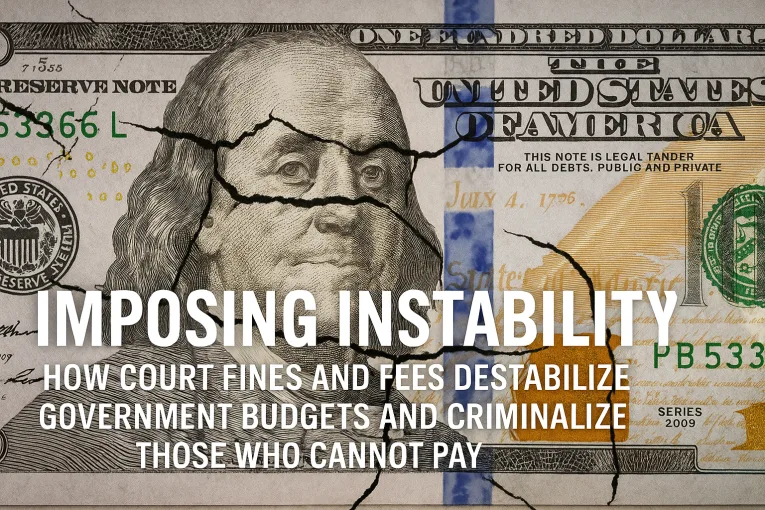
The 72-page report, titled Imposing Instability: How Court Fines and Fees Destabilize Government Budgets and Criminalize Those Who Cannot Pay, draws on data from 24 states between fiscal years 2018 and 2022.
It concludes that government reliance on court-imposed monetary sanctions not only entrenches poverty but also undermines the financial sustainability of public services.
“State governments exploit court-involved people as a way to generate revenue and harshly penalize them when they cannot meet budget demands,” the report states. “This revenue generation method is not only unjust but also unstable.”
The FFJC argues that the justice system has become a mechanism for hidden taxation—one that extracts money from those least able to pay, often for the express purpose of plugging budget holes created by tax cuts or shifting federal funding.
According to the report, courts in 24 states imposed nearly $14 billion in fines and fees over the five-year period. But more than half of that amount—over $7 billion—came from fees, not fines. The distinction is critical. Fines are meant to serve as punishment for violating the law, whereas fees are designed to fund government operations.
“We see that over half of all costs imposed were for the explicit purpose of making money for the government,” the authors write.
The findings reveal a perverse incentive structure: as public revenues shrink, governments increasingly rely on justice-involved individuals to make up the difference. This practice disproportionately affects low-income communities and communities of color.
The FFJC found that in eight states with available data, the median amount imposed in criminal cases was $2,984. For someone earning $15 an hour, that debt equates to nearly 200 hours of labor—before taxes, and assuming they could dedicate every dollar earned to paying off court debt.
For many, that’s not remotely possible. Nearly 40 percent of Americans say they cannot afford an unexpected $400 expense, let alone thousands in court-imposed debt. Research cited in the report shows that 80 to 90 percent of people who come before a judge are indigent, and a third of justice-involved individuals earn less than $10,000 per year.
“Objectively, as a group, people facing sanctions in the criminal system are less likely to be able to meet the higher fines and fees burden placed on them,” the FFJC concludes.
Despite a 20 percent decline in incoming court cases during the study period, the total amount of fines and fees imposed increased by 3 percent. Meanwhile, collections dropped by 33.4 percent.
“Court-involved individuals continued to be viewed as a potential source of revenue that courts needed to extract more from in order to maintain the same hoped-for income levels,” the report says.
The result is a destabilizing cycle for individuals and governments alike. People who cannot pay their debt face a host of punitive consequences, including additional fines, arrest, and incarceration. Between 2018 and 2022, just 13 states issued over 2.5 million bench warrants for failure to pay or appear in court.
“Debt is not a public safety issue,” the report stresses. “Yet we continue to jail people for it.”
The financial harm is compounded by the inefficiency of the system. For example, in Florida, court clerks expect to collect just 9 percent of the fines imposed in felony cases. In Jefferson County, Alabama, a five-year study found that most people with legal debt paid nothing—unsurprising given that 71 percent were found to be indigent. In Virginia, just 3 percent of public defender fees were collected the same year they were assessed. In Pennsylvania, over 90 percent of people with public defenders still owed court costs a decade later.
This approach isn’t just unjust—it’s fiscally irresponsible. The report shows that collections from fines and fees are declining across the board. From 2018 to 2022, the median collection amount dropped by one-third. Even as tax revenues began rebounding after the COVID-19 crisis, court-imposed revenue streams did not recover.
“Fines and fees are a declining revenue source that presents a risk to government funding while imposing an extreme burden on individuals and families,” the report says.
Examples abound. Florida’s traffic ticket revenue fell 22 percent between 2009 and 2021, creating a $40–$50 million budget hole. One nonprofit that helps police publicize unsolved crimes saw its state funding drop sharply. Another, serving people with epilepsy, lost nearly 80 percent of its funding from seatbelt citation revenue.
The federal system isn’t immune. The Victims of Crime Act Fund, which relies on fines from federal criminal cases, saw allocations to states drop by 41 percent between 2023 and 2024, endangering programs that support survivors of violence and abuse.
The report also highlights the dangerous decoupling of fines and fees from actual court activity. In FY2022, court-imposed fines and fees rebounded close to pre-pandemic levels, even though the number of court cases remained down by 20 percent. This suggests that courts may be increasing monetary sanctions per case to maintain revenue, rather than addressing actual threats to public safety. “This pattern suggests that some jurisdictions may be increasing fines and fees per case to offset declining caseloads and maintain revenue,” the report states.
The FFJC authors—Lillian Patil and Tanisha Pierrette—make five sweeping recommendations for reform.
First, they call for the total elimination of justice system fees, which they argue amount to a hidden tax on the poor.
Second, they urge states and municipalities to stop relying on court debt to fund operations and to replace these volatile revenues with sustainable, equitable funding mechanisms.
Third, they call for an end to the use of bench warrants to enforce debt collection, which they argue criminalizes poverty without improving safety.
Fourth, they recommend discharging old, uncollectable court debt, which would bring relief to struggling individuals without significantly affecting public budgets.
Finally, they urge all states to implement robust data collection and transparency systems to track fines, fees, and enforcement actions.
“Transparent and detailed reporting of fines and fees data is essential for evaluating their impact, addressing systemic inequities, and implementing evidence-based reforms,” the report concludes. Yet fewer than half the states even provide basic public data on these practices.
The consequences of inaction are clear. The system of court-imposed fines and fees punishes people for being poor, destabilizes communities, and fails to provide governments with reliable revenue. It erodes trust in the justice system and undermines its legitimacy.
And in the words of the FFJC, “it treats the criminal legal system like a piggy bank, maximizing people’s interactions with and payments to the system, rather than serving as a true tool for justice and public safety.”

From the Fines and Fees Justice Center (FFJC) mission statement:
“The Fines and Fees Justice Center (FFJC) is catalyzing a movement to eliminate the fines and fees that distort justice.”
As they should.
So does their report surprise you being that’s their core mission?
Given that their core mission arose out of the problems of fines and fees, no.
What I’m curious about is why you reacted to this article? I have done dozens on this issue over the years and you have rarely commented. Interestingly, I learned about this issue when I attended a 2019 symposium in NY on Fines and Fees. A lot of the interest in the issue arose out the Ferguson report.
In 2022 I interviewed Tony Messenger from the St. Louis Post Dispatch. He had attended the same symposium as I had, and ended up writing a book.
“Tony Messenger, a reporter for the St. Louis Post Dispatch, talks about the issue of fines and fees and is the author of the recent book, Profit and Punishment How America Criminalizes the Poor in the Name of Justice. In his book, he goes into rural Missouri to follow the lives of poor white people who are victimized by a system of fines and fees that ends up entrapping them into a cycle of poverty and debt from which many cannot escape.”
https://davisvanguard.org/2022/01/everyday-injustice-podcast-episode-140-tony-messenger-talks-about-criminalizing-the-poor/
These are YOUR people – the backbone of the Trump movement – rural poor whites. You should have some empathy for them.
Everyone is MY people. I don’t discriminate.
If you don’t have fines and/or court fees on traffic tickets what’s going to deter people from (for ex) speeding, regardless of their race or income?
Would you have them write on a chalk board 100 times “I will not speed”?
“If you don’t have fines and/or court fees on traffic tickets what’s going to deter people from (for ex) speeding, regardless of their race or income?”
The literature on this answers this question – it’s largely the add-on charges that are at issue rather than the initial fine
If the people who commit serious crimes were actually required to pay for the damage/harm that they cause to others, they would never get out of debt. (And that would include the cost to those they victimize, the cost of their own prosecution, incarceration, etc.)
Paying the full cost of the damage you cause to others would be an actual/real form of “restorative justice”. (But I’m not holding my breath, waiting for THAT to happen.)
Paying for damage caused by a crime is called restitution. It is not restorative justice per se. Restorative justice is a process, not an outcome. Making someone whole could be one of the goals a restorative justice process.
O.K. – but it doesn’t occur in regard to serious crimes. (See the short list I provided, above.) If those convicted of serious crimes were required to pay all of the costs they create, they would never get out of debt. One victim alone could be owed millions of dollars (not to mention the costs related to the judicial system itself).
There ARE times that “restitution” occurs – but it’s more-focused on those who will pay (e.g., parking infractions, traffic tickets, etc.). Anything to do with a vehicle, basically. (In fact, I believe that cities sometimes make money off of those types of infractions/crimes.)
There’s probably other examples, as well. But again, it’s focused on those who will pay, rather than experience the consequences of not doing so.
It generally occurs with property crimes or things like vandalism. Much of the fines and fees literature however focuses not on “crime” but rather “civil infractions”
My personal opinion is that those convicted of serious crimes should have to pay at least a portion of the damage they cause (which would likely last the rest of their lives).
Sort of like student debt – never goes away until it’s paid off.
Not sure (I haven’t looked into it), but believe that work programs in prison function that way, to some degree. (I assume that the “system” keeps a portion of the money that inmates earn.)
Of course, this type of thing needs oversight to ensure that it doesn’t turn into an incentive for what is essentially slavery.
Those convicted of serious crimes still need an incentive to participate in order to partially pay off the damage they caused. (Again, it’s not likely they’d even be able to pay off the full cost to those they victimize, the system itself, etc.)
Thank you for calling my attention to this report. The huge missing part of this analysis is restitution for the victims of these “Justice Involved Individuals”. They are “justice involved individuals” because they have done an injustice to some victim. Those payments are also not being made and are much more important than the fines or fees.