
Key Points
- Federal immigration raid arrests 200 people at Glass House Farms.
- Activist and Professor Dr. Jonathan A. Caravello detained, sparking public outcry.
- Protesters clash with agents, leading to use of rubber bullets and tear gas.
CAMARILLO, CA – A massive federal immigration raid at two Glass House Farms cannabis facilities in Southern California on July 10 led to the arrest of approximately 200 people, igniting public protests, allegations of abuse, and growing political backlash. Among those detained was California Faculty Association (CFA) member and activist Dr. Jonathan A. Caravello, whose apparent abduction and disappearance have spurred union condemnation and demands for immediate release.
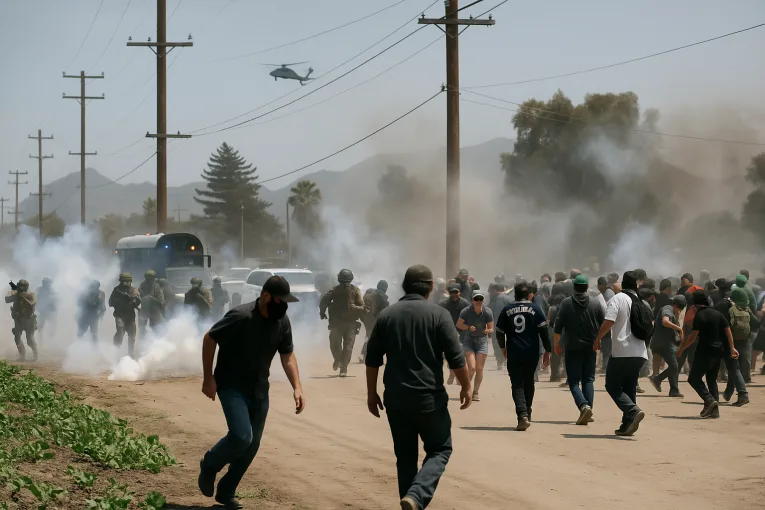
Videos from the scene show heavily armed federal agents firing rubber bullets and tear gas at protesters near the Camarillo site. The raid, coordinated by the Department of Homeland Security and involving ICE, the U.S. National Guard, and local law enforcement support, quickly escalated from a workplace sweep into what witnesses and advocacy groups described as a militarized assault on immigrant laborers and their supporters.
The United Farm Workers union reported that a worker fell several stories during the raid and was initially believed dead. Later reports confirmed the worker was critically injured. At least eight people were transported to local hospitals, while four others were treated at the scene. Authorities have not released the names of those injured.
The California Faculty Association issued a strong statement condemning what it called the abduction of Dr. Caravello and other community members. “These abductions are an attack on our constitutional rights to free speech,” the statement read. “We do not tolerate retaliation against our union members or any person who speaks out against injustice.”
The union reported unconfirmed information that Dr. Caravello is being held at Ventura Federal Detention Center on a $1 million bail. No official charges had been made public as of Friday evening. “That all these members still remain unaccounted for is unconscionable, and extremely alarming,” the union said.
In total, nearly 500 people gathered throughout the day to protest the raids. Protesters formed human blockades and attempted to halt vehicles leaving the site. Some were met with force as federal agents deployed so-called “less-lethal” ammunition into the crowd. Video footage aired by ABC7 appears to show one protester firing a gun after agents threw smoke canisters, prompting an FBI investigation into the shooting.
Ten undocumented minors were discovered at the Camarillo facility, including eight who were unaccompanied. CBP Commissioner Rodney Scott announced an investigation into potential child labor violations. The discovery has heightened scrutiny over labor conditions at legal cannabis operations and raised questions about enforcement priorities.
Cesar Ortiz, whose brother was among those detained, said many workers were being held in overheated shipping containers without air conditioning. “They are taking everyone… and the truth is it’s not right,” Ortiz told a photographer in Spanish. “Here, we all have a dream. We have to give it our all.”
Sarah Armstrong of Americans for Safe Access and Angelmarie Taylor of the 805 Immigration Coalition both confirmed the use of tear gas and rubber bullets by federal personnel. Taylor said some U.S. citizens were also detained indiscriminately. “We were notified that the people working inside were all being detained, whether they were U.S. citizens or not.”
U.S. Rep. Salud Carbajal (D-Santa Barbara) attempted to access the Carpinteria site but was blocked by agents. “It was disproportionate, overkill,” he said, warning that such tactics could lead to further violence. He identified himself as a member of Congress conducting oversight but was told to contact ICE headquarters.
Lucas Zucker of CAUSE, a regional labor and social justice organization, said the aggressive tactics were unjustified. “It was a small crowd of community members in pretty remote agricultural areas. I don’t think there’s any credible case that they were under threat.” Zucker noted that Glass House had been targeted before, with immigration raids increasing in frequency since June.
The operation disrupted not only workplaces but local institutions. Cal State LA announced it was moving classes online and permitting remote work due to nearby immigration enforcement activity. The move, a reflection of the climate of fear spreading across the region, prompted comparisons to public health emergencies.
Oxnard Mayor Luis McArthur said he was in contact with emergency services and warned that many Glass House employees—likely his constituents—were seeking shelter in vehicles in extreme heat. “These actions are causing unnecessary distress and harm,” he said. “I remain committed to working alongside our Attorney General and the Governor’s office to explore potential legal avenues to address these activities.”
Critics also questioned the decision to target Glass House Farms, one of the state’s largest licensed cannabis growers. “This is beyond outrageous,” said investor Marc Cohodes. “They decide to spend their resources going after a totally legal company that pays the state of California hundreds of millions of dollars.”
The company issued a brief statement acknowledging that ICE agents had executed a search warrant and that it had fully cooperated. Glass House offered no further comment, except to say it would provide updates if necessary.
Meanwhile, federal authorities are signaling more crackdowns to come. “People who continue to interfere will be arrested and charged with a federal offense,” U.S. Attorney Bill Essayli posted online. Trump border advisor Tom Homan went further, blaming lawmakers for encouraging resistance to immigration enforcement. “Protesters have become criminals,” he said.
But for many in Ventura County and across California, the raid represents something deeper: a warning about the future of democratic freedoms and the human cost of politically motivated enforcement.
As the California Faculty Association for the California State University (CSU) system concluded in its statement, “If our safety as unionized public servants in the largest institution of higher education in the United States cannot be guaranteed… then the future of California and its youth is uncertain.”
