
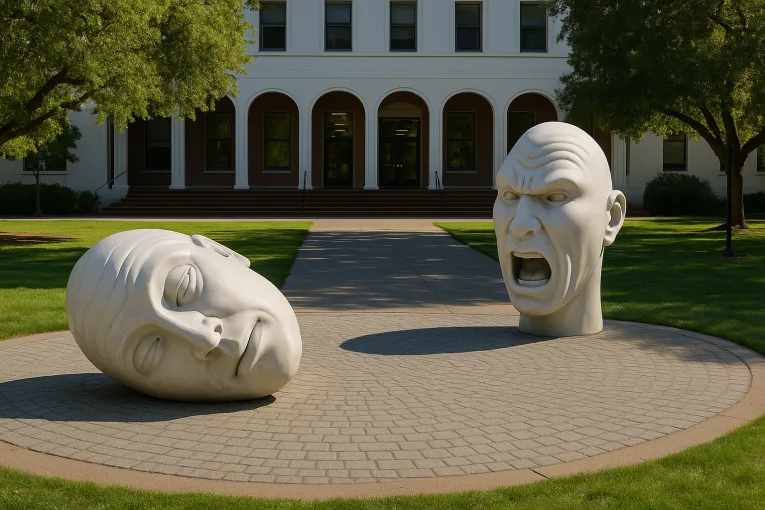
Key points:
- Judge denies defense motion to dismiss charges against UC Davis students.
- Students face felony charges for spray-painting Egghead sculpture.
- Defense argues prosecution is driven by political considerations, not public safety.
WOODLAND, CA – In a hearing Monday afternoon, Yolo County Superior Court Judge Sonia Cortés denied a defense motion to dismiss felony charges against three UC Davis students involved in a pro-Palestinian protest that included the spray-painting of one of the campus’s Egghead sculptures.
The students stand accused of conspiracy and vandalism related to a May 2024 protest that coincided with a student-led encampment calling for divestment from Israel. Defense attorneys argued the incident was political expression, not a serious criminal offense, and that continued prosecution undermined the values of justice, free speech, and community-based resolution.
“This is by far an unusual case in an unusual motion,” said Deputy Public Defender Danielle Craig, who filed the original Penal Code § 1385 motion inviting the court to dismiss in the interest of justice. “It’s not really even a motion. It’s an invitation to the court.”
Craig began her remarks by acknowledging the gravity and unusual nature of the proceeding. “This is by far an unusual case in an unusual motion to be making to the court,” she said. “In fact, it’s not really even a motion at all. It’s an invitation to the court.”
Before addressing the legal mechanics of the Penal Code § 1385 request, Craig took the court back to what she called the historical and political origins of the case: the humanitarian crisis in Gaza and the student activism it sparked nationwide, including at UC Davis. Her tone was calm but emotional, and she made clear from the outset that the context of the protest was central to understanding the actions of the accused.
“As of May 4 of this year, the UN Human Rights Watch has cited that there have been over 52,000 deaths in Gaza, and that about 70 percent continue to be women and children,” Craig told the court. “Israel has blockaded necessary food and medical supplies to civilians. The international community—the Hague and other international criminal courts, and organizations like the UN—have all pretty much uniformly and declaratively stated that what Israel is doing to the people of Palestine is a genocide.”
Craig then turned inward, connecting the political to the personal.
“My voice is a little shakier than it normally is in court,” she said, “but it’s worth mentioning that this is, in many ways for me, personal. Because I’m Jewish. And one of the greatest PR stunts in recent history has been equating antisemitism with anti-Zionism—equating critique of a foreign nation or foreign government with hatred of a people. That’s a false equivalency. And many people who share my faith would call what I’m saying today self-hating. But I don’t believe that. I believe standing up to injustice is part of my duty.”
From there, Craig moved into a passionate recounting of the events that led to the charges, emphasizing that the accused were engaged in protest—not criminal enterprise.
“These individuals are being accused of spray-painting an art installation on campus that cost less than $400 to clean,” she said. “UC Davis staff cleaned the sculpture in under two hours. The egghead in question—part of a series installed to provoke thought and challenge authority—was restored the next morning.”
She drew a sharp distinction between the accused’s actions and other, unrelated acts of vandalism on campus that same night, including one sculpture that required professional restoration costing over $3,800. “There is no evidence before the court that the accused had anything to do with those other incidents,” she said. “They weren’t seen near them, they weren’t captured on surveillance. There’s no evidence they acted in concert with any other group that night. But they are being held responsible for an entire movement.”
Craig criticized the prosecution’s decision to file a felony conspiracy charge, despite the actual physical damage alleged being a misdemeanor offense.
“Legally, a conspiracy charge can elevate misdemeanor conduct to a felony. I understand that,” she said. “But just because something is legally possible does not make it just. And here, the facts don’t support the punishment being sought.”
The core evidence, Craig reiterated, was limited to the spray-painting of a single Egghead sculpture. “That’s it,” she said plainly. “That’s the case.”
Then she pivoted to what she described as the most troubling aspect of the entire episode—the UC Davis police officer’s use of force against one of the accused during the arrest. Craig introduced body camera footage, played in open court, that showed an officer chasing and firing a round at a student protester as she fled.
“What the court just watched is a 20-year-old junior at UC Davis being hunted down and shot at by campus police,” Craig said, her voice rising slightly. “This was not a dangerous felony. This was alleged spray-painting. And she was shot at for that.”
Craig paused for emphasis, letting the silence linger. “That officer’s job was to protect her. She is a student on that campus. And instead, she was treated as an enemy.”
The video, Craig argued, should not be viewed in isolation, but rather as part of a broader narrative of institutional overreaction and political targeting. She argued that the accused were being prosecuted not for what they did, but for what they symbolized.
“This is about criminalizing dissent,” she said. “And it’s about doing so selectively, in a way that sends a message: If you protest this issue—this genocide—you will be met with force, and you will be prosecuted to the fullest extent possible.”
Craig closed her opening remarks with an appeal to the court’s sense of justice, arguing that the students had already suffered enough.
“These are young people who stood up for something they believed in,” she said. “They’ve been vilified. One of them was shot at. They have no criminal history. They’ve appeared at every court date. They’re not threats to anyone.”
She offered an alternative path forward. “If the court wants to impose conditions—if restitution is appropriate—we’re open to that. If the court wants to see some form of accountability, we’re not opposed to that either,” she said. “But to proceed with felony charges and lifelong consequences under these circumstances would be a failure of justice.”
David Nelson, attorney for one of the other accused, echoed the concern, saying, “We are very lucky that my client is sitting here today given the direction that pistol was pointed and where she came out of those bushes.” Nelson, a former Marine Corps captain and judge advocate, said the officer’s actions were unjustified even by military standards.
“There is no justification for it,” Nelson said. “She saw wrong and tried to make it right. That’s why these individuals are here today. I couldn’t be prouder of her.”
Craig and co-counsel James Granucci also questioned the political motivations behind the prosecution, noting that the UC Davis administration—including Chancellor Gary May—had supported referring the case to the District Attorney’s own Restorative Justice Partnership (RJP) program. That program, if completed, would have resulted in full dismissal of charges.
“It was put on the record at a prior court date that UC Davis confirmed they were on board with diversion for these three individuals,” Craig said. “The only veto for diversion…was the elected District Attorney Jeff Reisig.”
Craig argued this shows that the prosecution is being driven by political considerations rather than any legitimate public safety concern. “This case started out with a grand jury, which I have personally never seen in this county on a case of [this level],” she said. “It begs the question whether these individuals are being prosecuted for their alleged conduct or persecuted for their political beliefs.”
Judge Cortés acknowledged the defense’s concerns and confirmed that she had reviewed the extensive briefing materials, including letters of support, historical context, and the procedural history of the case. She also stated that she would consider the discussions around restorative justice and diversion only as part of the broader procedural timeline—not as evidence of settlement negotiations, which prosecutors had objected to being included.
“I do understand that this motion or invitation to the court was made months ago,” Judge Cortés said. “There were additional discussions that counsel was having regarding possible resolution…for the procedural history, I’ll allow for that purpose.”
Despite these acknowledgments, Cortés ultimately denied the motion to dismiss under § 1385, finding that the case did not meet the threshold for dismissal in the interest of justice at this time. Her decision did not include an in-depth oral explanation beyond the ruling itself.
In response, Craig suggested that the defense remained open to conditions if the court were interested in exploring an earned dismissal.
“If the charges…are proven true, then there was $400 and two hours of labor that went into restoring the Eggheads,” she said. “If the court wanted to see something from that before a 1385 was granted, defense would be open to it.”
The accused remain out of custody and have continued to attend hearings without issue. All three are current or recently graduated UC Davis students with no prior criminal records. Defense attorneys reiterated that their clients are ideal candidates for diversion and should not face the lifelong consequences of felony convictions.
“These are not recidivists. There’s no community threat here. There’s no lesson that needs to be taught that hasn’t already been learned,” Craig said.
Nelson concluded with a reminder of what he sees as the core issue. “This is a chilling effect on their right to protest,” he said. “They got our attention—and that was the point.”
Defense Highlights Police Misconduct; Prosecutor Objects to Use in Dismissal Motion
A central moment in Monday’s hearing came when defense counsel Danielle Craig played police body camera footage of a UC Davis officer firing his weapon at one of the accused during the night of the incident. The accused, a 20-year-old UC Davis junior at the time, had fled into a secluded part of campus after officers ordered her to stop.
Craig introduced the footage as “Defense Exhibit A,” and cued it to the moment of the shooting—approximately eight and a half minutes into the recording.
“What the court just watched,” Craig said after playing the video, “is [an accused student] being cornered into a part of campus after being hunted—and then shot at by a UC Davis police officer—for the crime, the alleged crime, of spray-painting on an Egghead.”
Craig described the shooting as “one of the most atrocious acts of police misconduct I personally have ever witnessed,” arguing that the officer’s behavior far exceeded the severity of the alleged offense and underscored the disproportionality of the entire prosecution.
“Frankly,” Craig said, “what occurred here in terms of the conduct of these three individuals—when compared to the conduct of that law enforcement officer and the conduct of the DA’s Office and the conduct of the Israeli government—we are talking in such different terms and scope that I don’t even know how to put it into words.”
The defense argued that the incident demonstrated not only excessive force, but also a broader institutional response to student protest that was aggressive, punitive, and politically charged.
However, Deputy District Attorney Jesse Richardson objected to the inclusion of the shooting in the court’s consideration of the motion to dismiss.
“For what it’s worth—and I apologize for the interruption—I am going to object to any consideration of settlement offer as evidence for a motion to dismiss,” Richardson said. He argued that, under case law and statute, such material—including information related to diversion negotiations or alleged misconduct—should not be used as a basis for judicial dismissal.
Craig countered that she was not introducing the incident as evidence of settlement, but rather as part of the full procedural and factual history that Penal Code § 1385 expressly allows the court to consider.
“I think the court has wide latitude to consider the procedural history of the case,” Craig said. “It would be a very different posture if I was making these arguments to a jury. But we’re not. We’re here on a request for the court to dismiss in the interest of justice—and this is relevant procedural context.”
Judge Sonia Cortés sided with the defense on that point, at least partially, stating that she would allow the incident to be referenced as part of the case’s history but would limit the scope of its consideration.
“In terms of the procedural history, I’ll allow it for that purpose,” Cortes said. “Because I do understand that this motion or invitation to the court was made months ago…and that there were additional discussions and developments that are part of the record.”
While the court acknowledged the gravity of the incident, it ultimately declined to address the shooting directly in its ruling on the motion to dismiss. Still, for the defense, the video served as a stark visual reminder of what they described as an excessive and politicized law enforcement response to a student protest.
As Craig concluded, “We’re not just talking about spray paint. We’re talking about a law enforcement apparatus that responded to a peaceful protest with a firearm. That alone should give this court pause.”
Judge Cortés Denies Motion to Dismiss, Citing Insufficient Grounds under Penal Code § 1385
After hearing nearly two hours of arguments from defense attorneys and acknowledging the extensive written record, Yolo County Superior Court Judge Sonia Cortés denied the defense’s invitation to dismiss the case in the interest of justice. Her ruling came despite impassioned pleas from all three defense attorneys, extensive documentation of the accused’s clean records and community ties, and uncontroverted statements that UC Davis—the alleged victim in the case—was amenable to a restorative justice resolution.
“The court has reviewed all the submitted materials, including the supplemental briefing and exhibits,” she said. “This matter has been fully argued and taken under consideration.”
She acknowledged the unusual trajectory of the case, including the DA’s decision to bypass a preliminary hearing by convening a grand jury, the refusal to offer restorative diversion, and the broader political implications that defense counsel had raised. However, she made clear that the legal standard under Penal Code § 1385 remained a narrow one, requiring the court to weigh whether continued prosecution would “serve the interests of justice,” a threshold she found had not been met at this stage.
“I understand the defense’s position and the broader context they’ve presented,” Judge Cortés said. “But the court must evaluate the motion based on the statutory and legal standards set forth for judicial dismissals. I do not find those standards have been satisfied at this time”
While the ruling was brief, it implicitly affirmed the court’s view that the DA’s charging decisions—however contested—fell within prosecutorial discretion, and that the conduct at issue, though minor in dollar amount, remained criminal under current law. The conspiracy charge, which the grand jury had endorsed, allowed the DA’s Office to pursue felony charges even though the physical damage from the incident was less than $400.
Notably, Judge Cortés did allow discussion of the restorative justice negotiations and the body camera footage of the police shooting incident as part of the broader procedural record, despite objections from the prosecution.
“In terms of the procedural history, I’ll allow it for that purpose,” she said, referring specifically to the internal DA deliberations regarding diversion and UC Davis’s support for an alternative resolution.
But ultimately, she declined to intervene. Her ruling left intact the current charges of felony vandalism and felony conspiracy to commit misdemeanor vandalism, meaning the case will now move forward toward trial unless another resolution is reached.
Craig, speaking after the ruling, emphasized that the defense remained open to further discussions—particularly any option that would allow the accused to avoid felony convictions. “If the court wants to see something further,” she said, “I know defense would be open to that.”
The defense’s offer to “earn” a dismissal, including potentially paying restitution or fulfilling other conditions, remains on the table. But for now, the court has declined to step in where the District Attorney’s Office has refused to offer an off-ramp.
“It’s a rare case in which we ask the court to act under 1385,” Craig said earlier in the hearing. “But this is not any standard case.”
As it stands, Judge Cortés has signaled that—absent new facts or a negotiated resolution—she will not be the one to end it.
The case is expected to proceed toward trial unless another resolution is reached. A future hearing date was set for September 17 in Department 9.

“Craig argued this shows that the prosecution is being driven by political considerations rather than any legitimate public safety concern. “This case started out with a grand jury, which I have personally never seen in this county on a case of [this level],” she said. ‘It begs the question whether these individuals are being prosecuted for their alleged conduct or persecuted for their political beliefs.’”
Wasn’t the point of going to a grand jury, a jury of peers, rather than the DA charging the accused an action designed to remove politics from the case?
It goes way beyond free speech when you damage property. It’s about time that protesters are held responsible for their actions. Maybe this will make future demonstrators think twice before doing acts of destruction.
“the egg heads”—serially tagged UCD Arneson statues known for their irreverence, as was the artist. He would be appalled that students are being charged with a felony for allegedly spray-painting “divest” on his eggs. I knew Arneson – he would have liked the protests and been right there with them, tagging his own statues.
I don’t recommend running around tagging property to express free speech, but I think the disproportionate and unjust use of legal power is the larger crime in this case. As Craig said “what occurred here in terms of the (alleged) conduct of these three individuals—when compared to the conduct of that law enforcement officer and the conduct of the DA’s Office and the conduct of the Israeli government—we are talking in such different terms and scope that I don’t even know how to put it into words.”
Protest on the UC Davis campus has been getting out of hand. Recently Beth Bourne and TPUSA were attacked by a masked mob. It’s about time that a strong message is sent that the community will no longer put up with this stuff.
Were they shot at by police?
No officer’s gun was “accidentally” discharged in the TPUSA incident.
I knew Ghandi, Matin Luther King Jr and Ceasar Chavez. They would have all been against vandalism as a form of protest.
You can be against vandalism and still believe the DA is overreaching by trying to get felony charges on these protestors not based on what they personally did, but by charging a felony conspiracy to commit a misdemeanor.
Do you know how to not get charged for a felony?
Don’t do the crime in the first place.
You’re trying to justify prosecutorial misconduct
No prosecutorial misconduct. You might want to argue about prosecutorial discretion but even that doesn’t hold up because this was a grand jury indictment.
The judge could have dismissed the charge but found that the dismissal in the interest of justice legal standard had not been met. So why do you only go after the DA when the judge disagrees with you as well?
There has been much antisemetic activity on campus and in the community and I’m not talking about the kind you can argue conflates anti-Gaza siege protest with antisemitism. I’ve personally scene graffiti that was clearly Jew hating including swastikas and the admonition to “Kill Jews.” So I’m okay with law enforcement taking a stand against law breaking on campus to send a message of deterrence.
The prosecutorial misconduct was directed to Keith because of the implications of his comment which is that if someone commits or is alleged to have committed a crime, the DA is justified in charging them with a felony and if they complain about it, don’t commit a crime.
To your point… it’s more complicated. Ultimately the DA makes a charging decision, he backdoored it through the Grand Jury process which cuts off the defense from arguing their points initially, the as long as the DA doesn’t abuse their discretion (which they didn’t here), the judge isn’t going to throw things out given it went through a grand jury and another judge at a 995 hearing. Two Yolo County judges failed to exercise any courage here, but ultimately there is one person and one person only who prevented this from going to an RJP.
Key Points pulled from Google AI:
1. Nature of the vandalism and value of the damaged property: The three individuals are charged with felony vandalism, along with conspiracy to commit a misdemeanor. In California, vandalism becomes a felony when the value of the damage is $400 or more. The Yolo County District Attorney’s office stated that charges of vandalism and conspiracy to commit a misdemeanor were filed. The sculptures are described as a “beloved art installation on campus” and considered landmarks by the university. According to the U.S. National Park Service, damage to such landmarks, especially those with historical and cultural significance, can be difficult and costly to repair. Vandalism of historic sites can lead to the loss of irreplaceable cultural and historical heritage and impose a significant financial burden for restoration and repair.
2.
Allegation of planning, sophistication, or professionalism: The conspiracy charge filed against the three individuals includes an enhancement alleging that the crime was done with planning, sophistication, and professionalism. This suggests that the
prosecution believes the act was not a spontaneous outburst but rather a deliberate and coordinated effort, potentially escalating the severity of the charges.
3. Resisting or obstructing officers: Two of the three individuals, Lysandra Dasilva and Cheyenne Xiong, are also accused of a misdemeanor charge of resisting or obstructing an officer. This additional charge, while a misdemeanor in itself, could contribute to the overall seriousness of the case from the perspective of the prosecution, especially when coupled with the vandalism and conspiracy charges.
I’m sad to see AI being posted as if it provides value to the discussion.
I’m not a lawyer so I’m not sure of the order of things but what I didn’t hear was any recognition of wrong doing or what they call Mens rea. I did read about the larger context and the political implications of the protest being justified by the horrors in Gaza. But what was lacking seems to be an admission that graffiti vandalism of art is not protected speech. Nor does there seem to be some act of civil disobedience where the perpetrators are willing to accept responsibility for actions taken in a pursuit of a bigger issue.
Those are good points, Ron, but remember that they are still in the middle of the criminal process and so they cannot admit fault or criminal liability at this stage. They are, however, willing to both pay for the damage and engage in a restorative Justice process that I think would address most of what you laid out rightly so as a concern.
“They are, however, willing to both pay for the damage and engage in a restorative Justice process that I think would address most of what you laid out rightly so as a concern.”
Only because they got caught and are trying to avert a felony and possible jail time. Does anyone think it’s about feeling any actual remorse for the damage they inflicted?
Is pulling a gun and firing a shot for vandalism arrest considered a literal “weaponization?”
Seems justification of that escalation would be connecting pro Palestinian protests to allegation they are antisemitism not just anti-Israel/antizionist.
I understand some feel there is no difference.
Great coverage David – thank you.
So an antizionist-Jew lawyer in the worst defense strategy ever turned the courtroom into their own political showroom and the judge didn’t buy it, as if there was anything to buy. What do their crimes have anything to do with what they claim to be as their underlying political motives to commit the crimes? And how can that ever be verified? Just because the lawyer said so doesn’t make it true, and in what sense is claiming a moral high ground on a controversial international issue a defense strategy, especially when it’s the lawyer getting all emotional — real or dramatized — over the issue, not the defendants themselves? What a terrible lawyer.
I didn’t even know the vandalism had anything to do with the war in Gaza, I just remembered three people had vandalized the eggheads and got caught. The vandalism absolutely needs to stop on campus. While I was outside of the Charlie Kirk visit at the Rec Hall, I watched a group detach from those pelting the police with eggs and water bottles and go graffiti a nearby building with anti-cop slogans. They also harassed and threw wattle bottles at people exiting the event.
At the Riley Gaines event, I followed the protestors after they left the event area because they couldn’t get past the line of cops to disrupt the event. (I can’t tell you how stupid they were — there were totally ways to deal with that, but they couldn’t figure it out). Anyway, they went over to Mrak Hall and spray painted the building, hilariously with a mix of every far-left progressive cause, only a little of it to do with Riley Gaines, and also included “F*ck the IDF”.
The main point here is that at both events they smashed in the glass doors as well. At Charlie Kirk they smashed in the doors on the Rec Hall (there’s video of this), and at Riley Gaines they smashed in the glass doors on both sides of Mrak Hall. At both events participants and bystanders were harassed and assaulted, and at both events the protesotrs mostly wore face-covering masks. So this is all interconnected. It’s the same people doing the vandalism and harassing people and wearing masks and pelting police and smashing things. I understand you have to prove particular crimes. But my point is that the deterrent is necessary to let the protestors know that any and all of this behavior will be met with consequences. And it won’t be because Gary May allows a ‘tolerance’ that means the campus cops aren’t to get involved or even try very hard — multiple recent examples of them being totally lame, and the reason goes straight to the chancellor who creates campus atmosphere. I supported the students in 2011 because they were wholly nonviolent and non-destructive. This clan has completely different tactics and they need to be stopped, not coddled.
Which brings me to Gary May, the king putz. Of course Gary May doesn’t want them prosecuted, because he enables this behavior. And he needs to be taken down for this, and most of all for allowing the Coffehouse incident on May 2nd, for which he shall pay. I don’t so much blame the groups conducting this behavior as I blame the chancellor of the University for enabling the behavior. Gary May is to blame, and the one thing that Cops Off Campus and I agree on is that Gary May must go. Just for entirely different reasons.
These people need to be prosecuted (and that doesn’t mean paying $400 and pretending to care), and in the end Gary May needs to be taken down, and he will be.
Well said Alan and I’ll bet more people than DG would like to admit agree with you here.
Alan,
After chewing on this for a while, I decided to respond.
You’ve got the legal framing wrong from the start.
This wasn’t a trial, and it wasn’t a question of guilt or innocence. The motion before the court was a request for dismissal in the interest of justice under Penal Code 1385, which is an entirely different matter.
The question before the judge wasn’t did they do it, but should this be prosecuted as a felony at all?
What made this case unjust wasn’t the defense invoking a “political showroom,” as you suggest, but the overreach of the District Attorney, who charged three college students — all with no prior criminal records — with felony conspiracy to commit a misdemeanor.
Personally I believe that should not be permissible – and I know a lot of attorneys agree with that in many states they can’t charge this way.
In my view, this is a disproportionate application of the law, particularly in a protest context.
And when the defense sought to reduce the charge to a misdemeanor, the DA refused.
Not Deputy DA Jesse Richardson who has seemed more reasonable, but DA Jeff Reisig.
Your are criticizing the defense, but what’s the alternative? Force these students to risk a felony conviction in front of a jury, then hope the judge grants a 17b motion to reduce it after a conviction? That would be a huge gamble.
You might think calling attention to injustice in the courtroom is theatrical, but it’s how public accountability works. These were students, not hardened criminals. They’re back in school. They were out of custody. They’re going to get their degree.
This is not about excusing vandalism. instead, we need to be asking whether the full weight of the felony system should come crashing down on young people over political graffiti and broken glass. And quite frankly – they are being charged for things that OTHER people did.
In terms of the issues, the war in Gaza was part of their motivation. Of course the defense would raise it. It’s a mitigating factor. It doesn’t excuse it, but it does put it into proper context. Context matters. Intent matters.
Calling the lawyer “terrible” for making a moral appeal misunderstands what was at stake. I’ve talked to quite a few attorneys who believe this was a very strong showing. These are people with decades of court experience.
You say that the judge didn’t buy it. I would say the bar was very high because she would essentially have to rule the DA is abusing their discretion – and unfortunately, that’s not the case.
The goal wasn’t to “win a case,” it was to avoid a felony conviction and hold a prosecutor accountable for punishing protest with the harshest tool in their toolbox.
If you think campus protest culture is out of control, that’s a separate conversation and a separate debate.
The question here is what is in the interest of justice – and I think so far both the DA and several judges now have dropped the ball on this.
The DA and judges didn’t ‘drop the ball’, they didn’t do what you wanted them to do.
You may be technically correct on some of the criminal points, and yes, my points were on campus protest culture more than the trial itself. I think Gary May should be the one on trial for not directing his police force to crack down on violations of both campus and public law regarding protest violations and vandalism. There should be dozens of protesters and vandals on trial, and I’d rather have a true quantity of violators, of which there are many, with misdemeanors to discourage more of this, rather than these three people who somehow got caught despite Gary May, being example deterrents with felonies propped-up as examples because the UC Davis police force doesn’t do it’s job. Because of Gary May.
In fairness, though you are blaming Gary May for this, I’m not sure that is altogether fair or accurate. This goes back to 2011 and the Pepper Spray incident. At that point, the university made a decision to not escalate enforcement in protests. Is that the right decision? Debatable. But it did not originate with him and I don’t know if it is his call alone. Moreover, given everything I’ve seen over the last 15 years both at UC Davis and on other college campuses, I’m not sure it’s the wrong decision. The end of the day, what’s the worst thing that’s happened on campus in the last 15 years?
“This goes back to 2011 and the Pepper Spray incident. At that point, the university made a decision to not escalate enforcement in protests.”
No, they made the decision not to escalate enforcement on *peaceful* protests. The protest on campus in 2011 was 100% peaceful in every way. That’s why I so strongly supported the students and condemned Linda Katehi, who I blamed, not the so much the cops, as she set the tone and atmosphere in which the cops acted.
The atmosphere of campus protest has changed violently. And it’s again the fault of the chancellor, more influenced by what came out of Portland and Minneapolis following George Floyd than from 2011 Pepper Spray. And again I blame the chancellor and the atmosphere of enabling more than the police or even the protestors themselves.
“what’s the worst thing that’s happened on campus in the last 15 years?”
Easy, May 2nd, 2025 at the Coffeehouse, something you failed to report on as did every other media outlet. And following that you made the most despicable comment you have ever made: you defended the right of protestors to mask themselves when from a ‘marginalized group’ — and I assume that means whatever *you* define as a marginalized group. First of all, how do you know they were from a marginalized group, or any group, when we don’t even know who they were, because all of them had their faces covered ? Shee-It, what would even prevent a false flag operation of masked protestors to discredit a group if everyone in the protest is masked, for Kee-Riist’s sake???
But even if they were, there’s a no-mask policy on campus for protests that isn’t enforced thanks to Gary May, and that was a highly aggressive protest that wasn’t at all cool for Jewish students and probably a lot of others, and without masks they can get away with anything if there is no enforcement. As well, part of protest is taking responsibility for your actions and your protest, as in getting arrested or even deported. Today’s protesters whine about getting arrested, then whine about getting released, then have their lawyer whine about how they should not be charged because they are ‘morally correct’ in their lawyer’s view and therefore should be set free, seeming to forget the point about the courage of one’s convictions.
I agree with you that ICE agents similarly should not be masked. We cannot live in a culture where people in the real world are masked, similarly to how people in the online world attack each other and spread death threats like daisies because they are all anonymous (masked). This is going to lead to nothing good. Really, you should be ashamed of your comment on protestors having the right to be masked because of your perception of their status. Just despicable.
You’re entitled to your opinion on the masks of protesters. I don’t agree. Though I do agree that this is leading to nothing good on multiple levels and angles. Given the threat of deportation and other retribution, I don’t see much choice but for protesters to wear masks. That’s what happens when we move to an authoritarian- no one feels safe to speak out.
“Given the threat of deportation and other retribution, I don’t see much choice but for protesters to wear masks. That’s what happens when we move to an authoritarian- no feels safe to speak out.”
Groups like Antifa were wearing masks BEFORE Trump got elected.
They’re doing so in order to attack property and other people without being identified. I suspect that just about all of them are Americans, and are under no threat of deportation.
I’m not sure if a university can implement a “no mask” policy, but I don’t think it’s legal to ban them while out in public (in general).
In any case, if you see a bunch of masked dorks at a protest (I view most of them that way), you can be pretty sure that they’re there to cause problems. But they’re easy enough for most people to avoid, at least.
DG say: “Given the threat of deportation and other retribution, I don’t see much choice but for protesters to wear masks. That’s what happens when we move to an authoritarian- no one feels safe to speak out.”
Blame it where you want, DG, but plenty of people are feeling quite free to ‘speak out’, in some pretty heinous ways. If the protestors are in danger of being deported, they aren’t US citizens, and don’t get to say/do anything just because our government or university enables it via lame policies, and the protestors cover their identities with masks.
I’m not saying non-citizens don’t have a right to speak out — peaceful protests are fine, and for example I’m totally against the arrest of Rümeysa Öztürk who wasn’t a citizen and who’s ‘crime’ was writing an editorial. But you don’t get to come to the US and violate protest policy and chant slogans to abolish Israel and hide behind masks. If they are US citizens, they aren’t going to be deported. But we don’t know, because they hid behind masks. How can you justify that?
If the protestors were a conservative group, would you also say they could hide behind masks. Y’know, like the KKK? Or what about masked Proud Boys? What if my assessment of the Proud Boys were as dismissive as your assessment of campus protests the last 15 years? Y’know, “what’s the worst thing that’s happened on campus in the last 15 years?” Waiting for your list of atrocities — go! I have a feeling your answer to whether they can be masked is biased by your assessment of their politics and whether they agree with yours. For me, masked proud boys are creepy, and masked unknown persons shouting slogans to abolish Israel are creepy . . . and I don’t mean ‘from the river to sea’ blah blah blah.
Like what disturbs me most is I don’t know who the f*ck they are. Which is part of what was kreepy about the hoods and the KKK. But since those completely masking their identity aren’t known — but support a progressive cause — in this case the elimination of Israel — it’s “OK” to you, DG, because it’s (maybe) a “marginalized” group, in your DG opinion, even though you don’t know who the f*ck they are either, and therefore if those on the receiving end are Jews, not persons of color (even though some Jews are persons of color), it’s “OK” ?
Please, make it make sense :-|
David says: “If you think campus protest culture is out of control, that’s a separate conversation and a separate debate.”
The word “expulsion” (or at least “suspension”) from campus comes to mind. You do this type of thing almost ANYWHERE else and they’ll ban you permanently.
Though I tend to agree with you (overall) regarding the criminal charges in this case. From what you’re stating here, I would not convict them of conspiracy (in regard to a felony) if I got selected for that jury.
RO say: “I would not convict them of conspiracy (in regard to a felony) if I got selected for that jury.”
And because you already made up your mind publicly, you won’t be selected for that jury :-|
De-escalation is the official policy of the UC Office of the President.
From 2022:
“The University will prioritize deterrence and violent crime prevention over the enforcement of non-violent minor offenses, such as non-hazardous traffic violations. The University will reinforce existing guidelines that minimize police presence at protests, follow de-escalation methods in the event of violence and seek non-urgent mutual aid first from UC campuses before calling outside law enforcement agencies.”
“Sworn and unsworn safety personnel must receive high-quality and regular training in verbal de-escalation and non-violent crisis intervention; lawful use of force; cultural competency and diversity; anti-racism, eliminating homophobia and transphobia; the potential for biased policing and responses to certain offenses such as domestic violence, sexual violence and hate crimes. Safety personnel will also be trained on employee personal wellness. Training on diversity, anti-bias and sex crimes should be conducted in consultation with campus Diversity, Equity and Inclusion (DEI) offices, and Title IX offices respectively.”
This policy was updated in 2024. Chancellors have some discretion, but not as much as they are usually granted.
From the LA Times:
“University of California President Michael V. Drake on Monday directed chancellors of all 10 campuses to strictly enforce rules against encampments, protests that block pathways and masking that shields identities amid sharp calls to stop policy violations during demonstrations such as those over the Israel-Hamas war that roiled universities in the spring. ….
Drake’s letters responded to rising criticism from some regents, faculty, campus security, legislators and others that the protests had gotten out of control and UC needed to consistently enforce campus rules around them. The top-down presidential directive, which allows for few if any exceptions, is unusual in a system that values the independent decision-making of its campus chancellors. Drake said, however, that he consulted widely over the summer with regents, campus leaders, faculty, students and others in shaping UC’s approach on protests going forward.
If policies are violated during protests, Drake said chancellors should continue to use UC’s progression of actions known as “tiered responses.” People must first be informed about a violation and given a chance to change their behavior. If they don’t, a warning of consequences is next. After that, UC police or the campus fire marshal will assess the situation and issue a notice of an unlawful assembly if warranted. Those who refuse to change their conduct may be cited for breaking university rules or cited, detained or arrested by police.
The letter to chancellors, however, said those guidelines are “not a rigid prescription that will capture all situations” and doesn’t dictate a specific time frame. That leaves chancellors some discretion over how far and fast to crack down on violations.”
References:
https://www.ucop.edu/uc-operations/systemwide-community-safety/policies-and-guidance/community-safety-plan/uc-community-safety-plan.pdf
https://www.latimes.com/california/story/2024-08-19/zero-tolerance-at-uc-campuses-in-new-order-banning-encampments-masking-blocking-paths
De-escalation became the policy during the anti-war protests in the 1970s when campus protests were often far more violent than what we’re seeing today. Campus chancellors and provosts found that if they backed off, the protests would usually wind down. Escalation was the desired outcome of the protestors, and when it didn’t materialize they usually just went home.
Fun history:
I remember when protestors took over Urey Hall at UCSD, sometime about 1970. My friends and I were walking over there to hang out on campus, as usual, but were blocked by a solid line of San Diego police officers dressed in riot gear standing right on the city side of the UCSD property line, waiting for the opportunity to go in and take charge.
Provost Paul Saltman told them they couldn’t set foot on UC property unless he invited them, which he didn’t intend to do. UC police simply stood by. The students locked themselves in the building, so he just turned off the power and water, secured the entrances and exits, offered to meet and talk with them any time, and waited. After they’d eaten all of the candy in the vending machines and flushed all the toilets, they came out. Took about a day.
Both Alan Miller and David Greenwald are correct in their assessments of campus protests.
David is correct that UCD is still apprehensive about campus protest intervention post pepper spray.
Allen is correct that the pepper spray victims were being completely non-violent when protesting, the predatory collapse of the credit markets during the great recession, while recent campus protests have not met the same standard of non-violence.
At this point I know many in the community that believe that UCD needs to move on from its post pepper spray hands off approach. With campus protests now being much more aggressive and crossing over into protests that do not abide by traditional norms of non-violent civil disobedience it is not unreasonable for the County authorities to step in and set limits when protests violate the law.
You seem to forget that UCD made a list of the top campuses in the nation for having an antisemitic climate on campus. In the vacuum of UCD not enforcing its own rules of community it has fallen to the legal apparatus of the County to take action.
As for the felony charges I will be surprised if any of these defendants end up with a felony conviction and no way to get it expunged from their records. But I’m in no hurry to let these kids off the hook too easily. I say let them sweat it out for a while. In the meantime I support the DA sending a message that there are limits to what protesters can do in Yolo County.
Agree 100% with RG here.
But one BIG note of correction (re: “I’m in no hurry to let these kids off the hook too easily”): None of these people were kids or even close to it, and only one was a relatively young adult, and TWO of the three were NOT EVEN STUDENTS.
Those arrested last year on the UC Davis campus for vandalism-related graffiti were: 1) Lysandra Dasilva, non-student, age 31; 2) Cheyenne Xiong, student, age 20; and 3) Nathan Orr, non-student, age 30.
So let’s cut the carp with the misplaced sympathy/empathy, and the excuse of Gaza-related protest. Two of three were age 30 or older and on campus vandalizing campus property, and now are trying to get their charges dismissed via their antizionist-Jew lawyer claiming their supposed cause that made them do it was so “morally righteous”.
Thanks for correction on age. I remember in the 60’s when we said “Never trust anyone over 30.” Now, I refer to anyone under thirty as kid, ala Alice’s Restaurant.
Responding to DS comment above:
De-escalation is a strategy that I strongly believe in and I am glad many cops are being trained in. The problem is no one responded to May 2nd, 2025 and no one was stopped or arrested as far as I know. It was more of a flash mob of anonymous/masked protestors who could have been anyone: students/non-students, US citizens/non-citizens, flag/false-flag, men/women (though I heard they appeared to be women). You can’t de-escalate what you don’t respond to, or fail to respond to in time. As we saw with the Cops-Off-Campus vs. TPUSA incident, cops ON campus seemed to be trained to sit there and do nothing even as someone is assaulted (and the fact that was someone a lot of people is Davis don’t like isn’t legally relevant – they have the same rights as all of us).
One only needs to look at what happened to Columbia University yesterday. Columbia was required to pay out more than $220M for violating Jewish students’ civil rights — with $20 million given to affected Jewish faculty. This isn’t going to stop with Columbia. I’m no fan of Trump, but these sorts of wins by his administration are very heartening — especially relative to the nationwide campus atmosphere enabled by the Biden/Harris administration. Remember that StopAntisemitism gave UC Davis an “F” grade, and unless you’re one of those people who wishes to believe all peoples except Jews — and there’s a word for that — the organization’s survey results of Jewish student’s feelings and experiences are pretty damning.
To be clear, I am not dismissing that MAPs (that’s MAPAs without the “allies” included) are feeling and experiencing bigotry directed at them as well. My issue with the MAPA report is about the slander of local Jews even if not exclusively “named”, the City hosting the report in its current form, and the lack of inclusion of the ‘dissenting’ opinion from the HRC Commission — not to dismiss the feelings and experiences of MAPs as such.
And back to the subject at hand: what UC Davis really needs to see coming at them like a firetruck down Main Street is the actions that Columbia agreed to take as part of their settlement in order to get some of that yanked federal money back. The settlement requires Columbia to maintain a trained security force to block demonstrations in academic spaces and coordinate with the NYPD to prevent a repeat of the famous takeover of Hamilton Hall by anti-Israel demonstrators in the spring of 2024. The university will also be required to impose a complete ban on masked protests (with exceptions for actual medical or religious reasons that hopefully won’t be exploited). The university’s admissions office will be required to step up vetting for foreign applicants, quiz potential students about their reasons for wanting to study in the US and share that data with the federal government. The disciplinary rule governance will be transferred from the faculty senate to the Office of the Provost. In addition, dozens of students involved in the that library demonstration and anti-Israel encampments will be suspended, penalized and/or expelled.
I would until recently have said that UC Davis wasn’t ‘as bad’ as Columbia, but May 2nd, 2025 changed my mind on that. I know many of you haven’t heard of the demonstration on that date because no media covered it, but it happened and you will hear about it. Gary May needs to get his finger out of his arse and get ready for what is coming — higher-power-of-your-choice willing. Columbia is first, but it shows what is coming for universities nationwide. UC Davis got that “F” for anti-Jew bigotry, and there are still 3-1/2 years of this presidential administration to go.
And please . . . wash that finger, Gary.