
Key points:
- Eviction is a public health crisis with community-wide consequences.
- Black mothers in Detroit face a 68% higher risk of premature birth due to eviction stress.
- State lawmakers in Michigan are pushing for stronger tenant protections and repairs.
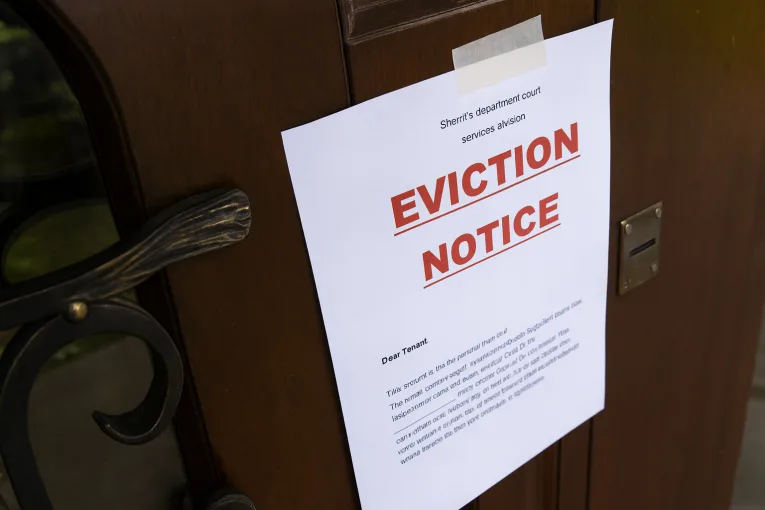
DETROIT, MI – A growing body of research continues to confirm what housing advocates have long asserted: eviction is not only a housing emergency but a public health crisis with community-wide consequences, particularly for Black mothers and children.
New studies are revealing that eviction’s impact extends far beyond the loss of shelter, touching on maternal health, child development, and the structural inequities woven into American housing policy.
In Detroit, where gentrification, rising rents and illegal evictions have become increasingly common, social epidemiologist Shawnita Sealy-Jefferson of The Ohio State University is leading a team of researchers working to quantify the community-wide effects of housing instability.
Their research initiative, SECURE (Social Epidemiology to Combat Unjust Residential Evictions), found that Black mothers living in Metro Detroit neighborhoods with higher eviction filing rates face a 68% higher risk of premature birth — one of the leading causes of infant mortality in the United States.
What’s more alarming, according to Sealy-Jefferson, is that the pregnant person does not need to be the one experiencing the eviction. The stress from witnessing a neighbor’s displacement or living under the constant threat of eviction in a high-turnover neighborhood can be enough to trigger serious physiological symptoms that increase the risk of preterm birth.
“We’re talking about spillover effects from the social environment of a neighborhood,” Sealy-Jefferson told Next City. “It is a source of neighborhood disorder; it’s a source of neighborhood violence; it’s a source of vicarious racism.”
Her team’s research — which involved 808 participants across Wayne, Oakland and Macomb counties in Michigan — used a mixed-methods approach over five years, conducting 16 focus group interviews and 55 in-depth interviews. One in four participants reported experiencing eviction as a child, and those who had were up to 37% more likely to experience negative health outcomes later in life.
Two peer-reviewed articles have already emerged from the data. A paper published in The American Journal of Epidemiology concluded that eviction contributes to psychological stress among pregnant Black women. Another, in the Journal of Urban Health, found that more than half of pregnant Black women surveyed had experienced a court-ordered or illegal eviction at some point.
While the SECURE study does not claim to establish a causal link, it adds to a growing list of studies that connect housing insecurity to a wide range of public health harms. It also affirms decades of work by sociologist Matthew Desmond, whose landmark book Evicted: Poverty and Profit in the American City and subsequent research at Princeton University’s Eviction Lab have reshaped the national understanding of housing instability.
According to a 2023 Eviction Lab report, Black households accounted for 51% of all eviction filings and 43% of all people evicted, despite making up only about 20% of the renter population in major U.S. cities. The lab also found that Black women are 36% more likely to be evicted than Black men.
Desmond’s 2014 report for the MacArthur Foundation offered an early explanation for these disparities, noting that Black women face uniquely high eviction rates due to a combination of economic vulnerability, landlord behavior, and systemic racism.
“Women’s nonconfrontational approach with landlords and their tendency to dodge the issue [of evictions] are two reasons why Black women face significantly higher eviction rates than their white counterparts,” he wrote.
These inequities only deepened after the COVID-19 pandemic.
According to the Center for American Progress, as of late 2022, 24% of Black renters remained behind on rent, compared to just 11% of white renters. With pandemic-era eviction moratoriums expired, a wave of displacement has followed, leaving families scrambling for limited legal resources and financial aid.
Sealy-Jefferson sees the issue as both urgent and structural, requiring more than band-aid policy solutions. “The inequities in preterm birth and the inequities in eviction are not because of behavior or people’s poor choices,” she said. “It’s because of the limits of opportunity and the limits of resources that people who so happen to be in this racial, ethnic group experience.”
In that context, she argues that public health and housing justice are inseparable — and so are their solutions. Alongside common tenant protections such as right to counsel, eviction diversion programs, and rental assistance, Sealy-Jefferson insists on a broader, more transformational remedy: reparations.
“If we want to solve this problem, we got to start with reparations,” she told Next City. “Because if we focus on individual solutions to a structural problem, it’s going to fail.”
State lawmakers in Michigan are taking some steps toward improving tenant protections. This year, State Sen. Sarah Anthony introduced legislation requiring landlords to resolve habitability issues within 48 to 72 hours. If they don’t, tenants could withhold rent until repairs are made.
“We’ve heard directly from renters across Michigan — families being pushed out, seniors struggling to stay housed, and tenants living in unsafe conditions through no fault of their own,” Anthony said. “That’s why this legislation matters.”
In Detroit, the policy conversation is shifting further, as tenants organize for a “Right to Renew” ordinance that would limit a landlord’s ability to refuse lease renewals or impose sudden rent hikes. Steven Rimmer, co-founder of the Detroit Tenants Association, told People’s World the city needs to overhaul its approach.
“We need to fundamentally change city policy to give renters more rights,” Rimmer said. “Right now, tenants are at the mercy of landlords, who can raise rents or refuse to renew leases with little notice. The Right to Renew would give us the security we deserve.”
Matthew Desmond has long advocated for a universal housing voucher program and stronger enforcement of existing tenant protections. In his 2023 follow-up book Poverty, by America, he argues that housing instability is not an unavoidable side effect of capitalism but a policy failure.
“Eviction isn’t just a condition of poverty; it’s a cause of poverty,” he writes. “We’ve made evictions cheap, fast, and easy. We’ve made the pain of displacement tolerable — for everyone except the displaced.”
For researchers like Sealy-Jefferson and Desmond, the evidence is increasingly clear: eviction harms not just individuals, but entire communities — undermining maternal health, widening racial disparities, and embedding inequality across generations. The next step, they argue, is not just studying the problem — it’s doing something about it.
