

Part One: California’s Private Judge Investigative Series – Baseball Private Judge
By Susan Bassi and Fred Johnson
A malpractice case against veteran divorce lawyer Mark Erickson is poised to do what few lawsuits ever manage—pull back the curtain on California’s quiet but powerful private judging industry and the bad actors who operate within it.
Private judging—often called “rent-a-judge” or “temporary judging”—is a legal mechanism in California designed to provide an alternative dispute resolution (ADR) option. Parties in a lawsuit can agree to have their case, or parts of it, decided by a privately hired, non-judicial officer (private judge) instead of a public court judge.
Cases before a private judge can be heard outside of regular court hours, under rules set by the parties and the private judge they select. Hearings are often held remotely or in discreet office settings, away from the public eye.
A private judge does not need to be an attorney. Their fees, often charged hourly, are set case by case. This process is most common in middle-class or high-asset divorces. In child custody disputes, a private judge may be called a “parenting coordinator.”
For decades, California family lawyers have quietly sold clients on this alternative to public court: hire a fellow attorney, often a former judge, to function as a “private judge.”
Clients are told private judging is quicker, cheaper, and more discreet. Clients are seldom informed that these private judges function without the state’s judicial oversight. There is no ethics commission review, no bar discipline, and little transparency.
Now, in a lawsuit involving Erickson and his former elderly client, Richard Garcia, a jury will be asked to decide whether Erickson misled Richard into choosing a private judge—one Richard says steered his divorce in favor of his ex-wife and her lawyer, David Patton, of the law firm Lonich, Patton, Ehrlich, Policastri, costing Richard millions of dollars in unnecessary fees and costs.
Nine years after hiring Erickson, Richard is still not divorced from his second wife, Mary Lopez, and is scheduled to testify as a witness on behalf of her former husband’s divorce attorney at the upcoming jury trial scheduled in Santa Clara County Superior Court.
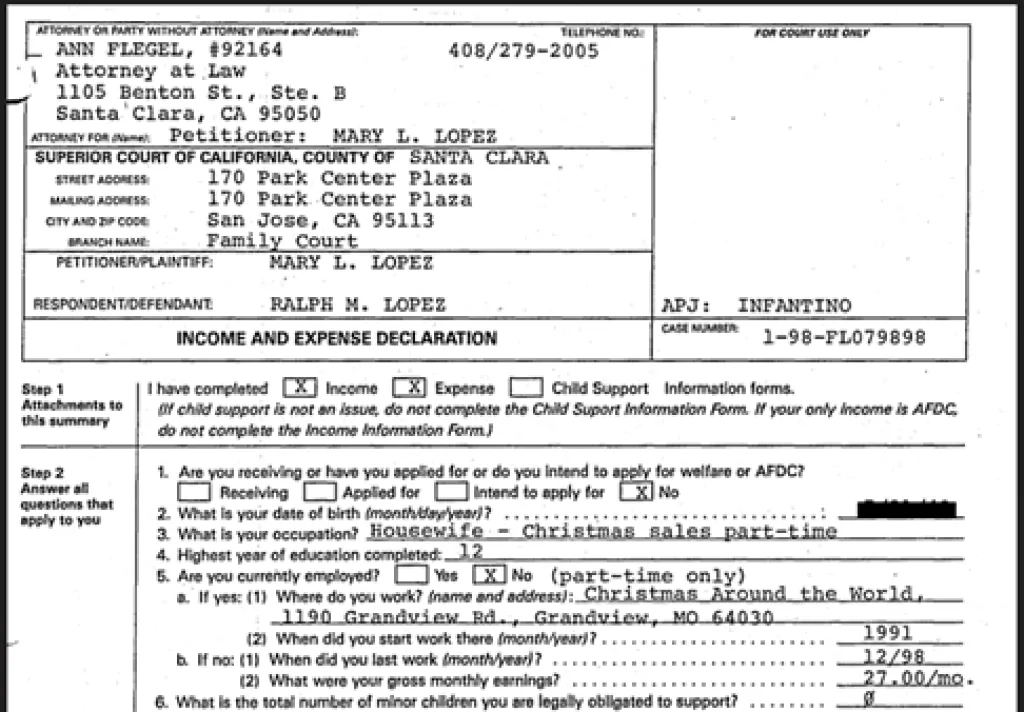
Income and Expense court document filed in Mary and Ralph Lopez divorce case that was final by 2001.
Second Time Around
Back in the 1970s, Richard’s first divorce was straightforward: one year in public court, full custody of his children, and a settlement overseen by a public court judge after his wife decided to end their marriage.
Richard met Mary in 1999 at the Santa Clara County Fairgrounds, where he volunteered for his local church and she ran a booth selling trinkets for Christmas Around the World.
At the time, Mary was in the midst of her own divorce from Ralph Lopez. Shortly after filing for a domestic violence restraining order in that case, Mary’s divorce was settled in public court before Santa Clara County Superior Court Judge Mary Ann Grilli. In the settlement, Mary kept the family home, valued at approximately $400,000, as her separate property.
By 2002, Richard and Mary had signed a prenuptial agreement, though they did not marry until 2007.
A few years into Mary and Richard’s marriage, Ralph’s wealthy uncle died, leaving behind cash, gold coins, and valuable real estate in San Jose’s Almaden Valley. Ralph and his siblings were the rightful heirs.
During his divorce from Mary, Richard alleged that she had helped Ralph hide gold coins from the estate to avoid sharing them with other heirs, and that she concealed her marriage to Richard in order to buy the Almaden Valley property at a below-market price.
In 2014, Mary arranged to buy the Almaden Valley property through a trust she claimed needed to be in her name alone to secure the reduced price. Richard used $1 million of his separate property funds to make the purchase possible while they lived in Mary’s separate property home.
According to court documents, once the Almaden Valley property was purchased by the Mary Lopez Trust, Mary stopped speaking to Richard, forced him into a separate bedroom, and abandoned the remodeling plans she had promised before the purchase.
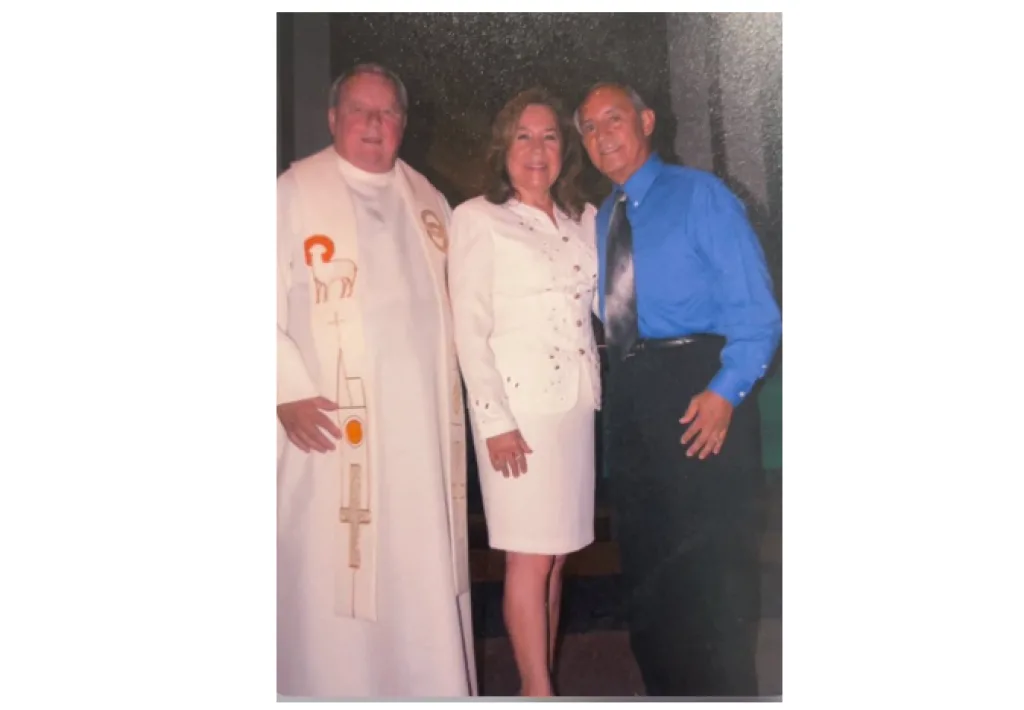
Mary Lopez and Richard Garcia’s wedding photo is an exhibit in the Erickson malpractice lawsuit.
Doomed Marriage and Divorce
In 2016, suspecting he had been the victim of an elaborate gold-digging scheme, Richard hired Erickson to manage the divorce and protect the assets named in his prenuptial agreement. Initially, Erickson drafted a Marital Settlement Agreement (MSA) similar to the one Mary had used in her first divorce. But Mary—represented by David Patton—quickly rejected it.
Erickson then advised Richard to hire a private judge, calling it “faster,” “cheaper,” and “more private” than using public court.
Nine years later, Richard is still not divorced. He now faces trial in his malpractice suit against Erickson, while Mary is set to testify against him.
Over the past decade, Richard—now 81—has spent hundreds of thousands of dollars on private judge fees, attorneys, transcripts, court reporters, depositions, and other costs. Instead of enjoying his retirement, he has spent thousands of hours attending hearings and trials merely to be divorced from Mary.
When Erickson recommended a private judge, he offered no directory, list, or references to aid in selection—only one name: Michael Smith, an attorney with no judicial experience who charged $600 per hour. Richard says he tried to research Smith’s record but found no public files, financial disclosures, rulings, or ethical complaints.
“I played baseball with him,” Richard recalls Erickson saying. “He’s a good guy.”
Eventually, Richard agreed to let Smith function as private judge.
Within months, Smith oversaw a settlement conference at his private office. Richard says he did not understand why the meeting was held since Mary had already rejected the MSA. According to the lawsuit, Richard and Mary were left waiting while Erickson, Patton, and Smith met privately.
After two hours, the legal trio emerged with a “Term Sheet” that Richard had never seen which he claims Smith pressured him to sign—without Erickson explaining its consequences. The result: Richard lost his $1 million separate property claim on the Almaden Valley property and will be obligated to pay $500,000 to Mary’s attorney, David Patton.
Eight months after Erickson allowed him to sign the Term Sheet, Erickson billed Richard for work trying to overturn that same Term Sheet in public court.
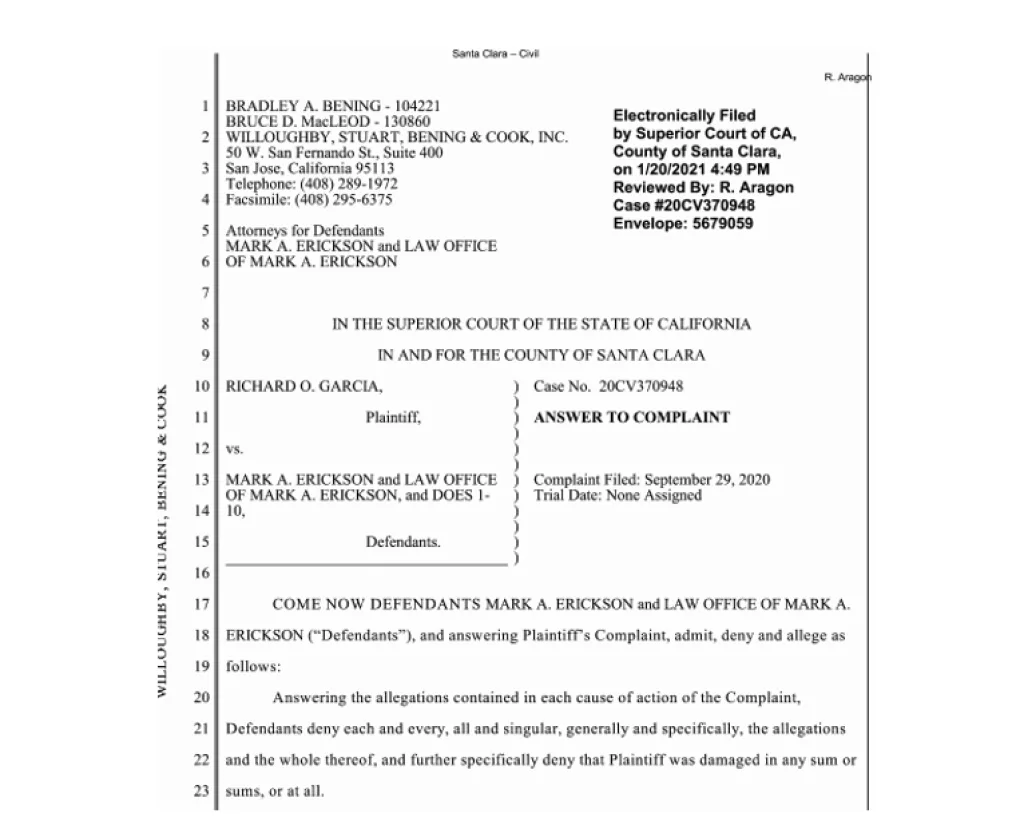
Court documents from the malpractice- fraud lawsuit brought against divorce attorney Mark Erickson.
California’s Private Judge Bribery Problem Hides in Plain Sight
The Garcia case is not unique. Across California, divorce attorneys often steer cases to private judging, where their colleagues are paid to preside.
Judge James T. Ford of Sacramento County Superior Court has even written that privately compensating temporary judges may violate criminal law. Penal Code §94 bars judicial officers from accepting gratuities for performing public acts, and judges pro tempore have identical powers to sitting judges.
In 2016, the same year Erickson pushed Richard toward a private judge, Tracy Hayward’s divorce in Napa County collapsed after she discovered her private judge, attorney Nancy Perkovich, had failed to disclose her ties to her ex-husband’s attorney, Robert “Bob” Blevans. The appellate majority voided all Perkovich’s orders, noting Perkovich’s non- disclosure had violated Tracy Hayward’s due process rights.
In his dissent, Justice James A. Richman warned that if private judges were evading disclosure rules, “parties up and down California will wake up to a majority opinion that tells them that the orders under which they are proceeding…are void… I can only imagine the havoc that will follow.”
Richard Garica’s divorce and his lawsuit against divorce attorney Mark Erickson gives a glimpse of what that havoc looks like.
Private Judges Lurking in Vineyards, Silicon Valley and Hollywood
Private judging is not just a small-county issue. In the high-profile split between Angelina Jolie and Brad Pitt, a private judge was appointed. When Jolie learned of undisclosed relationships between the judge and Pitt’s lawyers, she sought the private judge’s removal. The appellate court agreed, citing violations of California’s judicial ethics and likening the practice to a form of legalized bribery.
California’s private judging industry operates with no guardrails. The Commission on Judicial Performance has no authority. The State Bar rarely intervenes. Solo attorneys acting as private judges need no judicial training or experience, yet they can issue orders that reshape families’ finances and futures.
Attorneys representing Mary, Richard and Erickson did not respond to requests for comment prior to publication.
For lawyers, ADR companies, and malpractice insurers, Richard’s lawsuit is a test case. Win or lose, it may spark reforms, including higher malpractice insurance premiums for family law attorneys who participate in private judging.
As the trial begins, the question remains: Is this just one bad case—or proof that California has quietly privatized one of the most sensitive areas of its justice system, to the benefit of the well-connected and the detriment of everyone else?
The Vanguard’s investigative reporting team will be actively reporting on the jury trial in the Mark Erickson malpractice- fraud lawsuit over the next two weeks and Susan Bassi will be covering the trial on her social media platforms including on YouTube and LinkedIn.
