
Key points:
- President Donald Trump’s use of federal troops on American soil has reignited debate about the militarization of policing.
- The Posse Comitatus Act, passed in 1878, prohibits the Army and Air Force from enforcing domestic law.
- Critics warn that Trump’s actions threaten constitutional norms and heighten violence risks.
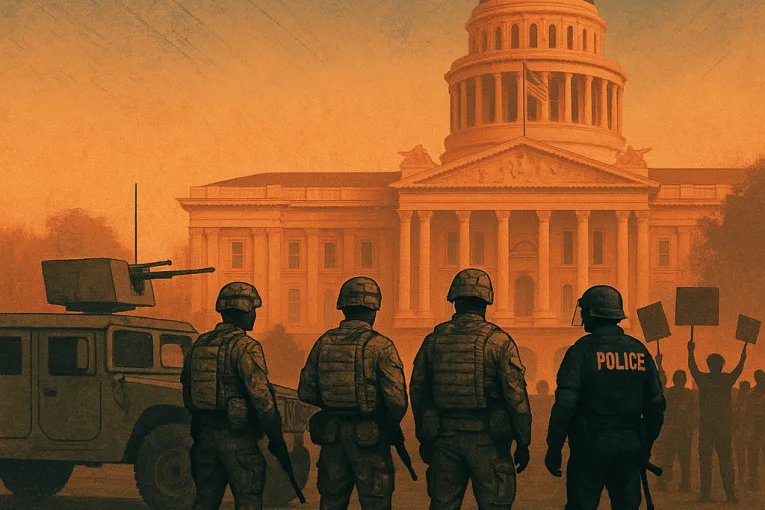
President Donald Trump’s repeated use of federal troops on American soil has forced a 150-year-old law — the Posse Comitatus Act — into the national spotlight, raising questions about the boundaries between military and civilian authority and reigniting debate about the militarization of policing.
In August, hundreds of National Guard troops marched into Washington, D.C., after Trump declared the city “lawless.” Thousands of miles away, a federal judge in California is considering whether Trump’s decision to federalize the National Guard during immigration protests in Los Angeles violated federal law. These parallel cases have become flashpoints in a larger constitutional struggle over the role of the military in domestic law enforcement.
The Posse Comitatus Act was passed in 1878, in the wake of Reconstruction. Southern lawmakers, intent on ending federal intervention in the South, pushed for the measure to bar the use of the Army in domestic policing. At its core, the act reflects an American tradition dating back to the Revolutionary War: a deep suspicion of military involvement in civilian life.
The statute prohibits the Army and Air Force from enforcing domestic law, including investigating local crimes, overriding local police authority, or compelling civilians to act. While exceptions exist — such as congressional authorization or the use of the Insurrection Act of 1807 in times of invasion or rebellion — the law has rarely been tested in practice.
“The tradition in the United States, which is more a norm than a law, is that we want law enforcement to be conducted by civilians, not the military,” said William C. Banks, a law professor at Syracuse University, in AP’s reporting.
The act generally does not apply to state-controlled National Guard units. But when Guard members are “federalized” — placed under presidential rather than gubernatorial authority — they fall within its restrictions. That legal distinction has now become the battleground in California’s courts.
In June, Attorney General Rob Bonta and Governor Gavin Newsom sued Trump and Defense Secretary Pete Hegseth after the administration deployed California National Guard troops to Los Angeles over the objections of state and local officials.
The deployment came on the heels of immigration raids in Los Angeles that sparked mass protests. Though demonstrations had quieted by the time troops arrived, the Guard’s presence reignited tensions, turning calm streets back into sites of confrontation.
Bonta accused Trump of abusing presidential power: “There is no invasion. There is no rebellion. The President is trying to manufacture chaos and crisis on the ground for his own political ends.”
Newsom warned that Trump’s actions represented “an unmistakable step toward authoritarianism,” adding: “Donald Trump is creating fear and terror by failing to adhere to the U.S. Constitution and overstepping his authority. This is a manufactured crisis to allow him to take over a state militia, damaging the very foundation of our republic.”
California’s lawsuit argues that Trump’s actions usurped the governor’s role as commander-in-chief of the state’s National Guard, deprived the state of critical emergency resources, and violated the Tenth Amendment. The order relied on a rarely used statute, 10 U.S.C. § 12406, which has been invoked only once in modern history — when President Nixon federalized the Guard to deliver mail during the 1970 postal strike.
The case highlights how much the Posse Comitatus Act relies on executive self-restraint. As Joseph Nunn of the Brennan Center for Justice explained to AP, “It’s premised on the executive branch policing itself.” Because it is a criminal statute, only the Department of Justice can prosecute violations — raising questions about whether states even have standing to challenge the president in civil court.
Legal scholars note that Trump has not directly flouted the law but rather sought to “dance around” it. He has leaned on Title 10, which permits the president to federalize the Guard under certain conditions, and claimed that troops are not enforcing laws but merely protecting federal property and personnel.
Yet critics say this legal maneuvering undermines the spirit of Posse Comitatus. By federalizing the Guard and deploying Marines in Los Angeles, Trump blurred the civilian-military line in ways unseen since the 1960s. Steve Vladeck, a law professor at Georgetown University, told AP that while the administration is “wrapping itself in the law,” it is simultaneously pushing the law’s boundaries further than any president in modern history.
The implications extend beyond California. Trump has openly threatened to deploy troops in other cities, including Chicago and New York. The California ruling could establish precedent for how far a president can go in federalizing troops for domestic use.
While Trump’s deployments have brought the Posse Comitatus Act into sharp focus, the militarization of policing is not a new phenomenon. Journalist Radley Balko has spent years documenting the ways in which American police forces have adopted military gear, tactics, and mentalities.
In his 2013 Cato Institute essay, Balko argued that policing had undergone a quiet but profound transformation over the past half-century. What began with the rise of SWAT teams in Los Angeles in the 1960s expanded into a nationwide trend, fueled by the federal government’s “wars” on drugs and terror. Through the Pentagon’s 1033 Program, billions of dollars in surplus military equipment — from armored personnel carriers to assault rifles — flowed into local police departments.
The result, Balko warned, was a shift in culture as much as in equipment. Officers were increasingly trained to see themselves as soldiers in a battlefield rather than public servants in a community. Balko wrote that this “warrior cop” mentality eroded constitutional protections, escalated conflicts, and alienated the very communities police are sworn to protect.
His book Rise of the Warrior Cop expanded on these themes, tracing how policies and court rulings steadily chipped away at the Fourth Amendment while legitimizing aggressive police tactics. A 2019 review noted that Balko’s central thesis — that militarized policing undermines civil liberties — has only grown more urgent in recent years. The reviewer emphasized that when police “see themselves as warriors rather than guardians, the balance between liberty and security shifts dramatically, and often dangerously.”
What Balko chronicled as a decades-long drift has, under Trump, become a deliberate strategy. By placing federalized troops alongside local law enforcement, Trump has accelerated the blurring of military and police functions. He has also used inflammatory rhetoric, describing cities like Washington and Los Angeles as “lawless” and hinting at broader deployments to impose “order.”
Critics argue that this approach not only threatens constitutional norms but also heightens the risk of violence. Deploying soldiers to police civilian protests, they say, virtually guarantees escalation. In Los Angeles, the presence of federalized Guard troops revived unrest that had largely subsided. In Washington, heavily armed troops patrolled public spaces in scenes that looked more like wartime occupation than community policing.
For civil libertarians, the concern is not only about Trump but also about precedent. If one president can invoke rarely used powers to federalize state militias over governors’ objections, what prevents future presidents from doing the same?
The legal battles in California and Washington will not resolve every question about the Posse Comitatus Act. Courts may issue narrow rulings based on specific circumstances. But the larger struggle is about whether the United States maintains a civilian policing tradition or accepts a creeping militarization that collapses the distinction between soldier and cop.
For Attorney General Bonta and Governor Newsom, Trump’s order is both unconstitutional and destabilizing. For scholars like Balko, it is part of a decades-long erosion of liberty that has now reached its logical endpoint: soldiers in American streets.
The deeper question, as Balko and others frame it, is whether Americans are willing to tolerate policing that looks and acts more like an occupying army. The Posse Comitatus Act may be old and imperfect, but it embodies a principle as urgent today as it was after the Civil War: that military power and civilian law enforcement must remain separate if democracy is to endure.
Follow the Vanguard on Social Media – X, Instagram and Facebook. To learn make a tax-deductible donation, please visit davisvanguard.org/donate or give directly through ActBlue. Your support will ensure that the vital work of the Vanguard continues.
