
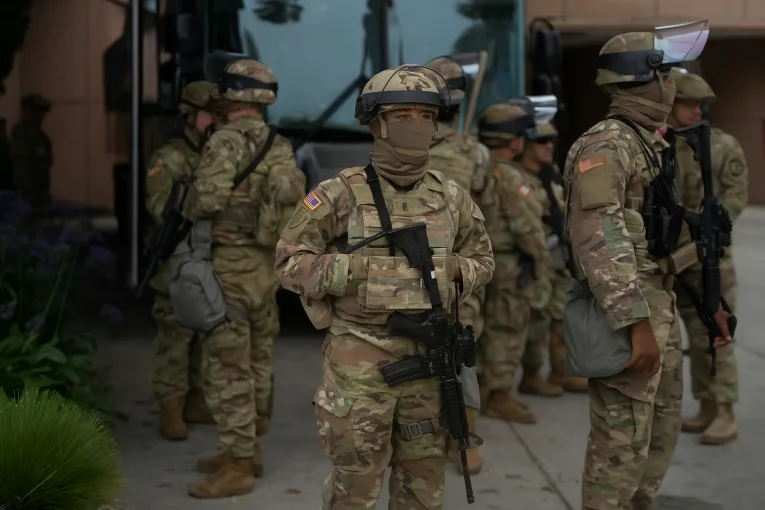
SACRAMENTO, Calif. — California officials are blasting the Trump administration’s deployment of thousands of National Guard soldiers and U.S. Marines to Los Angeles, saying the operation has already cost taxpayers an estimated $120 million and violated long-standing civil-military limits.
Governor Gavin Newsom’s office said Thursday that the Title 10 federal deployment of more than 4,200 National Guard members and 700 Marines racked up $71 million in food and basic necessities, $37 million in payroll, more than $4 million in logistics, $3.5 million in travel, and $1.5 million in demobilization expenses.
The deployment followed President Donald Trump’s June 2025 order federalizing California’s National Guard and sending U.S. Marines to Los Angeles. Newsom and Attorney General Rob Bonta immediately sought an emergency court order to block the administration from expanding the mission beyond protecting federal buildings to enforcing civilian law across the region, according to the Governor’s office.
Days earlier, a federal judge in San Francisco ruled that Trump’s use of federal troops to assist in immigration operations—such as crowd control and traffic blockades—violated the Posse Comitatus Act, which bars the use of federal military forces for domestic law enforcement. In his ruling, Judge Charles R. Breyer wrote that Trump and Defense Secretary Pete Hegseth were “creating a national police force with the President as its chief.” California’s preliminary injunction, filed that Tuesday to block the extension of the deployment through Election Day, followed swiftly.
That same day, a federal court granted the injunction, ruling that Trump’s use of the U.S. military for domestic policing violated the law. According to the Governor’s office, the decision underscored that the administration was “breaking the law by trying to create a national police force with himself as its chief.”
Newsom condemned the deployment as “political theater,” warning that it has “atrophy[ed] the readiness of Guard members across the nation” and inflicted “unnecessary hardships to the families supporting those troops.” He added, “Talk about waste, fraud, and abuse. We ask other states to do the math themselves.”
Beyond the financial burden, the Governor’s office highlighted the social consequences of the deployment. While fewer than 20% of deployed personnel were actively utilized, most soldiers were left idle at Joint Forces Training Base Los Alamitos. Troops initially slept on floors or outside in poor conditions, with inadequate plumbing and limited supplies.
Officials also noted that Guard members were pulled away from their civilian jobs as first responders, police officers, firefighters, doctors, nurses, and teachers. In California, Guard members were diverted from firefighting work on Taskforce Rattlesnake and drug interdiction operations at the border. The Governor’s office said these conditions contributed to low morale among soldiers while disrupting essential public safety and emergency services.
In August, Newsom’s office filed a federal Freedom of Information Act request to obtain records detailing the total expenses of the deployment. While federal agencies have not yet released those documents, the California National Guard calculated preliminary cost estimates at the Governor’s request.
Presidential federalization of the National Guard against a governor’s will is rare, usually reserved for crises such as school desegregation in the 1950s and 1960s. President Eisenhower federalized the Arkansas Guard in 1957 to enforce integration in Little Rock, and President Kennedy did the same in Mississippi in 1962.
The Trump administration invoked neither the Insurrection Act nor any clear statutory authority. Instead, it relied on the “protective principle,” claiming implied executive power to defend federal property. Judge Breyer rejected that rationale, and legal scholars noted that, while Title 10 federalization grants command authority, it does not permit law enforcement activity without an explicit Insurrection Act invocation.
The deployment now sits at the crossroads of constitutional law, civil-military norms, and taxpayer accountability. Beyond its $120 million price tag, officials warn it risks eroding long-standing boundaries between military and civilian life, straining Guard readiness, and pulling citizen-soldiers away from duties like firefighting and drug interdiction.
What is at stake, lawmakers argue, is not only cost but democratic accountability. As the case moves forward, the nation must confront what it means when federal military power is used to police American cities.
Follow the Vanguard on Social Media – X, Instagram and Facebook. Subscribe the Vanguard News letters. To make a tax-deductible donation, please visit davisvanguard.org/donate or give directly through ActBlue. Your support will ensure that the vital work of the Vanguard continues.

yeah, can’t stand Newsom or Trump. I appreciate some acts where Trump pushes things knowing he’ll get shut down by the courts, in order to push a political point — but sans DC, deploying military troops civilly is a dangerous overstep.