
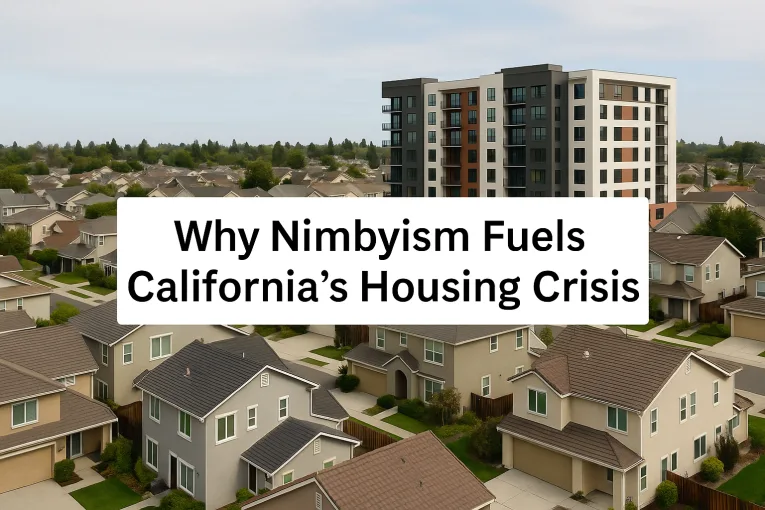
Key points:
- Los Gatos case highlights California’s housing crisis and impact of infill on existing neighbors.
- Resistance to infill projects often stems from fear of change, density, and loss of privacy.
- California’s housing crisis is exacerbated by Nimbyism, driving up costs statewide.
The Los Gatos case has put into sharp focus one of the most critical debates over housing in California: the impact of infill on existing neighbors. The conversation is not new, but the clash between state housing mandates and local resistance illustrates just how deeply entrenched the problem of Nimbyism has become.
I’ll state it up front. The impact of development on existing neighbors is almost always overstated. Time and again, projects that were once fiercely opposed turn out to be far less disruptive than feared. The resistance comes from fear—fear of change, fear of density, fear of something unfamiliar being built nearby. But fear is a poor foundation for policy, and it has played an outsized role in creating and perpetuating California’s housing crisis.
Take Los Gatos. Some residents who live close to proposed projects object that the buildings are too high, too dense, and too close to their backyards. They worry about privacy, noise, and the possibility of looming apartment buildings altering the character of their neighborhood. One homeowner put it bluntly: no one would want something built almost literally in their backyard.
That may sound reasonable at first glance, but it is exactly the kind of reasoning that has kept California from meeting its housing needs. Local opposition is often laser-focused on immediate impacts to existing property owners, while ignoring the broader consequences of not building enough homes.
The reality is that this is why we have a housing crisis—and the people who suffer the most from that crisis are not the homeowners who fear losing privacy in their backyard. It is those most vulnerable: the renters struggling to pay rising costs, the families forced to move far away and endure crushing commutes, the younger generations who can’t afford to live in the communities where they grew up, and the unhoused who are left with no options at all.
The critics point to state laws like the “builder’s remedy” provision, which allows housing projects to override local zoning rules when cities fail to adopt compliant housing elements. In Los Gatos, the Benedict Lane project by Green Valley Corporation has drawn sharp opposition under this provision. Homeowners object to the height and proximity, claiming it will eliminate privacy and increase noise.
But these objections don’t exist in a vacuum. They must be weighed against the wider crisis. Focusing only on whether a building is too close to a backyard ignores the systemic costs of underbuilding. Those costs include higher housing prices, longer commutes, traffic that clogs freeways rather than neighborhood streets, and a chronic failure to produce homes that match the needs of residents.
We’ve seen this dynamic play out before. When the Sterling Apartments were proposed in Davis, neighbors expressed fear about density, traffic, and disruption. The project was eventually approved, and, years later, when asked whether it had turned out to be a problem, most people acknowledged that it was not. Many of those who once complained now barely notice the development. The feared impacts never materialized.
Contrast that with the University Mall site in Davis. Intense opposition blocked housing there, leaving the site underutilized. Now those units will have to be built elsewhere, and the burden shifts to another neighborhood. The lesson is simple: when one community succeeds in blocking housing, it does not mean those units disappear. It just means another community has to absorb the demand, and the cycle of opposition repeats.
This is where Nimbyism becomes not just a local nuisance but a statewide barrier. Opposition by neighbors who are already housed perpetuates scarcity and drives up costs for everyone else. The beneficiaries of resistance are homeowners protecting the status quo. The victims are those locked out of homeownership, those priced out of rentals, and those pushed into displacement.
Some argue that the housing crisis is not really about Nimbyism, but about broader economic forces, or that people with limited means would never realistically move into wealthy enclaves like Los Gatos. But this misses the point. Housing is a regional and statewide system. The refusal of affluent towns to allow growth doesn’t just keep low-income residents out of their neighborhoods; it pushes demand outward, drives up prices in less affluent areas, and forces longer commutes that worsen traffic and pollution.
State law has recognized this reality, which is why the Legislature has passed reforms designed to limit the ability of cities to say “no” to housing. YIMBY Law, the California Housing Defense Fund, and Californians for Homeownership made this clear in an amicus brief in the Los Gatos litigation, describing it as “a story of state housing law working as intended to produce new housing while a resentful Town tries to gum up the process.”
If Los Gatos’ interpretation of the Permit Streamlining Act is allowed to stand, housing advocates warn, other anti-housing jurisdictions across California will take it as a green light to block projects through technicalities and dubious legal arguments. The law is explicit that courts must give “the fullest possible weight” to approving housing. Yet towns like Los Gatos continue to search for ways around the rules, no longer able to deny projects outright but still determined to delay and obstruct.
This illustrates the shift underway in California housing politics. State law has stripped localities of their veto power, but not their will to resist. The battlefield has moved from planning commissions and city councils to the courts, where procedural maneuvers are the new form of Nimbyism.
At the end of the day, the tradeoff is unavoidable. Either we build housing on the periphery—converting farmland and open space, creating sprawl, generating more greenhouse gases and traffic—or we build infill, which provokes backlash from neighbors who fear density in their backyard. The honest answer is that California needs both: smart growth on the edges and bold infill in existing communities. But pretending that we can avoid one or the other is just another form of denial.
The problem comes when the conversation focuses only on one end of the equation. When policymakers weigh only the perceived impacts on existing neighbors—most of which are exaggerated or never materialize—they ignore the very real impacts on everyone else of not building. Those impacts include skyrocketing rents, crushing commutes, homelessness, and the loss of entire generations from our communities.
It is easy to sympathize with a homeowner worried about a building rising behind their backyard. Change is unsettling, and everyone values their privacy. But housing policy cannot be built on the preferences of those who already have homes while millions of others face a crisis of scarcity. The greater good demands that we balance local concerns with statewide needs.
California has spent decades deferring to local fears, and the result has been a catastrophic housing shortage. If the state is to reverse course, it must stand firm against Nimby obstruction and ensure that housing gets built where it is needed. The lesson from Davis, Los Gatos, and countless other towns is clear: fear is loud, but it is not a plan. Housing delayed is housing denied, and the costs are borne by those least able to bear them.
Nimbyism is not just a local preference; it is a statewide problem. It is time we treat it as such.
Follow the Vanguard on Social Media – X, Instagram and Facebook. Subscribe the Vanguard News letters. To make a tax-deductible donation, please visit davisvanguard.org/donate or give directly through ActBlue. Your support will ensure that the vital work of the Vanguard continues.

“Many of those who once complained now barely notice the development.’
Define “many”.
Keith O
Alternatively can you present many people who have complained since the development was occupied?
The article’s picture showing the high-rise in the middle of a neighborhood is abhorrent.
I’m one of the “many” who are against this.
How about this?
Keith O
My experience from attending many meetings on these issues in Davis is the opposite. Those who objective are but a few, and the many viewed higher density housing favorably. That was true during the Downtown Specific Plan meetings, and it was true a the General Plan Update meeting in August. I expected much more opposition of the type you express but I heard almost none as I moved around the room and read the comments.
Those in the suburbs telling those in the core and outer core that they should take it up the whazoo while those Davis suburbs will never be touched. See map of ‘opportunity zones’. That weird shaped blob was not drawn that way by accident.
The destruction of the previous “Families First” facility (funded by taxpayer dollars in some manner, most likely) at the site now occupied by Sterling means that the services provided by such facilities is then shifted “elsewhere”. (The type of services that you normally support more of.)
This is essentially the same thing which causes cities like Davis to lose commercial spaces to housing. (For that matter, the site previously occupied by Families First (now Sterling) was zoned light industrial, as I recall.)
Regarding the University Mall site, you seem to have a short memory. The city APPROVED housing at the University Mall site. Rather than appreciate the fact that an owner of a retail mall was actually willing to reconstruct a mall (during this period of retail mall decline), the city essentially “did it’s best” to undermine and delay reconstruction of it. Fortunately, the owner of that mall succeeded with their original plan, despite the city’s interference (though it was delayed as a result of the city’s interference, resulting in a loss of taxes and economic activity).
Both of the examples above are essentially a form of “opportunity cost”. That is, housing attempting to replace another use. (This is often the case regarding infill – displacing existing uses – which sometimes includes destruction of existing lower-cost housing).
David says: “Some argue that the housing crisis is not really about Nimbyism, but about broader economic forces, or that people with limited means would never realistically move into wealthy enclaves like Los Gatos.”
Are you kidding, regarding this comment? You think the fact that Los Gatos is in Silicon Valley has no impact regarding the housing situation? And that it’s just a “coincidence” that its housing prices are high, and has no relationship to the obscene salaries, stock options, and ownership of nearby Silicon Valley businesses? Which didn’t even exist when many residents moved into existing houses?
David says: “But this misses the point. Housing is a regional and statewide system. The refusal of affluent towns to allow growth doesn’t just keep low-income residents out of their neighborhoods; it pushes demand outward, drives up prices in less affluent areas, and forces longer commutes that worsen traffic and pollution.”
You seem to be assuming that “low-income” residents can’t find “low-income” (or perhaps even better) jobs outside of a place like Silicon Valley. You also seem to be assuming that housing prices would come down in Silicon Valley (but not in nearby communities), by building more housing. This makes no sense, even if your theory regarding reducing housing prices by building more were true. It’s the DIFFERENTIAL in price which causes people to live elsewhere. It’s the DIFFERENTIAL in salary which may, or may not influence them to keep their job in a distant, wealthier community (while living in a cheaper community).
This is the same reason that newcomers to this area (especially younger families) move to Spring Lake, rather than Davis. There’s plenty of existing housing in Davis for sale – but it’s CHEAPER to buy one in Woodland (or Dixon, or Natomas, etc.). The fact that you can easily get a “new” house in Woodland (vs. a pre-existing house in Davis) is also a factor for some people, though I personally think that’s not a good reason in the long run.
(A real estate agent told me that existing “for sale” housing is double what it was a short time ago.)
Again, probably half the people in this region (including Davis) came from somewhere that they are now essentially “priced out of”. Does that mean that their existing home towns should now build housing so that they can presumably move back to their original towns? And that such housing should then be “reserved” exclusively for them?
(A real estate agent told me that existing “for sale” housing is double what it was a short time ago.)
It is much more than double. The number of “price cut” emails from Zillow is several per week now!
So the crisis is over, if there ever was one.
Truth be told, I’m glad to hear it.
It’s all imaginary money anyway, unless one engages in a transaction. And even then, that’s also based on what we agree is valuable in the moment (dollars, in this country).
Actually, all money is imaginary – we make it up – like the bogeyman (George Carlin, regarding a different subject).
Even the valuation of gold, when you think about it.
Now with Bitcoin, I’m absolutely certain that it’s based on something stable and real. :-)
Can’t also but think of the last lines in Monty Python’s “Always look at the bright side of life”. (You came from nothing, you’ll end up with nothing. What have you lost? Nothing. There’s actually a lot of wisdom underneath that.)
Ron O
If you had been a resident of Davis who followed what happened with the Families First facility, you would know that it had failed financially and deviated from its mission causing it to be closed for several years before Sterling was proposed. Your alternative world where FF continues on is a false path.
“You also seem to be assuming that housing prices would come down in Silicon Valley (but not in nearby communities), by building more housing. ”
We’ve been making this point repeatedly backed up by numerous studies–more supply leads to lower prices. (I don’t know what your point is about lowering prices elsewhere.) Regardless, the biggest price effect will be in the locale where the supply is built because its the attributes of that locale that is drawing demand. That’s why building in Davis with its unique attributes will have a much bigger impact on housing prices in Davis than in Woodland or West Sac. The differential will shrink. So David’s assumption is correct and well substantiated. The one study I’ve seen coming to a contrary conclusion was effectively negated through a strong critique that I’ve posted here previously.
We use price to allocate resources in our market economy, so housing generally is not built for one specific group. However, certain types of housing stock are more attractive to certain market segments. That’s why building missing middle market housing of 1500 sf homes is a preferred path over building 3000 sf commuter abodes.
The rest of your message is too confused to address further.
Regarding Families First, is it your position that the facility couldn’t be re-used? I viewed that facility on-site, and found it to be in good condition. No doubt, paid for in some manner by taxpayers.
Richard says: “I don’t know what your point is about lowering prices elsewhere.
I’m not surprised that you don’t (or more accurately – “claim” that you don’t). And yet, don’t you call yourself an economist?
Richard says: “Regardless, the biggest price effect will be in the locale where the supply is built because its the attributes of that locale that is drawing demand. That’s why building in Davis with its unique attributes will have a much bigger impact on housing prices in Davis than in Woodland or West Sac. The differential will shrink.”
You have no evidence of that whatsoever. None. But it does seem like you’re addressing the actual point (in an incorrect manner) after all, so maybe you “do” understand (despite playing dumb).
How much did The Cannery “lower” housing prices in Davis?
(Edited)
Hey folks, no swear words allowed, real or ****’ed.
There’s lots of evidence from many markets about how localized supply increases reduce prices more within that locality. The California Independent System Operator Local Marginal Price (LMP) market structure is based on this principle. The same thing holds for real estate markets that have entry barriers that limit conveyance of price signals. Present your evidence that increasing housing supply in a constrained market locations reduces housing prices by an equivalent market in a distant location. You made this assertion first so it’s your burden to demonstrate empirically that this has happened.
If what you claim is true then all of the housing prices would be the same everywhere because changes in supply and demand would wash through the entire market. So your response is illogical and refuted by the evidence right before our eyes. Somehow Davis prices gained a 50% premium over neighboring cities, which shouldn’t have happened based on your assertion.
The addition of the Cannery reduced the price premium that Davis has over Woodland and West Sac. “Lowering” prices is shorthand for reducing price growth over time and reducing prices relative to alternatives. You can see that in the Zillow history data.
Tall buildings have adverse effects on the local temperature, wind patterns, and microclimates.
Buildings taller than about 3 stories are difficult to shade, so this impact is hard to mitigate. Use of high-rise buildings to increase housing density is at odds with climate change mitigation.
So it’s not just the direct shading of nearby properties and the loss of views. Tall buildings will make neighborhoods less livable in many ways.
Don
High rises are much more efficient energy wise. Data I’m looking shows that 5 story buildings use only 1/3 the energy of a standard single family house. And there’s the additional reductions in transportation emissions which we haven’t yet calculated. This energy use is far and beyond a bigger contributor to climate change impacts than any effects from shading or air flow.
“High rises are much more efficient energy wise. Data I’m looking shows that 5 story buildings use only 1/3 the energy of a standard single family house. And there’s the additional reductions in transportation emissions which we haven’t yet calculated. This energy use is far and beyond a bigger contributor to climate change impacts than any effects from shading or air flow.”
None of that is relevant to my point which is the impact of the high rise building on the local surface and air temperatures. As usual, my concern is about mitigating the local impact. I am concerned with the habitability of the local environment in a warming climate, as with the urban heat island effect. Yours is on the global balance sheet.
Basically, in the hot interior parts of California, we shouldn’t build buildings that are taller than the trees which would shade them within about 20 years. So avoid buildings taller than about 30- 40 feet. In coastal areas this isn’t as much of an issue.
Don, in this great age of instant AI fact checking I submit the following rebuttal to your statement:
Question: is there any evidence that it is better to build 3 story buildings instead of 6 story buildings in terms of shading and heat island effects?
The short answer is: there’s no strong general evidence that buildings taller than 3 stories are inherently environmentally harmful, but there are some localized effects that can occur depending on climate, urban design, and placement. Let me break this down:
⸻
1. Shading Effects
• Localized cooling: Taller buildings can shade streets, sidewalks, and neighboring structures, which in hot climates often reduces the urban heat island effect and lowers cooling energy demand.
• Potential downsides: In colder climates, excessive shading may reduce passive solar heating and increase heating demand. It may also reduce sunlight for street trees, gardens, or solar panels if poorly sited.
Key factor: It’s not height per se, but orientation and placement relative to the sun that determine whether shading is positive or negative.
⸻
2. Wind and Microclimate Changes
• Wind tunneling: Tall buildings can create accelerated downdrafts and wind tunnels at street level, which may make sidewalks less comfortable or, in extreme cases, damage landscaping.
• Air mixing: On the other hand, tall structures can break up stagnant air pockets and improve ventilation, which can be helpful in cities with poor air quality.
⸻
3. Ecological Impacts
• Urban wildlife: Birds and insects are usually not significantly impacted until you get into much taller high-rises (10+ stories), where bird collisions with glass become a known issue.
• Vegetation: Three- to six-story buildings generally have modest impacts on neighborhood microclimates compared to factors like tree canopy, pavement, and open space design.
⸻
4. Empirical Findings
• Studies on urban form and energy use (e.g., from Lawrence Berkeley Lab and international planning research) show that mid-rise density (4–6 stories) often strikes the best balance: compact enough to support transit and reduce car dependence, but not tall enough to create extreme wind or overshadowing issues.
• A review in Urban Climate (2017) found that urban geometry, building spacing, and greenery have far more influence on microclimates than the difference between 3- and 6-story buildings.
⸻
✅ Conclusion:
There’s no inherent environmental harm in going taller than 3 stories. In fact, mid-rise (4–6 story) buildings are often the sweet spot for sustainable urban design: dense enough to support walkability and transit, but not so tall as to cause significant wind, shading, or ecological disruption. The key is good design—setbacks, orientation, green infrastructure, and materials matter more than strict height limits.
How building height affects the global urban surface heat island from local climate zone perspective
Jiufeng LI et al.
In low-density areas, an increase in BH tends to amplify SUHI, whereas in high-density areas, such an increase might mitigate SUHI, potentially due to the substantial shading effects of tall buildings (Yang et al., 2021a).
[Note: By the standards of these studies, we are low density.]
A study categorized Chinese cities into nine districts based on BH and building density, finding that the contribution of BH to SUHI is greater than that of building density, with its impact increasing as BH rises.
BH = Building Height
SUHI = Surface Urban Heat Island effect
I don’t intend to go through all of the AI-generated comments. AI is not useful in evaluating scientific studies as it does not discern between their rigor, nor does it evaluate how one study has built on prior ones. The “Conclusion” is not borne out by actual evaluation of studies that you can readily find online.
I suggest you not do this again. Just look up the research and summarize it in your own words to your own level of understanding.
My biggest concern in all of this is how these very tall buildings will impact the local air temperatures and local surface temperatures during very high-temperature weather events such as we had in September 2022 (7 days over 105, 2 of them 116). A light-colored wall will reflect considerable heat, as will nearby concrete. Dark-colored surfaces will absorb heat and release it back at night, increasing overall temperatures. This carries health risks (ozone linked to asthma, for example), but the extreme weather events are actual health safety concerns from heat stress and direct injury by hot surfaces. We know we’re going to be seeing those weather extremes more often. We need to plan now to mitigate it.
To illustrate this, go outside on a hot afternoon and put your hand on your west-facing wall. Now imagine that heat coming off of a building 60 to 70 feet tall. Or several such buildings. Yes, if you get a whole lot of them, as in high-density urban settings, the buildings can create their own local climate, and shade each other. That’s not what we’re talking about for Davis. You’ll be creating giant walls reflecting sunlight on the nearby area.
Air circulation and the presence of nearby irrigated landscaping can mitigate the heat reflecting off of buildings, but at very low wind speeds such as we get here during atmospheric inversions that will not happen. When the big domes of high pressure set up in summer and stay for days, those surfaces will make things worse for those nearby.
By far the best thing to do is cast shade on those surfaces and simultaneously cool the air by means of evapotranspiration of trees. But if your buildings are too big, you can’t do that.
Interesting Don.
I still disagree re AI. People are extremely good at finding and even cherry-picking out studies that agree with what they feel, it is one of the worst logical abuses of the internet era.
AI on the other hand has no agenda, and asking it a fair question and posting the results unedited removes that “shopping” bias that you see people (like Ron) do all the time. So I think its quite useful for those purposes.
I do think your comments and concerns are interesting, but I’m skeptical with regards to the weight we might attatch to such concerns. Is having a certain amount of heat being reflected form a building an ample enough concern for us to forgo the creation of housing for 60 medium income families that might have lived on stories 4-6 of that building? All of that housing also offsets need for the small single family units that the developers are trying to sell us.. all of which has twice the GHG footprint and twice the water consumption…..
And putting more people on upper stoies in areas where there is transit means fewer cars than the single family alternative…. and the property taxes are better for the city and…
The environmental and economic and logistical positives of multifamily housing tend to stack up pretty quickly… the effects you describe would have to be prety darn intolerable for them to serve as an actual reason for us not to build any 6-7 story buildings.
Of course.. nobody in this discussion is saying that we need LOTS of 6-7 story buildings everywhere… in the regional centers around our main shopping nodes, yes, we should have some… and downtown it should be common… that is the kind of housing we need exactly where shopping and transit are closest…
Along our arterials though we Dont actually need anyting of the sort. I have the math on this already.. its part of the DCPG’s next article: we could DOUBLE the population of our city with only 20 units per acre in those areterials… ( for reference, the only 6-7 residential buiding we have ( identity) is 80 units per acre). at 20 units per acre you can have a mix of townhomes, apartments, condos with only a few structures in that mix over 3 stories.
“Sprawl” is “failing to build densely”. and getting back to the point of David’s article, we REALLY need to stop asking projects to be less dense.. we knocked a story off of sterling because of fear…. and now we have how many fewer housing units as a result?
Don
First in China they are largely building apartments 15 stories and taller. (I was there in 2018.) This study is unlikely to provide insights on the difference between 3 and 6 story buildings.
Second, the real cause of urban heat islands is pavement, not building. Streets cover about 20% of urban land and parking another 20%. Increasing housing density shrinks that pavement which reduces the heat island effect. It is important to incorporate thriving vegetation in these place to mitigate the heat island further.
“This study is unlikely to provide insights on the difference between 3 and 6 story buildings.”
I could provide many more studies on the impact of high-rise buildings. I was simply illustrating to Tim Keller that using AI for this type of topic is not reliable.
“Second, the real cause of urban heat islands is pavement, not building”
Urban heat island effect is increased by all hardscape surfaces. Also, UHIE is a major concern, but what I’m addressing is chronic and acute heat risk. Those are risks that are directly related to the configurations of the buildings, the vegetation, and the types of surfaces.
Since your group is proposing specific standards and guidance for development projects, I assume you have consulted with experts on this topic. If not, please do so. Again: chronic and acute heat risk during high temperature events as well as Urban Heat Island Effect.
My point is that it’s easier to shade a 3-story building than anything taller than that. So in the interest of making habitable neighborhoods, lower buildings with more trees and vegetation will be much more comfortable 25 – 50 years from now than high-density housing.
The tradeoff, of course, is that we’ll have to develop more farmland.
“The destruction of the previous “Families First” facility (funded by taxpayer dollars in some manner, most likely) at the site now occupied by Sterling means that the services provided by such facilities is then shifted “elsewhere”. (The type of services that you normally support more of.)”
Your speculative generalizations demonstrate a complete lack of knowledge about the history of that site.
Also I guess I should respond that I don’t support the kind of services provided by the facility…. It was basically a group home for kids which I in no way support.
Here is one article I wrote back in 2013 – https://davisvanguard.org/2013/07/former-employee-terminated-after-whistleblowing-files-lawsuit-against-familiesfirst/
You don’t support group homes for kids? Or, you just didn’t support the troubled organization (in particular) which operated that facility?
In any case, the facility (multiple buildings) looked to me like it could have a number of different uses, and that the buildings themselves were relatively new and in good shape.
Looked like it could have functioned as housing for homeless people.
And again, it seems quite likely that this was funded with, or heavily-subsidized by tax dollars – the facility itself.
I visited the facility myself (and inspected the buildings), after the decision had (apparently) already been made to tear them down. As I recall, the city conducted an “outreach meeting” as if it hadn’t already been decided. (But in speaking with city staff onsite on that day, I could tell that it was a done deal.)
And again, it was actually zoned for light industrial uses as I recall, so the previous organization must have had a special use permit (something like that).
No I don’t. Why do you presume I support something when you write about something that you have absolutely no knowledge of?
O.K. – I’ve continued to remember this, whenever someone suggests that more homeless facilities are needed. (Or light industrial – whatever that means.) Or, whenever someone wants to spend tax dollars on a facility intended to serve those in need which will be torn down within a few years, when the organization operating it fails.
Of course, student housing (some 2-3 miles from campus) isn’t necessarily a “bad” use, but that’s what happens when UCD shifts its responsibilities and costs to a city eager to accommodate that. Sort of a “thank you sir, may I have another” situation.
As I recall, there was also an analysis which showed that this would eventually be a money loser for the city – like most other housing. (I remember discussing that with you on here, and that Matt saw the analysis as well. But I don’t think we ever pinned-down where that came from.)
This isn’t a homeless facility. Please educate yourself first, comment second.
Dude – read my comment. I said that it could have a number of different (subsequent) uses, including as a homeless facility. Those were modern buildings, in good shape. (I believe I took photos of them as well, but don’t know where they are for now.)
Seems pretty likely that a group home intended for kids (with multiple buildings) could have easily been repurposed into an adult facility.
Maybe try being a little less testy, and a little more willing to read what I wrote?
Perhaps take a deep breath before you respond, next time. And certainly do so before you admonish me with an incorrect understanding.
What I read was: “The type of services that you normally support more of.” You presumed to know my view of these services and that I would support it, and when confronted with that falsehood, you didn’t back down and apologize.
Here’s what I said in my 5:37 p.m. comment, above:
“In any case, the facility (multiple buildings) looked to me like it could have a number of different uses, and that the buildings themselves were relatively new and in good shape.”
Let me know when you want to retract your comment, apologize, and start reading before you respond.
And again – next time, please do so BEFORE you proceed to admonish me in regard to your failure to read. (Second time I’ve pointed this out in this article, alone!)
My complaint was from earlier.
Do you also have trouble telling time? This isn’t “earlier” than my comment.
David M. Greenwald says:
September 10, 2025 at 5:44 pm
This isn’t a homeless facility. Please educate yourself first, comment second.
My earlier comment included this statement:
“Looked like it could have functioned as housing for homeless people.”
But again, the zoning for it was actually light industrial as I recall. So Families First must have had a conditional use permit of some type.
The point of all this (in case you missed it in regard to your continued misunderstanding) is that there’s an “opportunity cost” when decisions like this are made.
Now, you can certainly try to deny that (or claim that UCD’s student housing needs should take precedence for that location, if you’d like to). But don’t pretend that there isn’t an opportunity cost.
Overall, I have not found city leaders to be putting a priority on city interests in regard to decisions like this.
There’s lots of evidence from many markets about how localized supply increases reduce prices more within that locality. The California Independent System Operator Local Marginal Price (LMP) market structure is based on this principle. The same thing holds for real estate markets that have entry barriers that limit conveyance of price signals. Present your evidence that increasing housing supply in a constrained market locations reduces housing prices by an equivalent market in a distant location. You made this assertion first so it’s your burden to demonstrate empirically that this has happened.
If what you claim is true then all of the housing prices would be the same everywhere because changes in supply and demand would wash through the entire market. So your response is illogical and refuted by the evidence right before our eyes. Somehow Davis prices gained a 50% premium over neighboring cities, which shouldn’t have happened based on your assertion.
The addition of the Cannery reduced the price premium that Davis has over Woodland and West Sac. “Lowering” prices is shorthand for reducing price growth over time and reducing prices relative to alternatives. You can see that in the Zillow history data.
You have that backwards, regarding presenting evidence. You’re the one claiming that building housing in Davis reduces prices there, but not in places like Spring Lake.
Neither of those things are actually true, as demonstrated by The Cannery.
There’s too many factors involved to isolate causes. Right now, housing prices are dropping (and inventory in particular is increasing) in Davis and elsewhere, which has nothing to do with building more housing.
Zillow says that Davis housing prices have decreased by .9%, while Redfin states that they’ve dropped by 12.5%. (And of course, even those figures can be skewed by various factors.)
Richard says: “If what you claim is true then all of the housing prices would be the same everywhere because changes in supply and demand would wash through the entire market.”
That’s not what I said.
Richard says: “Somehow Davis prices gained a 50% premium over neighboring cities, which shouldn’t have happened based on your assertion.”
Matt and others have gone over this with you, before. The price differential you describe (which is closer to 40%, as I recall) existed prior to Measure J, and during the time that Mace Ranch and Wildhorse were built).
But again, I’m not one to argue that housing should be built for the purpose of lowering prices (and a developer on here confirmed that developers don’t do so in the first place).
If Davis only had “one” house, its value would NOT be “unlimited”. The reason being that people seek alternatives (and that category itself is very broad, and is not limited to housing choices). It would extend to whether or not people choose to move to the area in the first place, for example. It could extend to whether or not students choose to enroll in the university in the first place, as well. It could extend to whether or not they look at UC Merced, whether or not they choose to get a college education, whether or not they stay home and attend a local community college for the first couple of years, etc.
The ONLY choice that residents of Davis have is to either expand (or not expand) in ADDITION to what surrounding communities are pursuing. (“Keeping up with the Joneses” in a negative manner, so to speak.)
“ Matt and others have gone over this with you, before. ”
I found this amusing
Glad that you do. Are you claiming that it’s incorrect?
Also, you recently published an article which claimed that building more housing had an impact on a broader area – the opposite of what Richard claims.
But even that may not be true.
I am quite certain that any young family in particular looking to move to the immediate area (for some unknown reason, since UCD isn’t hiring more people) look to both Davis (and Spring Lake – “North, North Davis” in particular).
There’s too many factors influencing housing prices (mostly centered on economic activity, interest rates, etc.).
And when you build a development like The Cannery, it attracts those who might not otherwise even move to the area – which is probably the reason they ended up advertising in the Bay Area. And yet, The Cannery itself is actually a pretty modest development overall, in regard to the type of housing that was built.
It also seems likely that the condo-style housing at The Cannery is occupied primarily by students.
My amusement was independent of any judgment of the validity of the statement
“I am quite certain that any young family in particular looking to move to the immediate area (for some unknown reason, since UCD isn’t hiring more people) look to both Davis (and Spring Lake – “North, North Davis” in particular).”
This is pretty amusing as well
Well, a lot of people don’t find that amusing. They think it’s a disaster, because (rather than driving 4 miles through a congested city to reach campus), they only have to drive 7 miles in a straight line (bypassing Davis entirely).
They apparently think that more-efficient transportation causes more greenhouse gasses, somehow.
Even if they take a bus to campus from either location.
Of course, these are also the same people who claim that both workers in a given household work on campus (but that somehow, housing on campus is the least-efficient option of all).
O.K. – now I’m starting to find this amusing, as well.
Ron is so right. From Wildhorse I would often prefer driving the 7 miles to Woodland to do my shopping than dealing with driving into downtown Davis.
I just received an article “automatically” emailed to me, by Realtor.com. Apparently, birth rates have fallen to a record low (1.6 kids per woman) – and Realtor.com attributes housing prices as a partial cause of that.
So if true, then high housing prices are actually helping to curb unsustainable population growth (which of course, helps reign in every other environmental concern – including climate change). Of course, Realtor.com doesn’t frame it that way, despite being undeniably true.
https://www.realtor.com/news/trends/birth-rates-plummet-home-prices-surge-housing-market-family-planning/?cid=eml__1946:66e221571a4446d4e6969d41:rm202509221030_Marketing_Consumer_Daily_EditorialRSSDynamic
What’s sad is you view that as a good thing
If there is a correlation (and there probably is to some degree), it’s perhaps not the most “ideal” way to ensure a stable population. But it would ultimately result in widespread consensus that there is no housing shortage. (It obviously impacts demand for housing, going forward.)
This issue is so serious (a stable population) that whatever works is a good thing. And again, it impacts everything else (housing “shortages”, climate change, species extinction, habitat loss, etc.).
Truth be told, I also think it’s a “good thing” that young people are apparently examining the cost of having kids (outside of housing costs). Maybe only people who can afford to have kids should do so.
Like I said yesterday, I’m apparently the elder “pied piper” of the younger generations regarding this issue. I’m apparently the Bernie Sanders (in regard to appeal to young people) regarding population stabilization.
So, after all the talk regarding “boomers”, it’s apparently the Generation X’ers like you who are “out of touch”. ;-)
Not ideal? Come on, think about it, if accurate, it means that the housing crisis which you have claimed doesn’t exist, is so severe it is disrupting life decisions like breeding? That’s horrific and the consequences for it down the line could be catastrophic.
Too much breeding IS the problem – in regard to “housing shortages” (and every single environmental problem, as already noted). If that’s not obvious to you, I’m not sure how to explain it any more clearly.
And from now on, please call me “Bernie” or the “Pied Piper” of population stabilization.
We could all be driving Hummers, if there were fewer of us. (Though they’ve never appealed to me.)
But seriously, I’m apparently on the same side of young people in regard to these decisions.
I’ve never been this hopeful/optimistic about the future, before. We’re in no danger of running out of people, despite the drastically-declining birthrate in this country and elsewhere.