
Key points
- “What we really see is a system becoming overreliant on punishment and overreliant on jails and incarceration, rather than investing in systems that provide some form of safety to communities like adequate mental health response teams or affordable housing or social workers that can help work with people rather than continue to punish them.” – Claudine Constant, Policy Director at the Vera Institute for Justice
- “Contrary to the rhetoric that’s happening around the country, North Carolina does not even have a cashless bail system.” – Claudine Constant, Policy Director at the Vera Institute for Justice
- “Ultimately, we believe that murder is terrible and it shouldn’t have happened in the first place. But demanding more money, bail systems will not prevent more violent crime.” – Claudine Constant, Policy Director at the Vera Institute for Justice
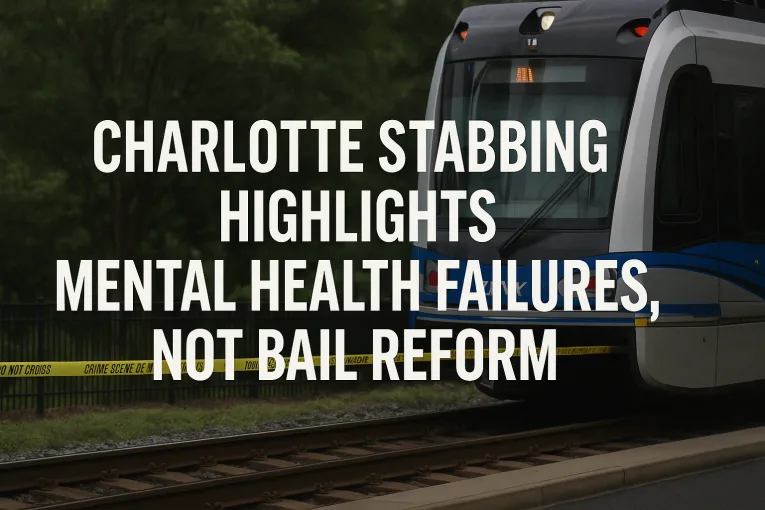
CHARLOTTE, N.C. – The August 22 stabbing of 23-year-old Ukrainian refugee Iryna Zarutska on a Charlotte light rail train has become a political flashpoint. Within hours of her death, national politicians and Trump administration officials sought to link the tragedy to bail reform, claiming that a “cashless bail” system allowed the suspect, 32-year-old Decarlos Brown, to walk free before committing the murder.
That narrative is not just misleading—it is flatly inaccurate. North Carolina does not have a cashless bail system, and experts say tying Zarutska’s killing to debates over bail is both opportunistic and harmful.
Claudine Constant, Policy Director at the Vera Institute for Justice, noted that North Carolina operates under a traditional bail system where judges have a range of options. “Contrary to the rhetoric that’s happening around the country, North Carolina does not even have a cashless bail system,” Constant said.
Court records show Brown’s release earlier this year was not the result of any sweeping reform but of a low-level charge that barely met the threshold for criminal prosecution. In January, Brown was arrested for making several bizarre 911 calls in which he claimed he was a machine. He was released on a written promise to appear in court, a common pretrial condition in North Carolina that requires no money. At most, the incident reflected a man in the midst of a psychiatric crisis, not a threat that money bail could have mitigated.
“Ultimately, we believe that murder is terrible and it shouldn’t have happened in the first place. But demanding more money, bail systems will not prevent more violent crime,” Constant said. “The root causes of crime, like mental health conditions and affordable housing, that’s what prevents violence, not forcing our systems to favor the wealthy more than they already do.”
Zarutska boarded the Lynx Blue Line in Charlotte’s South End neighborhood around 10 a.m. on August 22. Witnesses told police she sat down in front of Brown, who then pulled out a pocket knife and stabbed her three times, at least once in the neck. She died at the scene.
As passengers screamed and scrambled for safety, Brown allegedly declared, “I got that white girl. I got that white girl,” before fleeing onto the platform, where police arrested him within minutes. He has been charged with first-degree murder.
Zarutska had come to Charlotte after fleeing the war in Ukraine. Friends described her as a kind and loving woman with a “heart of gold” and a passion for animals. Her death has shaken the Ukrainian community and raised concerns about public safety on Charlotte’s transit system.
Political leaders, however, immediately reframed the tragedy into a referendum on bail. Carolyn Levitt, press secretary for the Trump administration, presented the case as proof that eliminating cash bail makes cities unsafe. Conservative commentators quickly amplified the message across social media, portraying the crime as the result of leniency.
The reality is that Brown’s prior case was not a bail case at all. His January arrest was a minor charge born out of a mental health crisis. To equate his release with bail reform not only ignores the facts but distracts from the real systemic failure: the absence of meaningful intervention for someone with untreated schizophrenia who had already cycled through involuntary commitments.
“What we really see is a system becoming overreliant on punishment and overreliant on jails and incarceration, rather than investing in systems that provide some form of safety to communities like adequate mental health response teams or affordable housing or social workers that can help work with people rather than continue to punish them,” Constant said.
She argued that investing in mental health services, not ramping up pretrial detention, is the way to prevent tragedies. “Mass incarceration is a huge tax on communities and requires lots of investment from several places and it doesn’t, again, solve the root issues and doesn’t address violent crime,” she said. “What will address those issues are addressing the root, ensuring that people have adequate access to housing, adequate access to healthcare, adequate access to mental health resources, public education, transportation, all of that.”
Constant said it is important to push back against the narrative that bail reform is to blame for crimes committed by people released pretrial.
“Many studies have shown that there are several requirements that go along with the progress of bail reform and limiting the use of money bail or eliminating money bail completely,” she said. “And there are often many contingencies that are put upon a person like a promise to appear, electronic monitoring or some kind of diversion system to ensure that they show back up to court.”
She noted that bail reform does not mean automatic release. In jurisdictions like Illinois, which eliminated cash bail in 2023, courts employ rigorous standards to determine pretrial detention or release, and public safety remains a central factor.
“Public safety and not wealth should determine who is released and who remains in jail,” Constant said. “And a charge is not a conviction and people shouldn’t be held pretrial just because they can’t afford to pay their way out, especially if it’s for low level charges.”
Constant also pointed out that pretrial detention often makes communities less safe.
“It is incredibly destabilizing and oftentimes people have families and being incarcerated for one day or seven days can really destabilize a person’s entire life,” she said.
That destabilization can increase the risk of future criminal activity, undermining the very goal of public safety. But despite the data, fear-based narratives persist. Constant urged people to shift the conversation away from crime headlines and toward the real question of safety.
“I think the biggest thing really is for folks to remember that this is not a conversation about crime. This is a conversation about safety,” she said. “And most people want to live in safe communities. And so when we redirect the conversation to talking about what does it take for a community to feel safe, we often find that incarceration is not one of the priority answers.”
She stressed that evidence from places like Illinois and Washington, D.C., shows that bail reform has not led to higher crime.
“Understanding that the statistics and the facts that are coming out of these localities like DC and Illinois are proving that crime rates are down, are showing that these effective policies, these policies are effective and working and really demonstrating that as long as we have this collective commitment to feeling safe and feeling whole, we will move in the right direction,” Constant said.
The question then is not whether bail reform made Charlotte unsafe—it did not—because there was no bail reform to speak of. The question is how a man with a documented history of severe mental illness slipped through the cracks of an underfunded and fragmented mental health system.
“This is fundamentally a problem about somebody with persistent mental illness who isn’t being treated,” Constant said. “And how do you stabilize a person like that when we’ve deinstitutionalized this country, when we don’t have a lot of inpatient options, when the healthcare system is garbage?”
For advocates like Constant, resisting the easy narrative is essential. “The simplest way that I can say that is to just not buy into it,” she said. “Just do your best to not buy into it and root down in the facts and figures that are presented to us on a daily basis.”
Zarutska’s death is a devastating loss, particularly for a community that had welcomed her after she fled war. But blaming bail reform obscures the truth. Brown’s release was not the product of progressive policy—it was the predictable outcome of a legal system ill-equipped to handle serious mental illness.
The tragedy should spark a debate about mental health intervention, crisis response, and community safety. Instead, it is being used as political capital in a campaign against bail reform. For those who knew Zarutska, and for those who care about building safer communities, that misdirection is its own kind of failure.
Follow the Vanguard on Social Media – X, Instagram and Facebook. Subscribe the Vanguard News letters. To make a tax-deductible donation, please visit davisvanguard.org/donate or give directly through ActBlue. Your support will ensure that the vital work of the Vanguard continues.

Decarlos Brown had 14 prior arrests and was released without cash bail solely on a promise to appear in court by Judge Stokes. Was it the “cashless” bail reform no, but Brown was still released without any cash bail.
Why didn’t the judge consider his 14 prior arrests? Progressive justice policies are the problem.
Generally speaking because of the nature of what he was accused of. You can’t just hold people indefinitely for minor crimes. That’s a failure of the system, but it’s not a failure of bail, it’s a failure of our lack of mental health options and funding.
America’s three largest mental health facilities are jails – https://bailproject.org/learn/americas-three-largest-mental-health-facilities-are-jails/
In January 2025, Decarlos Brown was released after being charged with a class 1 misdemeanor for misuse of 911 in Charlotte, North Carolina.
I can’t imagine any place where he would be held in custody on that charge.