

by Malik Washington, Destination Freedom Media Group
One week ago Vicki Gonzalez — the host of Insight, a daily program that airs at 12 noon Monday through Friday on Cap Radio (90.9 FM) Sacramento — interviewed Rusty Hicks, the Chair of the Democratic party in California and Omar Noureldin, Senior Vice President of Policy and Litigation a national government watchdog group.
The topic of discussion was ‘Partisan Gerrymandering’ and Proposition 50 which seeks to change the redistricting policy here in California in order to respond to what the legislature in Texas has done in order to gain 5 seats in the U.S. House of Representatives.
Governor Newsom signs ‘Election Rigging Response Act’ legislative package; Gives people power to push back on Trump’s attempts to shred democracy (Vote Scheduled for November 4, 2025)
Prior to moving to San Francisco, California in 2020, I lived in Texas for 12 years.
I am intimately familiar with the tactics and strategies used by the Republican Party (GOP) to weaken the voting power of communities of color. I will explain in layperson terms and language exactly what is happening in Texas. My intent is to inform and educate the electorate here in California, so that more people will understand why California Governor Gavin Newsom and the Democrats are attempting to change the redistricting map policy in the State of California.
WHAT IS REDISTRICTING AND WHAT IS THE GOP IN TEXAS UP TO?
Redistricting is when political district lines for Congress, state legislatures. or even city council seats are redrawn, usually after the census. In Texas, communities of color are Hispanic, Black and Asian populations that make up nearly all of the state’s population growth in recent years. Logically you would think that these minorities would gain more fair representation in the state. However, the way that the Texas Legislature has drawn new maps coupled with policies of the past has actually had the opposite effect. Let me be absolutely clear here.
The Texas State Legislature is dominated by the Republican Party, and they know exactly what they are doing.
THE STRATEGIC PLAN
There are very specific and well thought out strategies that the GOP in Texas has implemented in order to weaken and marginalize the voting power of communities of color. Let’s take a close look at these strategies:
1.) CRACK COMMUNITIES APART: Instead of keeping Hispanic and Black neighborhoods together, the redistricting maps in Texas split them apart into multiple districts where they become minorities in each district. This makes it harder for communities of color to elect the candidates of their choice.
2.) PACK VOTERS TOGETHER: In some cases, large communities of color are squeezed into one or two districts instead of being spread fairly across several districts. This wastes their voting power, giving them fewer seats than their population size would suggest.
3.) DILUTE URBAN GROWTH: Most of the population growth in Texas is in cities like Houston, Dallas, Austin, and San Antonio where communities of color are concentrated. The redistricting maps created by the GOP in Texas often dilute the influence of these areas by attaching them to rural and predominantly white counties.
HOW DOES THIS BENEFIT THE GOP?
Here I will describe how the GOP benefits from implementing these racialized voter suppression tactics in Texas.
A.) Secures more “safe” Republican seats: By breaking up growing communities of color (which tend to vote Democratic), Republicans strengthen their ability to hold onto districts where the overall population is shifting away from them.
B.) Slows the impact of demographic changes: Without a doubt, the State of Texas is becoming more diverse, but the redistricting maps allow Republicans to keep outsized political power for the next decade.
C.) Protects Incumbents: Many GOP politicians get safer districts with fewer competitive elections which means less accountability.
THE BIGGER PICTURE
Communities of color provide almost all the population growth in Texas, but they do not get proportional representation. Through partisan gerrymandering, Republicans lock in more seats than their share of the population would normally allow. The problem that this presents is that policies and laws may continue to be passed that do not reflect nor address the needs or the voices of Black, Hispanic, or Asian Texans, even though these groups are driving the state’s future. Now, just in case I have not made my point crystal clear, please allow me to share specific examples from Texas redistricting that show exactly how the redistricting maps harm communities of color while strengthening Republican control. I’ve divided my examples into case studies.
“In Texas, communities of color … make up nearly all of the state’s population growth in recent years.” ¹ ² ³
“The Legislature’s maps use well‑known gerrymandering tactics — cracking, packing, and attaching urban cores to distant rural counties — to weaken voters of color.” ⁴ ⁵ ⁶ ⁷
“These tactics secure more ‘safe’ Republican seats, blunt demographic change, and protect incumbents.” ⁸ ⁹ ¹⁰
Case Study #1.) Houston/Harris County Before Redistricting: Harris County (Houston) has a large Hispanic and Black population. These groups have driven most of the county’s growth over the past decade.
After Redistricting: Instead of adding a new district where communities of color could elect their candidate of choice, map makers split up neighborhoods.
Specific Example: Congressional District 7 was redrawn. It used to be a swing seat in West Houston, but now it’s packed with Democratic voters (many are Hispanic and Black), making it overwhelmingly safe for Democrats. Meanwhile, surrounding districts (8, 22, and 36) were drawn as Whiter and more Republican, so Democrats waste their votes in one district (#7) while the GOP secures multiple safe zones.
The Impact: Houston’s diverse voters don’t get proportional representation. Their influence is concentrated in one or two districts instead of being spread across several districts.
“TX‑07 was redrawn to be overwhelmingly Democratic while adjacent districts were drawn to be whiter and more Republican, concentrating diverse voters into a small number of seats.” ¹¹ ¹²
Case Study #2.) Dallas/Fort Worth Metroplex Before Redistricting: Dallas and Tarrant counties saw explosive Hispanic and Black population growth. Democrats expected more representation commensurate with their growing numbers.
After Redistricting: Lawmakers in Texas sliced minority heavy areas into multiple districts, attaching them to sprawling, rural and mostly White counties.
Specific Example: Congressional District 33 (a Hispanic opportunity district) was kept, but the lines around Dallas/Fort Worth suburbs were shifted so that new diverse suburbs didn’t gain their own voice.
The Impact: Rapidly diversifying and growing suburbs in the Dallas/Fort Worth Metroplex remain under White majority GOP controlled districts. This weakens the voting power of new Hispanic and Black residents. THESE ARE PRAGMATIC AND METHODICAL STRATEGIES SUPPORTED BY THOSE IN POWER WITHIN THE NATION’S CAPITOL!
“Minority‑heavy suburbs were split and attached to exurban/rural counties; TX‑33 was preserved, but fast‑growing diverse areas did not gain additional opportunity districts.” ¹³ ¹⁴
Case #3.) Austin/Travis County Before Redistricting: Austin is young, diverse, heavily Democratic and a hub for computer technology.
After Redistricting: Austin is carved into multiple districts, each dominated by surrounding conservative areas.
Specific Example: Congressional District 10 ties East Austin (which is heavily Hispanic and Black) to rural counties stretching toward Houston. Congressional District 21 ties parts of Austin to the Hill Country, again a majority White and Republican area. It doesn’t take long to see the pattern and method being implemented.
The Impact: Instead of having a fair chance at multiple Austin-based seats, the city’s communities of color are swallowed up by rural GOP voters.
“Austin’s urban core is carved into multiple districts including TX‑10 and TX‑21 that extend deep into conservative areas, diluting city voters of color.” ¹¹ ¹⁵

U.S. Representative Lloyd Doggett of Austin, Texas has said that he will retire if these new Redistricting Maps are implemented in Texas. Doggett has applauded the leadership of California Governor Gavin Newsom in framing an adequate response to the threat posed by these maps. Doggett said: “This is bigger than Texas……This is really about what happens to our Democracy.” Source: PBS NEWSHOUR August 25, 2025
Case Study #4.) San Antonio/South Texas Before Redistricting: South Texas, with its heavy Hispanic population, was competitive for Democrats.
After Redistricting: Congressional district 23 (which stretches from San Antonio to the border) was redrawn to remove Hispanic voters and add Whiter, more Republican areas. This makes it harder for the Hispanic community to elect a candidate of their own choice, even though they form the majority of the population in many parts of the district.
The Impact: Hispanic political influence in South Texas is diluted, giving Republicans a stronger foothold in areas where demographic trends were shifting to Democrats.
“TX‑23 and other South/West Texas districts were drawn to reduce Latino electoral opportunity by removing Latino voters and adding whiter, more Republican areas.” ⁵ ¹⁶ ¹⁷
WHAT IS THE OVERALL ADVANTAGE TO THE GOP?
Republicans in Texas don’t gain new seats just by population growth; instead, THEY HOLD POWER BY MANIPULATING THE MAP! Communities of color (especially Hispanic people) accounted for 95% of Texas’ population growth between 2010 and 2020, but they didn’t get additional opportunity districts.
The Result: The GOP locks in more safe seats, Democrats are packed into fewer districts, and communities of color have fewer chances to elect candidates who represent their interests.
“People of color drove ~95% of Texas’ 2010–2020 growth, yet the new maps did not create proportionate opportunity districts.” ¹ ² ³
“Federal courts won’t police partisan gerrymanders (Rucho), but racial vote dilution claims remain available under Section 2 of the VRA (Gingles; Allen v. Milligan).” ¹⁸ ¹⁹ ²⁰
“Independent redistricting commissions and strong map‑drawing rules are associated with measurably fairer maps.” ²¹ ²²
At the beginning of this piece I mentioned an interview conducted by Journalist Vicki Gonzalez (Host of Insight — https://www.capradio.org) with Omar Noureldin, Senior Vice President of Policy and Litigation of Common Cause. This nonprofit monitors the creation and implementation of Redistricting Maps like the one in Texas and the proposed map here in California.
The organization has a 6-point Fairness Criteria system which they utilize in order to test the fairness of proposed maps. Texas failed in every one of the following categories: 1.) Proportionality 2.) Public Participation. 3.) Racial Equity. 4.) Federal Reform. 5.) Endorsement of Independent Redistricting, and 6.) Time-limited. I invite members of the community, especially those involved in supporting and who are in opposition of Prop 50 to comment. We must create environments where we can debate respectively.
“Common Cause and aligned watchdogs evaluate maps on proportionality, public participation, racial equity, federal reform compliance, independent‑commission principles, and process timelines; Texas scores poorly across these dimensions.” ²³ ²⁴
I’ve offered this overview not to score partisan points but to invite a principled, fact‑based conversation about representation and fairness. If you live in a community affected by these maps — whether you’ve seen your neighborhood split apart, your vote packed into a single district, or your city hitched to distant counties — I want to hear from you. Share your experience, your questions, and your best ideas for solutions that honor every Texan’s voice. You can reach me respectfully in the comments or directly at mwashington@destination-freedom.org. Let’s model the dialogue we deserve: curious, civil, and grounded in evidence — and let’s use it to move our democracy a step closer to true representation for all.
Here’s the link to the footnotes and Bibliography for our research:
https://1drv.ms/b/c/bd2dbf553c0a1145/Ef6oaxfmJWBLgYGJVx7N9-wBcWIhv7yPYyQUls6qdhdAeg?e=TAA7a5
The Redistricting Maps are part of a much larger problem
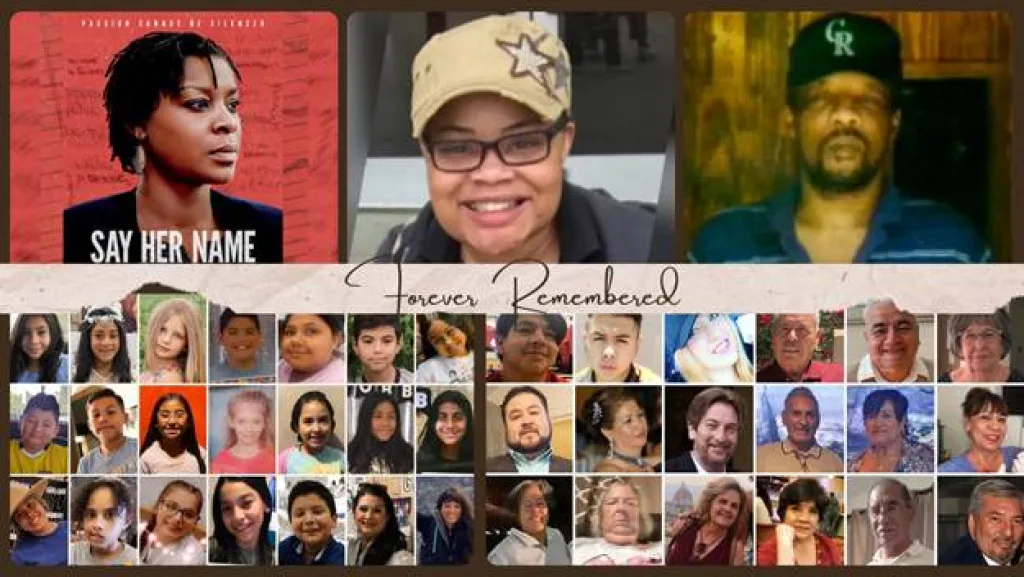
Top: Sandra Bland, Atatiana Jefferson, and James Byrd, Jr.
Bottom: Ulvade Texas School Shooting Victims (left) and Walmart El Paso Texas Shooting Victims (right)
Communities of Color are not protected nor respected in the State of Texas. Your Vote is your Voice and in Texas it is being Silenced, Muffled and Ignored. ASK THE PARENTS AND FAMILY MEMBERS OF THESE VICTIMS WHETHER THEY FEEL THE STATE OF TEXAS RESPECTS THEIR “VOICE”?
PHOTO CREDITS
Churches remember the 21 who died in Uvalde school shooting (Minnesota Remembers)
Caption: A composite of the 19 students and two teachers killed by a gunman in Uvalde, Texas on Tuesday, May 24, 2022.
Prairie View A&M Hosted Sandra Bland Documentary Discussion
HBO’s documentary, Say Her Name: The Life and Death of Sandra Bland which aired December 3rd at 10:00 pm ET, revealed more details about the circumstances surrounding Bland’s death (July 13, 2015)
Watch: 25 years after James Byrd Jr. was killed for being Black, his loved ones question how much has changed in Texas
https://www.texastribune.org/2023/06/07/james-byrd-death-texas-hate-crime-racism
Caption: “James was a loving person and he loved people,” Louvon Byrd Harris said about her brother. “So you can’t figure out who in the world would get mad enough at James [to kill him].”
Former Texas officer sentenced to nearly 12 years in prison for the killing of Atatiana Jefferson in her home
https://www.cnn.com/2022/12/20/us/aaron-dean-sentencing-atatiana-jefferson
A ‘hero’ grandfather, a teen, an Army vet: These are the victims of the El Paso massacre
caption: Top row, from left: Javier Amir Rodriguez, Andre Anchondo, Jordan Anchondo, Juan de Dios Velazquez, Arturo Benevidez, Angelina Englisbee. Middle row, from left: Leonardo Campos, Elsa Mendoza De la Mora, David Johnson, Raul Flores, Maria Flores, Gloria Irma Marquez. Bottom row, from left: Maribel Hernandez, Margie Reckard, Maria Eugenia Legarreta Rothe, Sara Esther Regalado, Adolfo Cerros Hernandez, Jorge Calvillo Garcia.
We leave you with a beautiful song and video by the Douglas Family, which embodies the spirit of resistance that we are attempting to cultivate in more people’s hearts and minds.
The Douglas Family – Stand Up! #standup #equaltyfreedomand justice
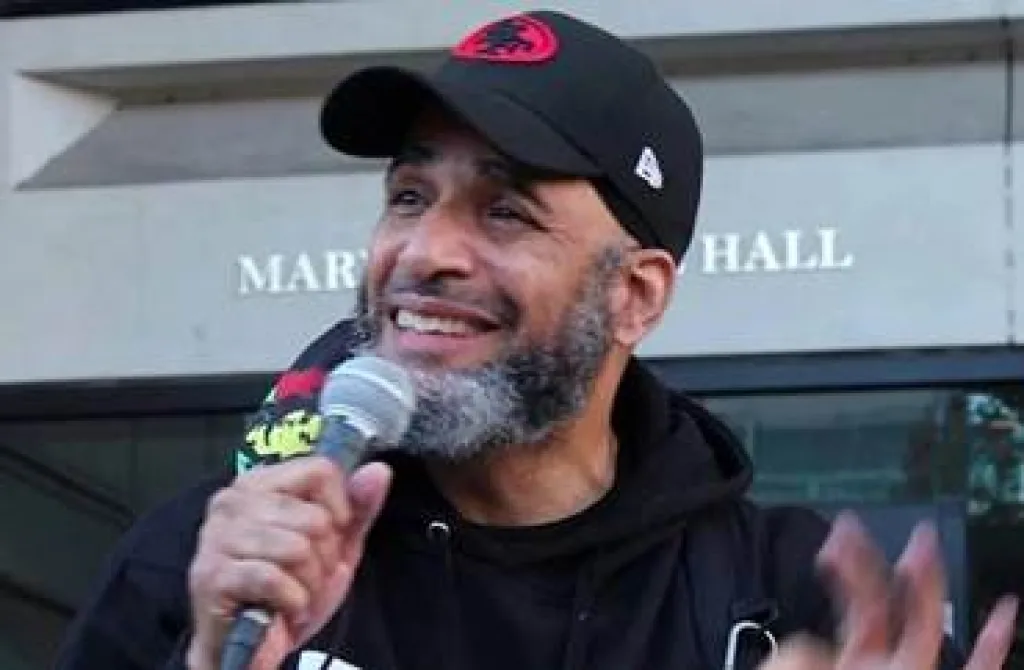
Malik Washington is a freelance journalist and Director at Destination: Freedom and Destination Freedom Media Group. For over 13 years, Malik has been a published journalist and news reporter focusing on criminal justice issues, conditions of confinement in jails and prisons, as well as hot-button political issues. You can reach him via email: mwashington@destination-freedom.org
Suggestions or leads on stories are always welcome.
Write to Malik at:
Keith Washington Xref 5383546
c/o Securus Digital Mail Center – Sacramento Main
P O Box 20888
Tampa Florida 33622
Please follow us on Facebook: https://www.facebook.com/destfreedom13 and Instagram: https://www.instagram.com/destinationfreedom13/
Follow the Vanguard on Social Media – X, Instagram and Facebook. Subscribe the Vanguard News letters. To make a tax-deductible donation, please visit davisvanguard.org/donate or give directly through ActBlue. Your support will ensure that the vital work of the Vanguard continues.
