
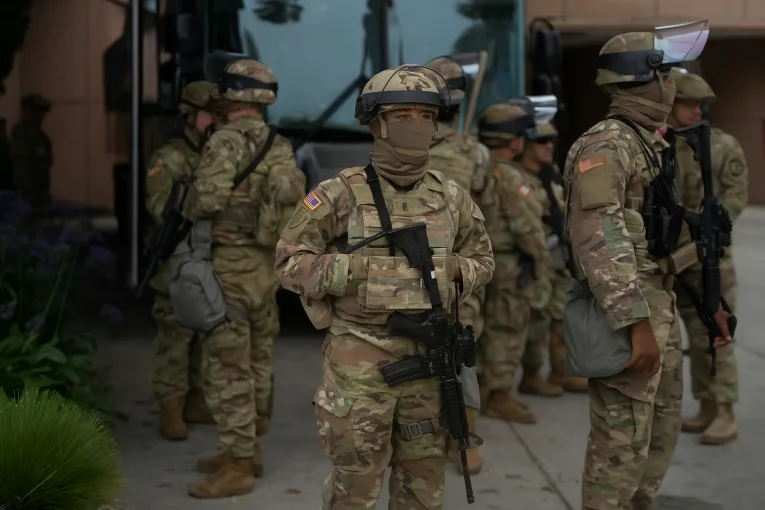
SAN FRANCISCO — A federal judge in the Northern District of California on Tuesday issued a second injunction against President Donald Trump for deploying U.S. Marines and National Guard troops in Los Angeles during protests against immigration enforcement earlier this summer, citing a Reconstruction-era law to block the move.
Former Assistant U.S. Attorney and Bulwark writer Kim Wehle noted this is Judge Charles Breyer’s second injunction related to the troop deployment, the first of which was struck down in June.
According to Wehle, when staying the first injunction, the Court of Appeals for the Ninth Circuit allowed Trump to “put federal troops in the streets to work alongside local law enforcement so long as he has a ‘colorable basis’ to do so and acts on the ‘good faith’ belief that his ability to execute federal law has been ‘significantly impeded.’”
Wehle argues that the Trump v. United States decision “manufactured criminal pre-immunity for Trump,” holding that “a president’s state of mind is off-limits for purposes of criminal investigations involving official acts.” She said this decision makes the standards set forth by the Ninth Circuit “impossible to probe.”
The Constitution gives Congress the power to “provide for calling forth the Militia to execute the Laws of the Union, suppress Insurrections and repel Invasions,”
Wehle explained that Congress delegated to the president the authority to deploy troops “if a state’s legislature or governor asks for them,” “to enforce the laws of the United States or suppress rebellion whenever unlawful obstructions, combinations, or assemblages, or rebellion make it impracticable to enforce federal law otherwise,” and “to suppress any insurrection, domestic violence, unlawful combination, or conspiracy that hinders the execution of the laws in a way that deprives people of their constitutional rights or if the state opposes or obstructs the execution of the laws of the United States or impedes the course of justice under those laws.”
Wehle cited past National Guard deployments, including when President George H.W. Bush, at the request of California Gov. Pete Wilson, sent troops to Los Angeles during the 1992 riots following the Rodney King verdict. She said those riots were “much more deadly and damaging than this year’s protests in Los Angeles” and, citing Breyer, emphasized that “there was no rebellion, nor was civilian law enforcement unable to respond to the protests and enforce the law.”
Despite the lack of rebellion, Wehle wrote that Trump “[called] in the National Guard ‘to temporarily protect ICE and other United States Government personnel … and to protect federal property,’” despite opposition from California Gov. Gavin Newsom.
In the most recent injunction, Breyer cited the Posse Comitatus Act, a law Wehle said was “enacted in 1878 to address concerns that white supremacists would return to power and use the military to undermine Reconstruction.” The law states that “the military cannot be invoked against civilians for local law enforcement unless a statutory exception to the law applies.”
Breyer ruled that the Posse Comitatus Act was violated when Secretary of Defense Pete Hegseth instructed troops to do what was “necessary to ensure the execution of federal functions and the safety of federal personnel.”
According to Wehle, the Trump administration argued in court that “there did not even need to be actual threats—just the potential for unexpected threats—to unleash federal troops on civilians.” She noted Trump had said, “I have the right to do anything I want to do. I’m the president of the United States. If I think our country is in danger, and it is in danger in these cities, I can do it.”
Breyer warned that following the logic used by the administration and the Ninth Circuit’s ruling, the government could use difficulties enforcing tax, drug, or election laws as a justification to deploy the military on American soil.
Because of the Supreme Court’s ruling on “universal injunctions,” Wehle said this ruling does not stop the Trump administration from deploying the military in other U.S. cities.
Wehle reported that, as of Sept. 4, 300 National Guard troops remain stationed in Los Angeles. She said the appeal from this case could end up in the Supreme Court, where Trump’s authority could be stretched even further.
Follow the Vanguard on Social Media – X, Instagram and Facebook. Subscribe the Vanguard News letters. To make a tax-deductible donation, please visit davisvanguard.org/donate or give directly through ActBlue. Your support will ensure that the vital work of the Vanguard continues.
