
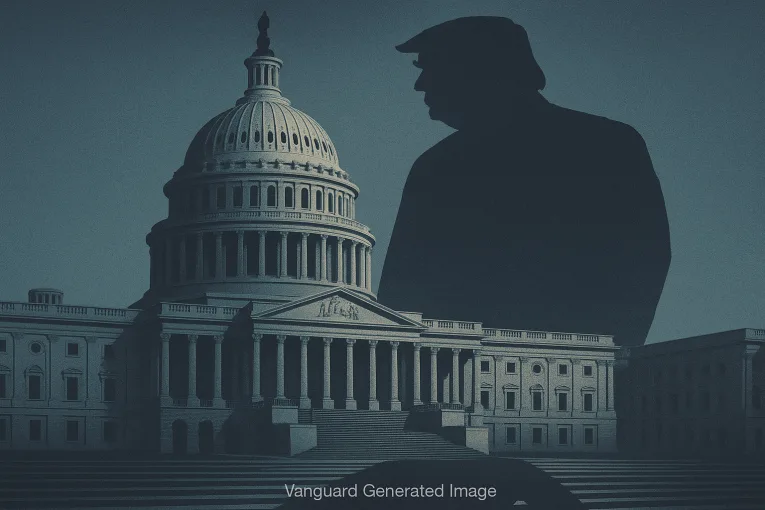
- “This shutdown feels different because it is coming amid an authoritarian takeover of the federal government. Shutting down the government does nothing to arrest that takeover and there is a real risk it will accelerate it.” – Austin Sarat
A leading legal scholar is warning that the looming government shutdown could give President Donald Trump sweeping opportunities to consolidate power and push forward what he describes as an authoritarian takeover of the federal government.
Austin Sarat, the William Nelson Cromwell Professor of Jurisprudence and Political Science at Amherst College, said shutdowns have historically been disruptive but temporary. This time, he argued, the stakes are far higher.
“This shutdown feels different because it is coming amid an authoritarian takeover of the federal government. Shutting down the government does nothing to arrest that takeover and there is a real risk it will accelerate it,” he said.
Sarat pointed to the historical record of government shutdowns in the United States. Since 1980, there have been 14 shutdowns, most of them brief. The longest came at the end of 2018 and stretched into 2019, lasting 35 days.
According to the Pew Research Center, as many as three-quarters of Americans in past shutdowns called the disruption “a bad thing,” and more than a third described it as a “crisis.”
While short shutdowns may not inflict major economic damage, experts estimate that every week a shutdown continues reduces gross domestic product growth by about 0.2 percentage points.
But Sarat emphasized that the real danger this time lies not in the economics but in the political environment.
He cited MSNBC columnist Michael Cohen, who warned in September that “a government shutdown might represent a symbolic roadblock for Trump’s increasingly authoritarian agenda, it won’t stop him.” Cohen further wrote that “a shutdown intended to stop Trump could actually give him and the GOP more power to wreak havoc with the federal government.”
Commentators across the political spectrum have voiced concern that Trump would use a shutdown to reshape government operations.
The Atlantic has suggested that a shutdown “could lead to the dramatic winnowing of its size that conservatives have sought for decades,” while PBS reported that Trump would have “enormous latitude to determine which services, programs and employees can be sidelined, decisions that could go far beyond what has occurred during past shutdowns.”
Evidence suggests the administration is already planning for such an opportunity.
The White House Office of Management and Budget has directed federal agencies to prepare “reduction-in-force plans for mass firings during a possible government shutdown, specifically targeting employees who work for programs that are not legally required to continue.” Sarat explained that such authority would enable the president to decide, unilaterally, which operations to keep open and which to halt. “He can halt government services in blue states but not in red ones in order to exact retribution from people he thinks did not, and do not, support him,” he said.
Beyond personnel decisions, Sarat warned that Trump could use the shutdown as cover to expand his reliance on emergency powers.
“Even when Trump doesn’t declare a legal emergency, he describes crises that justify dramatic action,” The New York Times reported. The paper noted that Trump invoked emergency powers more often in his first 100 days than any other modern president in the same period.
Sarat pointed to scholarship by Elizabeth Goitein, co-director of the Brennan Center for Justice’s Liberty and National Security Program, who explained that “unknown to most Americans, a parallel legal regime allows the president to sidestep many of the constraints that normally apply. The moment the president declares a ‘national emergency’ — a decision that is entirely within his discretion — more than 100 special provisions become available to him.”
According to Sarat, these powers could be applied in sweeping ways during a shutdown. Trump could suspend statutory wage-rate requirements for public contracts, override labor-management protections, or call upon the military to perform work typically carried out by civilian agencies. “A shutdown will feed that particular beast,” Sarat said.
The professor also highlighted the political irony that Senate Minority Leader Chuck Schumer once voiced similar concerns.
Last March, Schumer voted with Republicans to prevent a shutdown, warning at the time that “a shutdown would give Mr. Trump… permission to destroy vital government services at a significantly faster rate than they can right now.”
Schumer also acknowledged that, under a shutdown, “the Trump administration would have wide-ranging authority to deem whole agencies, programs, and personnel nonessential, furloughing staff members with no promise they would ever be rehired.”
Schumer noted that such decisions would effectively be left to the executive branch, with little oversight, since “the decisions about what is essential would, in practice, be largely up to the executive branch, with few left at agencies to check it.”
He added that a shutdown would be “the best distraction Donald Trump could ask for from his awful agenda. Right now, Mr. Trump owns the chaos in the government…. In a shutdown, we would be busy fighting with Republicans over which agencies to reopen and which to keep closed instead of debating the damage Mr. Trump’s agenda is causing.”
Sarat lamented that Schumer has since shifted course.
“It is too bad, in the present moment, that Schumer didn’t heed his own counsel. Little has changed since March — except that Schumer now knows that if he repeats his March performance, the political blowback would be enormous,” Sarat said.
He concluded by stressing that the fragility of American democracy makes it all the more vital to avoid the shutdown.
“Since the spring, American democracy has grown more fragile. That’s why all of our energies need to be focused on rallying to its defense,” Sarat argued. “In the end, Schumer should have supported passage of the legislation that would have kept the government open and not picked a fight that, at other times, would have been well worth fighting.”
Follow the Vanguard on Social Media – X, Instagram and Facebook. Subscribe the Vanguard News letters. To make a tax-deductible donation, please visit davisvanguard.org/donate or give directly through ActBlue. Your support will ensure that the vital work of the Vanguard continues.

If the democrats are afraid of an authoritarian takeover by Trump then why did they shut it down?
You do know it’s widely being called the “Schumer Shutdown”. Schumer took a lot of heat for not shutting down the gov’t last time. Since he’s now afraid of being primaried by AOC he’s doing all he can to appease the far left of his party.
You seem to be conflating the viewpoint of a legal scholar with that of the Dems.
David, you wrote the article. Did you forget you wrote this? Schumer is the leading voice of the Democratic Party at this point in time.
“Last March, Schumer voted with Republicans to prevent a shutdown, warning at the time that “a shutdown would give Mr. Trump… permission to destroy vital government services at a significantly faster rate than they can right now.”
Schumer also acknowledged that under a shutdown, “the Trump administration would have wide-ranging authority to deem whole agencies, programs, and personnel nonessential, furloughing staff members with no promise they would ever be rehired.”
Schumer noted that such decisions would effectively be left to the executive branch, with little oversight, since “the decisions about what is essential would, in practice, be largely up to the executive branch, with few left at agencies to check it.”
He added that a shutdown would be “the best distraction Donald Trump could ask for from his awful agenda. Right now, Mr. Trump owns the chaos in the government…. In a shutdown, we would be busy fighting with Republicans over which agencies to reopen and which to keep closed instead of debating the damage Mr. Trump’s agenda is causing.”
It’s an article, it’s not an opinion piece. But it’s based on Sarat’s opinion. He is not writing on behalf of the Democrats and neither am I. There is a clear divergence in Schumer based on criticism received in March. But the Republicans don’t need Schumer or the Democrats, they have the votes to continue the government with zero help from the Democrats.
Then let’s talk about Austin Sarat in order to get an idea of where his views are coming from. According to AI he’s hardly unbiased:
“Professor Austin Sarat, a political science and law professor at Amherst College, is a frequent opinion writer whose recent columns often criticize the rhetoric and actions of former President Donald Trump and other prominent Republicans. His articles and analyses frequently align with Democratic Party stances on issues related to authoritarianism, voting rights, and judicial nominations.”
“While no source explicitly calls Sarat a Democrat, his consistently critical stance toward the Republican Party and his alignment with key Democratic talking points on issues such as election legitimacy, abortion rights, and authoritarianism strongly suggest a left-leaning political perspective.”
You needed AI to figure out he’s probably on the left? What’s your point? That doesn’t mean he agrees with Schumer or speaks for the Democratic Party. Neither do I.
The implication of this analysis is that Democrats voting for a continuing resolution would somehow prevent an ‘authoritarian takeover’ and there is no evidence of that.
You could be right. Personally I have no faith in any one in a leadership position to know how to navigate this.
“The implication of this analysis is that Democrats voting for a continuing resolution would somehow prevent an ‘authoritarian takeover’ and there is no evidence of that.”
There’s no ‘authoritarian takeover’ in the first place.
Democrats are getting blamed for the shutdown. Here’s Schumer getting laughed at for calling the NY Times biased for a poll which pointed this out.
https://www.youtube.com/shorts/Ve1n0sPwWEo
What is the “government shutdown” that you speak of? Haven’t noticed any change, in regard to my own life.
But have they “closed the outdoors” yet again (federal lands) as a result? (That action alone takes personnel to accomplish.)
:-)
Ron, thanks for reminding me of that, Yes Obama closed all national parks, monuments, recreation areas, historic sites, and battlefields to the public in 2013 in order to put more pressure Republicans to fund his agenda.