
- Even among Republicans, concern is growing. A New York Times-Siena College poll found that 54% of registered voters — including almost one in five Republicans — believe Trump is “exceeding the powers available to him.”
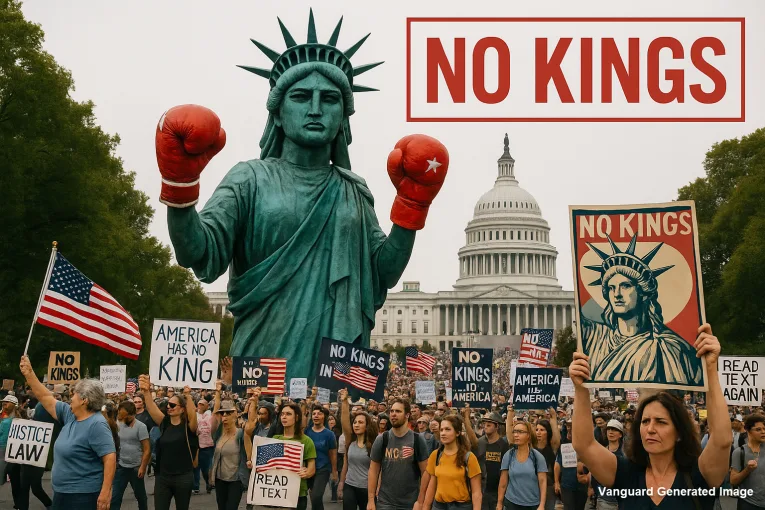
Republicans have spent the past week ridiculing the massive “No Kings” rallies that filled streets across the country, portraying them as radical, anti-American, and unnecessary. President Donald Trump’s allies argued that the protesters were extremists, even predicting violence that never occurred.
Trump himself dismissed the crowds, saying they were “not representative of this country,” and posted mocking memes and AI-generated videos that showed him wearing a crown and dumping waste on demonstrators.
House Speaker Mike Johnson echoed that line Monday night on Fox News, claiming that the protesters’ message was “completely the opposite of what America was founded upon.”
But new data suggest that the message behind the “No Kings” movement — a warning about the dangers of unchecked executive power — resonates far more deeply with the public than Trump and his allies acknowledge.
A new survey from the Public Religion Research Institute (PRRI) shows a clear majority of Americans believe Trump poses a serious threat to democracy.
Respondents were asked to choose between two statements: that Trump is a “potentially dangerous dictator whose power should be limited before he destroys democracy,” or that he is a “strong leader who should be given the power he needs to restore America’s greatness.”
Americans chose the “dictator” description by a wide 56% to 41% margin.
That margin has nearly doubled since April, when a similar PRRI survey found Americans split 52% to 44% between those two views.
The new poll also found that 54% of Americans agree that Trump is waging “an assault on constitutional balances and the rule of law,” compared with 43% who see his overhaul of government as “a long-overdue correction of disastrous policies.”
Nearly half of independents strongly agreed that Trump is a dangerous dictator and that he is undermining the separation of powers that anchors the Constitution.
Even allowing for the limitations of binary survey questions, the depth of conviction is striking. Forty-five percent of Americans said they “strongly” agree that Trump is a dangerous dictator, and 43% “strongly” agree he is assaulting checks and balances.
That kind of intensity is rare in modern polling, especially on questions of democratic norms.
Other surveys have found similar patterns.
A July CNN poll found that 56% of Americans believe Trump had gone “too far” in using presidential power, up from 52% earlier this year. An April AP-NORC poll produced nearly identical results, with 57% saying Trump had gone “too far” in using his power to achieve his goals.
A September Washington Post-Ipsos survey found that 62% of respondents believe Trump exceeded his authority as president.
Another poll from the Pew Research Center that same month reported that 69% of Americans believe Trump exercises more presidential power than other recent presidents — and nearly half said that was “bad for the country.”
Even among Republicans, concern is growing.
A New York Times-Siena College poll found that 54% of registered voters — including almost one in five Republicans — believe Trump is “exceeding the powers available to him.”
Despite this mounting evidence of public unease, conservatives have largely dismissed the symbolism of “No Kings.”
“I don’t understand how Trump is a King when he won every single swing state, the electoral college and popular vote in a democratic election,” Meghan McCain wrote on X.
Fox News analyst Brit Hume added, “Some King,” noting that Congress has approved at least some of Trump’s policies.
Yet the point of the protests was never that Trump is literally a monarch. It is that he seeks to rule like one — bypassing Congress, defying the courts, and framing loyalty to himself as loyalty to the nation.
The danger many see in Trump’s behavior mirrors what scholars and journalists have long identified as the logic of kleptocracy — the hollowing out of institutions to serve the personal power and enrichment of those at the top.
As Kleptopia author Tom Burgis described, modern autocrats fuse state machinery with private networks of wealth and loyalty, transforming law enforcement, media, and the judiciary into tools of personal rule. Trump’s repeated efforts to weaponize the Justice Department, purge career civil servants, and funnel contracts and influence to political allies fit that pattern.
This is not kleptocracy in the crude, cash-grab sense of the 1990s oligarchs. It’s a subtler, more insidious capture of the democratic apparatus itself — a model in which public office becomes a mechanism of personal protection and retaliation.
The “No Kings” rallies, at their core, are about resisting that conversion of democracy into a protection racket. Protesters are warning that when a leader identifies himself as the nation and defines dissent as disloyalty, corruption becomes indistinguishable from governance.
The “No Kings” message emerged as a direct response to a pattern of executive overreach that many Americans believe has reached a breaking point.
Before Trump’s second term began, polling already showed deep public skepticism about his intentions.
In December, a Washington Post-University of Maryland survey found Americans evenly split on whether Trump would “try to rule as a dictator,” with 40% predicting he would and 41% disagreeing. Another December Reuters-Ipsos poll found that 53% believed it was at least “somewhat likely” Trump would act as a dictator.
By the time Trump took office again, those fears had grown.
A Quinnipiac University poll found 53% of voters were concerned about Trump’s 2023 statement — which he later said was a joke — that he wanted to be “a dictator for a day.” And an October 2024 ABC News-Ipsos poll found that 49% of voters described Trump as a “fascist.”
Those numbers contrast sharply with public perceptions of other presidents.
In the same ABC-Ipsos poll, only about two in 10 voters called Kamala Harris a fascist — less than half of Trump’s number. A Washington Post-Ipsos survey also showed that just 34% of Americans thought President Joe Biden had exceeded his constitutional authority, compared with 62% for Trump.
Perhaps most revealing is how Americans’ overall view of presidential power has shifted since Trump returned to office. In an April AP-NORC survey, 54% of Americans said the presidency now holds “too much power,” up from 32% last year, when Biden was still in office. That dramatic increase underscores the public’s growing anxiety about authoritarian drift.
The broader political context also matters.
The “No Kings” movement gained momentum after Trump’s administration expanded its use of the National Guard in major cities, targeted journalists under new federal speech laws, and overrode state policies on immigration enforcement — all actions that have alarmed civil libertarians and constitutional scholars.
At the rallies, protesters carried signs reading “Power Belongs to the People” and “No One Above the Law.” The slogan “No Kings” captures a sentiment as old as the American Revolution: a rejection of concentrated, unaccountable power.
For many demonstrators, it was not just a political statement but a moral one — a reaffirmation of the belief that democracy depends on limits.
Republican leaders, meanwhile, have sought to turn the protests into a culture-war spectacle, framing them as anti-Trump hysteria. But the data suggest otherwise.
Across poll after poll, the majority of Americans — Democrats, Independents, and a significant minority of Republicans — express concern that Trump’s consolidation of power poses an existential threat to democratic institutions.
The debate over labels — whether “king,” “dictator,” or “fascist” — may be semantic. The underlying anxiety is clear: the sense that one man, elected or not, is placing himself above the laws and limits that define the republic.
Republicans may continue to laugh off the “No Kings” rallies as political theater. But the numbers tell a different story. They reveal a country alarmed by the prospect of absolute power — and a public increasingly united around the idea that America, at its core, was never meant to have a king.
Follow the Vanguard on Social Media – X, Instagram and Facebook. Subscribe the Vanguard News letters. To make a tax-deductible donation, please visit davisvanguard.org/donate or give directly through ActBlue. Your support will ensure that the vital work of the Vanguard continues.

“The danger many see in Trump’s behavior mirrors what scholars and journalists have long identified as the logic of kleptocracy — the hollowing out of institutions to serve the personal power and enrichment of those at the top.”
I know this is your new toy that you’ve been trying to push but that dog don’t bark.
The term has been around for at least a decade in terms of modern construction around regimes like Putin’s
It’s barking so loud I can’t get back to sleep and now I’m really woke up.
“A new survey from the Public Religion Research Institute (PRRI)”
Who?
“Respondents were asked to choose between two statements: that Trump is a “potentially dangerous dictator whose power should be limited before he destroys democracy,” or that he is a “strong leader who should be given the power he needs to restore America’s greatness.”
What a BS poll? So if one thinks Trump is maybe slightly overstepping his powers it classifies him a dictator even though the respondent might not feel that way. No subtleties whatsoever, it’s either or. That’s why these cherrypicked polls are useless.
“Slightly” overstepping legal boundaries so badly and obviously that his own appointed judge in Portland says his attempt at using the military is not legal. ‘He is a convicted felon, so why are we surprised?’ is the only answer that makes sense to me.