
by Seth Sandronsky
Trade policy isn’t sexy, but it is weighty, economically speaking. Jobs and wage-income are at stake. Take President Trump’s trade policy, notably his fondness for tariffs, a tax on U.S. imports that businesses and workers pay.
We begin with the Trump administration’s decision to provide a $20 billion “swap line” (currency exchanges between central banks) with the government of Argentina. Treasury Secretary Scott Bessent is the point man for the White House on this financial and political issue. Behind Bessent is a Wall Street hedge fund manager, Rob Citrone, a major foreign investor in Argentina, CNN is reporting.
The Latin American country is in financial distress over its issuance of foreign bonds since President Javier Milei slashed public spending to spur economic growth. Such economic policy goes by the name of austerity.
However, Milei’s so-called pro-growth approach has had the opposite effect. Hunger and poverty among the Argentine working class are up. Workers’ household income is down.
“Argentina’s poverty rate has soared to almost 53% in the first six months of Javier Milei’s presidency,” reports The Guardian, “offering the first hard evidence of how the far-right libertarian’s tough austerity measures are hitting the population.”
What in part preceded such measures slamming the Argentine people was inflation, a general rise in prices.
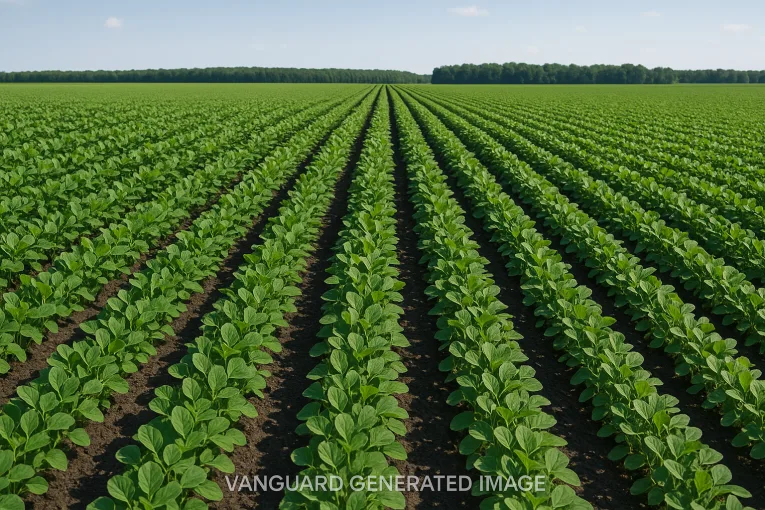
In the meantime, the Milei government cut the export tax on soybeans. Chinese buyers jumped at this opportunity, reportedly purchasing some 20 shiploads of soybeans from Argentina.
That tax holiday cut revenue to the Argentine government, and created the trade conditions for lower export prices for foreign buyers. That arrangement didn’t fix the tax revenue problem for the Argentine government, however.
Meanwhile, American Soybean Association (ASA) President Caleb Ragland shared this statement on some impacts of Trump’s trade policy of tit-for-tat tariffs between the world’s two biggest economies.
“U.S. soybean farmers have been clear for months: the administration needs to secure a trade deal with China. China is the world’s largest soybean customer and typically our top export market. The U.S. has made zero sales to China in this new crop marketing year due to 20% retaliatory tariffs imposed by China in response to U.S. tariffs. This has allowed other exporters, Brazil and now Argentina, to capture our market at the direct expense of U.S. farmers.”
According to Politico, the use of tariffs in China-U.S. trade is having far-reaching effects on American agriculture generally. “The 20 percent retaliatory tariff that Beijing has imposed on U.S. imports hasn’t just pounded soybean producers. All agriculture exports to China were down 53 percent in the first seven months of 2025, compared with the same period last year, according to USDA data.”
Ragland, head of the ASA, continues his criticism of Trump’s trade policy on American soybean farmers. “The frustration is overwhelming. U.S. soybean prices are falling, harvest is underway, and farmers read headlines not about securing a trade agreement with China, but that the U.S. government is extending $20 billion in economic support to Argentina while that country drops its soybean export taxes to sell 20 shiploads of Argentine soybeans to China in just two days.
“ASA is calling on President Trump and his negotiating team to prioritize securing an immediate deal on soybeans with China. The farm economy is suffering while our competitors supplant the United States in the biggest soybean import market in the world.”
What will the White House do to relieve the pain from the decline of demand from China for American agricultural products? Well, the president is considering a $10-$15 billion bailout for agriculture commodity producers.
Wait. There is a federal government shutdown. In other words, the allocation and distribution of a federal bailout for farmers experiencing a shortage of buyers from China will have to wait for the government shutdown to end. Your guess is as good as mine when that happens.
Such contradictions of economics and politics drive history, according to Marx. The federal government shutdown over health care spending while U.S. Border Patrol agents and National Guard troops deploy on the streets of American cities for reason of so-called public safety are two cases in point. Trade policy that harms domestic agriculture generally and soybean growers particularly is another.
###
Seth Sandronsky is a Sacramento journalist and member of the freelancers unit of the Pacific Media Workers Guild. Email sethsandronsky@gmail.com

This article cites a poverty statistic from the first six months of Milei’s presidency which are outdated. A quick google search would provide more current data. The next six months of Milei’s presidency after his policies were enacted saw poverty fall by 14.8 percentage points to 38.1% at the end of 2024. This is largely due to the substantial reduction in inflation that was achieved by reducing fiscal expenditures. Link to the AP article reporting this found here: https://apnews.com/article/argentina-economy-poverty-milei-austerity-inflation-061bbba174706475a255c6b871953009
This is basic monetary theory that is once again being demonstrated via real world policy. So, no, austerity is not the cause of the run on the peso. The recent elections in Buenos Aires which saw the socialists overperform sparked fears that Milei’s legislative program of fiscal responsibility would be reversed back to the profligate ways of the Kirchnerites. This lead to a devaluation of the peso which had stabilized to a band of values after Milei allowed it to float freely. This was a titanic change from the old policy regime which maintained a government mandated official exchange rate which diverged wildly from the market pricing. It is hard to overstate how dysfunctional monetary and fiscal policy have been in Argentina under the socialists. For those even vaguely aware of Argentinian economic performance in the last ten years, they will be aware of the runaway inflation which soared from the crippling baseline inflation levels post the 2001 default.
The successive leftist governments since the fall of the junta have utterly mismanaged monetary and fiscal policy in Argentina which has lead to default and some of the world’s highest levels of inflation. Inflation is always and everywhere a monetary phenomenon which goes in tandem with unsustainable fiscal spending. As someone who has visited Argentina several times, has close Argentinian friends, and who is a descendant of an Argentinian immigrant, it is again hard to overemphasize how debilitating the actual reality the unchecked inflation has had on Argentinian society. It is impossible to make any plans for the future; forming expectations about price levels for investment theses is a fool’s errand. The result is a society that can place no faith in the value of their currency. This has been exacerbated by the economically irrational policies of the socialists to maintain an official exchange rate that is completely divorced from market rates. This inevitably created a black market for pesos and has pushed Argentinians to adopt cryptocurrencies given the utter lack of faith one can have in the peso. This comes with its own set of problems but illustrates just how dysfunctional the previous monetary regime was when Bitcoin is a better currency alternative than fiat currency.
After nearly a century of economic mismanagement, Argentina finally has the opportunity to start building back towards economic normalcy. Expectations that it will be swift or painless are facile at best. Excising the rot and out of control fiscal spending and monetary dysfunction will take time to settle into a new equilibrium. The potential threat of continued economic chaos that is presented by the potential return of the socialists is paralyzing and destabilizing. How can any firm or individual make long range investment decisions when the specter of 200%+ inflation remains looming? Ultimately, the best hedge against this chaos is to dollarize the economy to take monetary decisions out of the hands of a central bank that was co-opted by the socialists. In order to achieve this goal or even the more modest goal of maintaining a stable exchange rate for a floating peso, it is necessary for Argentina to have sufficient foreign reserves of dollars which are the preferred foreign currency of choice by Argentinians.
Tariffs are an entirely different matter altogether. US soybean farmers are suffering because of economically ignorant policymaking that has lead to predictable retaliatory measures. China shifting their supply chains to Argentina and other soybean producers is the result of imprudent ad hoc policy making by economic neophytes in the current US adminstration. Argentina reducing export taxes produces a more efficient allocation of resources. This is something all countries should do. All taxes are distortionary. Reducing them creates greater efficiency. I would suggest anyone interested consult David Ricardo as this is something economists have known for more than two centuries. The US allowing for dollar exchanges has very little to do with Chinese soybean purchases. Conflating the two does not make sense. If one wishes to criticize tariffs, then criticize tariffs. A stable peso has very little relation to the US-China trade war.