
- “Without facts, you can’t have truth. Without truth, you can’t have trust. Without all three, we have no shared reality, and democracy as we know it… is dead.” – Maria Ressa
Maria Ressa has a chilling way of describing the world we now live in. She argues that an “invisible atom bomb” has exploded in our information ecosystem, that technology platforms have infected us with a “virus of lies,” and that “without facts, you can’t have truth. Without truth, you can’t have trust. Without all three, we have no shared reality, and democracy as we know it… is dead.”
That sounds abstract until you remember what our politics, our feeds and even our local conversations look like right now. The crisis she’s describing is not just about national elections in the Philippines, the United States or Hungary. It’s about Davis, Yolo County and every small community that now has its public square filtered through a handful of opaque, unaccountable platforms.
Maria Ressa is a Filipino American journalist and the co-founder and CEO of Rappler, an independent digital news outlet in the Philippines that has investigated Rodrigo Duterte’s drug war, government corruption, and online disinformation.
A former CNN bureau chief and head of news at ABS-CBN, she became a global symbol of press freedom after the Duterte administration responded to Rappler’s reporting with a barrage of criminal cases widely seen as politically motivated.
In 2021 she was awarded the Nobel Peace Prize, alongside Russian editor Dmitry Muratov, for “efforts to safeguard freedom of expression,” and her work now sits at the intersection of investigative journalism, human rights, and the fight against Big Tech–driven authoritarianism.
Ressa’s story is rooted in journalism, but the real subject of her book is power. She shows how Facebook’s “friends of friends” architecture, built to maximize time on site and advertising revenue, rewards anger, fear and outrage; how politicians and political marketers learn to game that system; and how lies—if repeated often enough and never corrected—become the new common sense.
It is not an accident that white replacement theory is now a mainstream talking point, or that a sizable share of Americans still believe Donald Trump won the 2020 election. It is not an accident that authoritarian leaders from Duterte to Modi to Bolsonaro found, in Facebook and YouTube, a ready-made infrastructure for propaganda. Algorithms that “serve up content that radicalizes us” are not a side effect; they are baked into the business model.
Ressa’s indictment of Big Tech is thorough. She shows that Facebook knew its recommendation systems were driving people into extremist groups—that in Germany, “64% of all extremist group joins are due to our recommendation tools”—and chose not to fundamentally change course. She documents how the company repeatedly prioritized political relationships and profits over democratic stability. “Violence,” she writes, “has made Facebook rich.”
But the book is not just an autopsy of platform failure. It’s also a handbook for what we can do. And this is where community journalism comes in.
Long before Rappler became a global symbol of press freedom, Ressa was building citizen journalism networks in the Philippines—embedding ordinary people in local institutions, training them to document what was happening around them, and then weaving those stories together into a larger national narrative. The Maguindanao massacre—where 58 people, including 32 journalists, were murdered in 2009—became a turning point. Citizen journalists on the ground helped expose the brutality and impunity that traditional power structures wanted to keep hidden.
For Ressa, citizen journalism is not just a cost-saving measure or a clever engagement strategy. It is “rooted in an individual battle for integrity: How far will you go to correct what you perceive to be wrong? Or evil?” It is a moral and civic practice as much as a journalistic one.
She keeps coming back to a few core ideas. Meaning is something you build through the choices you make. Courage is choosing to face your fear rather than run from it. “Staying silent or compliant changed nothing. Speaking up was an act of creation.” “All it takes is one person to stand up and fight, because a bully doesn’t like to be challenged publicly.”
And in an age when bad actors use armies of trolls, bot networks and fake accounts to overwhelm the truth, she returns to a simple rule: “Don’t become a monster to fight a monster.” She refuses to respond to disinformation by adopting the same tactics—fake accounts, coordinated harassment, deceptive memes—even when those tactics “work.” Instead, she calls for “communities of action” built around evidence, integrity and shared values.
By the end of the book, she distills her strategy into three pillars: demand accountability from technology, protect and grow investigative journalism, and build communities of action that can resist and repair the damage.
The Davis Vanguard cannot fix the global tech business model. We are not going to single-handedly force Meta or X to abandon surveillance advertising or redesign their recommender systems. But we can do a great deal in the second and third pillars.
We can protect and grow independent, evidence-based journalism rooted in local reality. We can train more people to think like reporters—skeptical, fact-driven, aware of bias and propaganda. We can create community structures that make it harder for lies to take hold because people have firsthand knowledge of what is actually happening.
That’s what community journalism is at its best: not just a newspaper or a website, but a network of people who refuse to outsource their understanding of the world to an algorithm. People who show up to the city council meeting, the court hearing, the school boundary forum and the homeless services discussion, and then share what they saw with their neighbors.
We already see, in miniature, what Ressa describes. Every big local story now has two lives: the one that unfolds in public meetings and documents, and the one that unfolds in comment threads and group chats, where rumors, bad-faith narratives and out-of-context clips spread quickly.
If we are serious about resisting authoritarianism and disinformation at the national level, we have to get serious about building resilient information ecosystems at the local level. That means we cannot afford to have only a handful of people covering critical beats like housing, schools, policing, immigration, homelessness and the courts.
Ressa warns that “silence is consent.” If we let the loudest, angriest voices online define reality—whether they are pushing conspiracy theories about elections or weaponizing fear about homelessness and crime—then we are ceding the public square to precisely the forces she has spent her life fighting.
The alternative is messy and demanding, but it is within reach: a community where many more people see themselves as co-creators of the news, not passive consumers of content. Where neighborhoods, congregations, student groups, civic organizations and everyday residents take on small pieces of the reporting work. Where we build our own “#FactsFirst” pyramid from the ground up—data, documents, eyewitness accounts, analysis—and then share it in ways that strengthen, rather than fragment, our shared reality.
Ressa likes to say that you always have the choice to be who you are. In a time when “anger and hate are literally shaping who we will become as a people,” that choice is not abstract. It shows up in whether we forward a rumor or ask where it came from. Whether we retreat into cynicism or decide to tell the truth about what we see. Whether we scroll ourselves into despair or step into community and take responsibility for the story of this place.
Community journalism is not a luxury anymore. It is a survival tool for democracy.
A Pitch to Local Writers and Community Reporters
If any of this resonates with you, consider this an invitation.
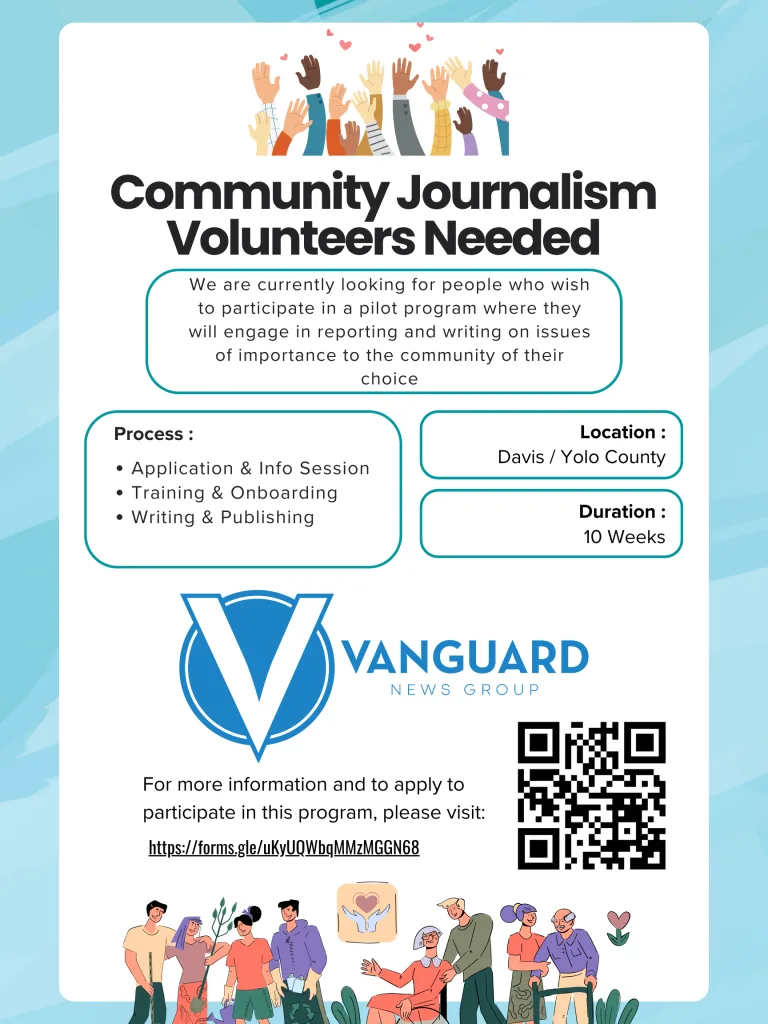
The Vanguard is launching an expanded community journalism project, and we are looking for people who want to help tell the truth about Davis, Yolo County and the region—carefully, honestly and with a sense of responsibility to our neighbors.
You do not need a journalism degree. You do not need to write like a New York Times columnist. You do need curiosity, integrity and a willingness to learn.
Maybe you already go to school board meetings and come home fuming that no one outside the room really understands what just happened. Maybe you are following housing debates and feel like the loudest voices are drowning out the facts. Maybe you are a student watching your friends struggle with rent, a parent trying to navigate special education, a worker seeing firsthand what “essential” means when paychecks don’t match the rhetoric.
Those are exactly the vantage points we need.
Here is what we want to build, drawing directly from Ressa’s vision:
– A network of community correspondents who regularly cover specific beats: city council, DJUSD, housing and land use, courts and jails, homeless services, immigrant communities, climate and environmental justice.
– A training pipeline—especially for young people, women, people of color and currently and formerly incarcerated people—that teaches the basics of reporting, verification, ethics and digital safety.
– A set of collaborative projects where residents, data folks and writers work together to investigate big questions: How is public money being spent? Who is being left out of local decision-making? Where are our systems failing, and where are they working?
We are especially interested in people who:
• Are willing to attend public meetings regularly and write up what happened in clear, accessible language.
• Want to learn how to request and interpret public records.
• Care about making sure underrepresented communities are heard.
• Understand that good journalism is not “both-sides-ism” but a commitment to evidence over spin.
In Ressa’s terms, we are trying to “build communities of action.” Not just an audience, but a mesh of people who care enough about this place to hold power to account and to tell the truth, even when it is uncomfortable.
If you’ve ever thought, “Someone should really cover this,” that someone might be you.
If you are interested in writing, reporting, taking notes at meetings, doing research behind the scenes or helping mentor younger aspiring journalists, reach out. Tell us a little about yourself, what you care about and what kind of work you might like to do.
We cannot control the algorithms in Menlo Park. But we can decide, here, that we will not let them have the last word on who we are.

“We can train more people to think like reporters—skeptical, fact-driven, aware of bias and propaganda.”
I hope they’re also trained to be aware of their own bias. To report on stories that might not fit their narrative or agenda. That’s something that I often find lacking on the Vanguard.
“You do not need to write like a New York Times columnist.”
Well that’s a good start being that The NY Times is hardly unbiased.
“Maybe you already go to school board meetings and come home fuming that no one outside the room really understands what just happened.”
For instance when a parent comes home fuming because of rulings that allow boys to invade girl’s spaces like restrooms, locker rooms and sports?
“We cannot control the algorithms in Menlo Park”
But can they use AI? Does the Vanguard use AI? AI has shown to be left leaning biased.
“Understand that good journalism is not “both-sides-ism” but a commitment to evidence over spin.”
So I’m not understanding this, does the Vanguard only want one side? Let me guess, the side that leans left? If one points out that something nefarious is taking place never mind that the other side is doing or has done the same thing?
“A training pipeline—especially for young people, women, people of color and currently and formerly incarcerated people”
So being an older white man that’s never been incarcerated does that leave me out?
BTW, what’s the pay?
Let me know if you want to do it – it’s a volunteer thing
Sorry, but I don’t work for free.
Keith O
First, there’s no such thing as “unbiased”–that is a demand for an impossible human trait. We all come with our own unique experiences and our own sets of ethics and morality. If a reporter finds that what someone says is not factually true or morally repugnant, the reporter is not obligated to write about it. That you disagree with that stance, then that is a problem that undermines our democracy–spreading disinformation that has no factual basis and undermining the ethics that protect our freedoms is what authoritarians want.
That mainstream journalists have overlooked certain storylines because they run counter to their own biases is problematic, but often those storylines don’t have the factual basis that others complain about. There are no “Jewish space lasers” that set of wildfires. Bring forward a cohesive set of facts, not just speculation, so we can have a wider discussion. And acknowledge the validity of the facts that have been presented, or directly refute them.
It’s sad if you only engage in financially-transactive work. Volunteers are what make our community and society go. I find that work the most satisfying that I do here.
Ironically he wants unbiased but not willing to do his part.
LOL, I’m not working for you for free.
Your choice
BTW, you already have a 401k and a Keurig, what you don’t have is a chance to report on things in your community.
Honestly, the commenters on here are already doing the job of actual journalists – at no charge.
They aren’t, just don’t have the time to engage you guys as much right now.
There’s only a few of us, at this point.
I noted an outright, significant error from you yesterday, which you didn’t respond to. Took me all of 5 minutes to find it and post it. (Granted, you did post my comment noting the error, but didn’t respond.)
Sincerely,
“Ron Factchecker”
I didn’t consider that an error, but didn’t have time to engage on it. So I left it at that.
You literally misquoted and changed the question asked of voters in regard to the UC Irvine study, to suit your advocacy.
If that’s not an error, something more serious is going on with your reporting.
In the future, it would be helpful if you actually provided a link to what you claim. (I’ve brought this up previously.)
Ron O: “I noted an outright, significant error from you yesterday, which you didn’t respond to.”
Does this mean that you’re responding to the invitation to volunteer for the Vanguard?
Hiram: As I noted, I’m already volunteering for the Vanguard – partly as a “fact-checker”.
So when David, for example, claims that a survey shows that voters are concerned about a housing “shortage”, when that word wasn’t even used in the question posed to potential respondents, I’m already providing a service by pointing that out.
“BTW, you already have a 401k and a Keurig, what you don’t have is a chance to report on things in your community.”
I don’t understand what my 401K and a Kuerig has to do with this? What, are you jealous because they don’t they give you coffee in the Gulag that you fully expect Trump to put you in?
“So when David, for example, claims that a survey shows that voters are concerned about a housing “shortage”, when that word wasn’t even used in the question posed to potential respondents, I’m already providing a service by pointing that out.”
Yes Ron, you provided a good service there. Because remember “Without facts, you can’t have truth. Without truth, you can’t have trust.”
DG: “Understand that good journalism is not “both-sides-ism” but a commitment to evidence over spin.”
KO: “So I’m not understanding this, does the Vanguard only want one side? Let me guess, the side that leans left?”
Sound like the Vanguard may subscribe to the belief system of Katherine Maher, head of NPR: “Our reverence for the truth might be a distraction that is getting in the way of finding common ground & getting things done.”
David
I hope that you have some degree of editorial oversight to ensure that the journalists have factual bases for their reporting. The reason why the NY Times is credible because it extensively fact checks its writing and admits when its wrong (which WILL happen because we are all human–even AI makes up “facts” up to 47% of the time!).
Yes, that would be me doing the editing to the best of my ability.