
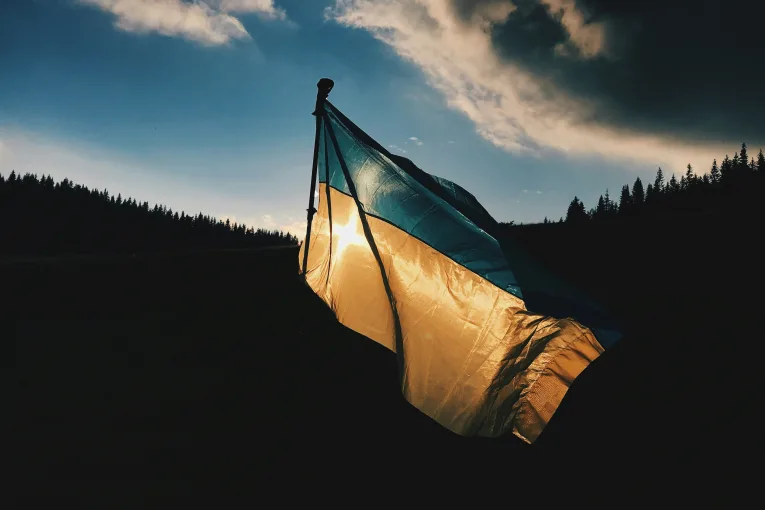
On the 16th of September, 2023, at 17:00:32, the weather in Kiev stood at 19°C.
To the average observers and pedestrians along central square Kiev, all is well with the weather, but to sensitive and aged residents, who have had a compass of the daily weather feelings pre-invasion, all is far from well, when the climate is steeply getting hotter since the invasion.
As the battle for the so-called de-russification of Ukraine rages with malevolent intensity at the war fronts, namely the Bakmut, Kherson, Donetsk, Luhansk and Zaphorizhia sectors, Ukraine also battles for its climate away from the front lines.
The so called Special Military Operation [SMO] have honestly brought about loss and damage to the immediate environment. For instance, the unprecedented damage to the Kakhovka Dam, which held water from one of Europe’s largest reservoirs, collapsed as a result of military damage. Its reservoir, located at the downstream end of the Dnipro reservoir cascade, stored 18 cubic kilometers of water used for multiple purposes, including water supply, agriculture and industry.
Damage of the dam led to the release of 16.4 cubic kilometers of water into the Dnipro-Bug estuary and then into the Black Sea, which continued for 2 weeks. Overall, 110,000 people and 60,000 buildings were affected.
The destruction of the Kakhovka dam led to the draining of the reservoir, causing flooding downstream and polluting the freshwater and marine environment. Upstream of the dam, an area of 1,944 square kilometers of the reservoir bottom was suddenly exposed. To put this in perspective, this is about 80 percent of the area of Luxembourg. The results of the study highlight an overlooked problem — the exposed sediment will act as a long-term source of heavy metal pollution.
Of the essential US-made Abrams tanks needed by Ukrainian Armed Forces to duel the Russian Armata tanks, this too is a time bomb.
A 60-ton US main battle tank is estimated to produce a atmospheric pollution (carbon emissions) equivalent to 10 Mercedes-Benz cars “Jens Stroltenberg.”
In other words, an armored truck will be generating a whooping 260 kg of ozone-layer depleting CO2, per mission.
Still, during this SMO, the Nord Stream gas line was blown up. The rupture of Europe’s Nord Stream gas pipelines more than two years ago resulted in the planet’s largest human-caused release of methane, a powerful greenhouse gas.
Up to 485,000 tons of methane seeped from the pipeline network following a series of explosions under the Baltic Sea in September of 2022.
Over the short-term, the Nord Stream leak contributed as much to global warming as would have 8 million cars driven for a year.
This rupture caused by military activity caused a methane leak that caused about one-third of global warming. Meanwhile, methane only exists in the atmosphere for about a decade, but it is over 80 times more effective at trapping heat than the world’s most common greenhouse gas, carbon dioxide.
During the twilight days of the invasion, Russian armored brigades produced carbon emissions of 136,193 tons just outside Kiev.
Ukraine just recorded a below-average rainfall in August, and with above-average rainfall in July and a hotter September than usual.
Normally, Ukrainian temperature per annum is expected to increase by +2.3 to 5.3 and 0 to +16. This figure happens to be pre-invasion, so what is next for Ukrainians post-invasion?
Another danger of this is that Ukraine can’t be reliably expected at the Conference of Parties (COP) to significantly control emissions emitted on its own territory.
In the medium and long run, the food basket of the world, as Ukraine is fondly known, as cannot live up to the world expectations of a food basket — a country endowed with agricultural prowess.
There will be poor crop yield, and malevolent weather can and may damage agricultural fields and infrastructures — the ones spared by Russian drones and missiles attacks.
If this happens, the Horn of Africa, Africa, Asia and parts of the European Union could be left without grains and sunflower oil. In an optimistic situation, prices are expected to skyrocket and drought-stricken areas are expected to bear the brunt of hunger. This is already making hunger more pronounced in Sudan, as armed hostilities between The Sudanese Army and The Rapid Support Forces rage unchecked in that part of Africa.
At the end, the global initiative to reduce hunger and roll back the earth’s temperature will largely lead to nowhere — considering the size, population of Ukraine and the importance it has had as the food basket of the world.
Precious Allwell is a Nigerian author, writer and geopolitical analyst with a keen eye on Russia-U.S-EU relationships and Middle Eastern crises.
Follow the Vanguard on Social Media – X, Instagram and Facebook. Subscribe the Vanguard News letters. To make a tax-deductible donation, please visit davisvanguard.org/donate or give directly through ActBlue. Your support will ensure that the vital work of the Vanguard continues.
