
A recent Los Angeles Times opinion piece written by Chris Elmendorf, a professor of law at UC Davis, and Harvard economist Ed Glaeser argues that California must decide whether large-scale experimental housing developments such as California Forever should move forward under reformed statewide approval processes.
The authors frame the proposal not simply as a housing project, but as a test of California’s willingness to overcome regulatory delays, overlapping jurisdictions and local political veto points that have stalled large-scale development throughout the state.
California Forever began with a series of land purchases starting in 2017, when Jan Sramek and his affiliated entity Flannery Associates began buying farmland in Solano County. Over several years, the company assembled more than 50,000 acres of land near Travis Air Force Base and between existing communities. The project’s long-term vision includes a walkable, dense city built from scratch, housing up to 400,000 residents.
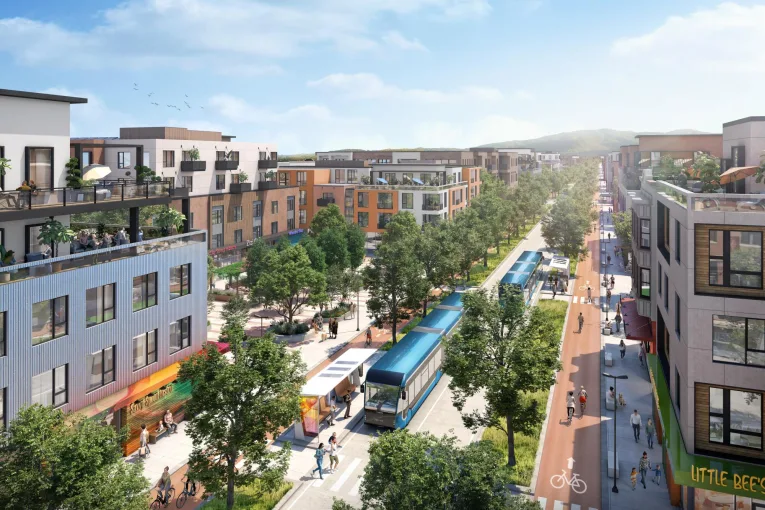
Concept drawings show dense neighborhoods designed with row houses, multifamily housing, greenways, transit corridors and grid-style streets. The plan includes a manufacturing hub and commercial districts alongside residential zones. The proposal describes a community built around transit, walkability and sustainability rather than traditional car-dependent suburban development.
Elmendorf and Glaeser argue that California Forever represents an attempt to apply decades of urban economics research in real time.
They write that dense cities provide economic benefits through what economists call agglomeration, a phenomenon in which proximity among people, jobs and services increases innovation, productivity and opportunity. They note that traditional development markets underproduce dense housing because individual developers only capture revenue generated by their own buildings rather than the broader economic gains density creates.
In contrast, they write that California Forever’s control of residential, industrial and commercial areas gives its investors incentives to support dense construction, infrastructure and public services because the long-term value of the development depends on those conditions.
According to the authors, the main obstacle is not economic feasibility but the structure of California’s housing approval system. Under existing rules, the project must secure approval from Solano County, the city of Suisun and multiple state agencies.
Each approval triggers review under the California Environmental Quality Act, exposing the project to potential legal challenges and delays.
Elmendorf and Glaeser highlight that a single county supervisor has already told project leaders, “Go somewhere else.”
Under local governance rules, support from only two additional supervisors could effectively halt the proposal.
The authors write that California has passed hundreds of housing bills intended to address the statewide shortage, but local governments retain the authority to block projects.
They argue that a single jurisdiction should not have veto power over development intended to address regional or statewide needs.
To address the issue, they propose a permitting system similar to the existing framework used for large-scale clean-energy infrastructure, where a single statewide decision-maker would evaluate and approve proposals after consulting relevant agencies.
While supporters describe the project as an innovative response to California’s housing crisis, the plan has also drawn intense criticism.
A coalition called Solano Together formed soon after public details emerged. Members argue that the proposal threatens agricultural land, wildlife habitat and open space.
Environmental advocates have warned that large-scale development in a rural region could strain water supplies, increase traffic, and damage sensitive ecosystems.
Some critics have raised concerns rooted in process rather than land use, pointing to the secrecy of the land acquisition phase. For several years, land purchases occurred without public disclosure of the buyer’s identity.
The scope of the holdings became public only after reporting revealed the scale of the transactions. The manner of acquisition led some residents and officials to question whether the development would operate transparently or prioritize public interests.
Opposition also centers on practicality. Critics argue that building a new city from scratch may prove more expensive and resource-intensive than increasing housing capacity in existing communities with infrastructure already in place.
They contend that infill development, upzoning, and transit-oriented housing could achieve similar housing goals without converting agricultural land or constructing entirely new infrastructure systems.
Polling conducted among Solano County voters indicated broad skepticism toward the proposal when it appeared as a ballot measure.
The earlier initiative, which sought voter approval to convert agricultural land into urban use, was later withdrawn. The company stated publicly that it would pursue traditional planning processes rather than asking voters to authorize zoning changes directly.
Despite the controversy, California Forever continues to refine and resubmit proposals. Recent filings shift the project strategy from founding a new city to expanding Suisun City boundaries as a framework for the project.
The updated plan includes dense residential housing and manufacturing districts intended to generate jobs and create what supporters describe as a self-sustaining urban economy.
The debate now extends beyond the project itself. Supporters of reform argue that the fight over California Forever exposes a systemic issue: major developments with statewide implications can be blocked by local jurisdictions.
Opponents counter that local approval protects communities from outside interests, environmental harm and large-scale speculation.
The project has become a symbol in California’s broader housing debate, illustrating the tension between environmental protection, local governance and the severe statewide housing shortage.
The future of California Forever remains uncertain, but the arguments surrounding it are shaping discussion about how — and whether — California can build at scale to address housing affordability, economic inequality and urban planning challenges.
Follow the Vanguard on Social Media – X, Instagram and Facebook. Subscribe the Vanguard News letters. To make a tax-deductible donation, please visit davisvanguard.org/donate or give directly through ActBlue. Your support will ensure that the vital work of the Vanguard continues.

I did not check out the op-ed, but it’s clear that you’re not really interested in process since you don’t mention from the get-go the pretty much nuclear level of anti-transparency that went on for years… including to Garamendi.
“… built around transit…” is equally ridiculous because you don’t challenge it: Holistically – but also low hanging fruit conceptually – there’s exactly zero plan for external connections aside from highway widening. It’s not mentioned in the State Rail Plan, and this would require a completely new rail corridor on two sides and going through it… shuttles to the current rail corridor will not be attractive compared to private automobiles… And how would it be served by high-speed rail services based on a split line to the east and west? I’ve been watching this for years and I’m surprised there’s not even a pretense in this regard…
To bring it slightly closer to home… What happens when all these people decide to head east (and south) by car? A lot of it will go via 12 to 5 and so on, and a lot via 113 to 80… I’m not holding my breath that the In-n-Out on Richards will be mentioned in the EIR…
The developers assume that the new city will be self-contained. They will increase the population of Suisun 15 fold but only double the capacity of Highway 12 (in the West Direction, the East is constrained by the two lane bridge over the Sacramento River) and double Highway 113. You have to take them at their word that there will be no commuters.
“You have to take them at their word that there will be no commuters.”
It’s mind boggling isn’t it? In Davis there are people saying that huge housing developments will actually create less traffic.
Yes. Mind boggling is the right description – that anyone would believe them. And it’s mind boggling and academics from elite universities would not apply the critical thinking skills that they preach that their students should develop. If this proposal were in Tehama or Shasta Counties – or out of commuting distance – at would be more credible that it would be self contained. But it was chosen specifically for its proximity to the San Francisco Bay Area. The land, being in Solano County and protected under the Orderly Growth initiative that prohibits development on unincorporated ag lands, was the best protected agricultural land in California – therefore California Forever could buy it cheap – at one half the cost that it would have demanded in Yolo County where it didn’t have equivalent protection. This strategy made development harder and led to this bat-crazy idea of the annexation by Suisun City over the objection of Solano County and the majority of the residents.
“Polling conducted among Solano County voters indicated broad skepticism toward the proposal when it appeared as a ballot measure.”
70% opposed.
The project developers haven proven they are not trustworthy. This is not a good project for housing supporters to align with.
I disagree. Elmendorf is correct. Local control has failed to produce the housing California needs for a healthy society. While the Davis Vanguard still clings to the myth that local control can solve our housing shortage the evidence continues to mount that it has failed to do anything but under produce the housing California needs.
“I disagree. Elmendorf is correct. Local control has failed to produce the housing California needs…”
Solano County and all of its cities have housing plans that are in compliance with the state laws.
Solano County and its major cities are all pro-growth. Housing development has been very robust in Fairfield, Vacaville, and Dixon.
This project has many problems, but the major one is the development team itself.
Ron G
You’re overlooking the importance of building some amount of consensus and trust before pushing forward. These developers blew it at the outset by trying to hide their land acquisitions. LA is still hearing about its land grab in Owens Valley more than a century ago. Democracy involves a lot of messiness to accomplish objectives. Remember what Churchill said about democracy.
Solano County already is sprawling outward from its city centers, and doing only the minimum to divert from automobile hell-scape domination paid for by your tax dollars. The C-Forever project (fill in your own “C” word) is located on a 2-lane highway that connects to other two-lane highways and in two directions two-lane bridges. It is in a rural area designated that way by Solano County, which made the wise decisions long ago to develop out only from it’s city centers. Do you also want to see Pleasants Valley destroyed like Tustin just because there is a housing shortage? And Pleasant’s Valley Road a four-lane expressway? Is everything a target, because . . . housing shortage? This is sick thinking. It’s one thing to argue Davis should expand, it is quite another to plop down a mini-Orange-County on Solano range land.
This is an example of “never let a good crisis go to waste.” The “housing crisis” is really a housing affordability crisis. And California Forever is an example of the problem, not the solution. This effort is backed by a group of billionaire investors – they aren’t builders, they aren’t developers, they are investors. The housing affordability crisis is triggered, or at least exasperated, by this attitude that housing isn’t about generating dwellings, it’s about making money. These will be million dollar (in 2024 dollars) units. One quarter of the housing built in California is immediately snapped up by investors – this wouldn’t be any different. These investors drive up the cost of housing and if they own big enough blocks can set their own (high) rent prices. You could pave all of Solano County with houses and I’m not convinced that it would move housing costs a dollar. As far as I can tell the currently in vogue “abundance doctrine” applies a simple minded supply and demand argument here – that that is only one component behind high housing costs. In 2008 you could have bought a house in downtown Fairfield for $90,000. Those same houses are now $450,000 to $500,000. That price increase had nothing to do with supply and demand. I don’t know why people think that the same people who screw up housing decisions when they hold local elected positions will mystically make wiser decisions when they move up to statewide office. And I don’t know why people think that giving more power to land speculating billionaires will solve our problems.
You’re completely correct. California Forever didn’t have the best start here in Solano County.
First, they reenacted the 1974 neo-noir Jack Nicholson movie Chinatown and secretly acquired land
https://www.nytimes.com/2023/08/25/business/land-purchases-solano-county.html
The mysterious group with their secret land acquisition led local Congressmen to worry that it was the Chinese buying up land next to Travis Air Force Base for nefarious purposes – as it turned out, it was instead motivated by good ol’ all-American land speculation greed.
They then bullied and sued the farmers who wouldn’t sell to them.
https://www.nytimes.com/2024/01/19/business/economy/flannery-california-forever-solano.html
Really, using the 1890 Sherman Anti-Trust Act as a club against families who had owned that land for over a century? Those stories were heart-breaking. A friend of mine whose farm was targeted said, “Jim, this is literally killing me.” And then he said, “my lawyer told me that I likely would win eventually but he estimated that it would cost $2.5 million.” He settled. They all did.
And the CEO Jan Sramek didn’t help their cause. Their “information sessions” turned into the public shouting at him and yelling out, “you need to work on your people skills.” I notice that he keeps his head down locally and devotes his efforts to his X account.
The locals here are convinced that this is merely a get rich quick scheme by Silicon Valley billionaire investors that will exit the night that the land is rezoned from agriculture to residential and realize a tidy ten-fold profit – that night. Many of the elected officials believe that too. So this article advocates a statewide system where a land use czar could override local concerns in favor of modern day robber barons. We really do live in a reenactment of the Gilded Age where billionaires own government. Surprisingly, apparently they own part of academia too.
The goal of this article is to provide some academic and ideological cover for California Forever’s lobbyists in Sacramento to try to override existing environmental laws and community protections. They almost succeeded at the end of the last legislative session by convincing Lori Wilson and Chris Cabaldon to carry a bill that would have exempted California Forever’s “shipbuilding” effort from CEQA and local zoning laws over the objections of the Solano County Board of Supervisors. This would have forced building an industrial area on the most sensitive part of the California Delta. The Governors Office of Business and Economic Development (Go-Biz) told Solano County that if you don’t support this effort we will put it through the legislature as a rider to a spending bill like we did for CEQA “reform”. Although the last minute nature of the bill doomed it, this was the first example of the influence of California Forever in Sacramento and their success forcing a state level override of local land use policies and state mandated environmental laws.
This LA Times Op Ed gives academic cover for these actions
My dislike of Chris Elmendorf is eclipsed only by my dislike of Scott Weiner; or maybe it’s the other way around.
I remember when liberals fought for the environment, not for developers to ruin it. Progressives now largely align with what ultra-conservatives once supported.
C-Forever (you can fill in your own “C” word) is an abomination. Chris Elmendorf fails at what all the blind developer supports fail at, to recognize that transportation is the issue. Oh they say all the right words, but the implementation is a bastardization of reality, gaslighting all. They are trying to minimize what they will need to contribute as they put strain on the whole system from I-5 and the Rio Vista 2-lane bridge to the east, to Antiocha and the Antioch bridge to the south, through to Suisun/Fairfield to west on 12 and 80, and 113 to the north through Dixon. It’s still all about cars, and they aren’t adequately addressing even that.
And the batards aren’t even smart enough to realize they have a solution right in their pocket — there is an all-but abandoned rail line running right through their project, a former trolley line that once ran from San Francisco to Chico via Sacramento. They could propose making this the core of their project, a new rail line connecting to BART at Pittsburg going south, and at Sacramento going north. There’s even a branch of the right-of-way that goes west right to the Vacaville Capitol Corridor stop.
This would actually make the project less car-dependent and less of a strain on the highway system if done right (super fast to be competitive). But of course this would be a multi-billion-dollar investment, requiring new bridges over the Carquinez Straight and the Ship Channel. But these are the real costs of development, and of course the developers want the taxpayers to pay for it, and of course the state does not yet have the vision to make northern California a different transportation paradigm than Orange County and its auto hell-scape system.
On another note, the stupid “anti” people can’t even see that “Greenbelt Alliance” has stepped in to organize the opposition, even though that organization as a way of cozying up to developers and rubber stamping sprawl if it’s “green”. Step away from the spell, fools; and beware false prophets . . . and multi-billion-dollar profits.
The fact that this proposal has gotten as far as it has demonstrates that there’s something wrong with the entire political system, itself.
The fact that a UCD law professor is apparently leading the charge (in regard to writings) demonstrates that there’s something wrong with the UC system, as well. Is he essentially getting paid with taxpayer dollars for this type of advocacy (under the guise of research)?
How far has it gotten?
The fact that we’re even talking about it? The fact that some of the local officials support it (and have already taken steps to support it)?
The fact that there’s an organized group opposing it and the related actions of their local representatives? There’s a Facebook page which explains more about this. (Haven’t looked at it lately.)
But it is interesting that (as usual) the argument is being framed as “state” officials being supportive, when it’s actually some of the local representatives who are (despite the opposition from their own constituents).
Somebody bought land, paid money to plan something… that’s as far as it’s gone. There is no way to prevent that in a free society.
“There is no way to prevent that in a free society.”
But it is evidence of a very sick society.
It’s low down on the list if it belongs there
You are incorrect, regarding how “far its gone”. Again, some local officials have since taken action to ensure that ranchland is considered for future development. As I recall, their argument for doing so was something along the lines of, “this has nothing to do with California Forever”, which (obviously) seemed incredulous to the local opponents.
There is also no way that “somebody bought some ranchland” in expectation of future ranching. If you believe that, then you’d also believe that Whitcombe’s interest is in farming.
You’re not actually making that argument, are you?
OK
“some local officials have since taken action to ensure that ranchland is considered for future development.”
There is very high likelihood that those local officials will be recalled by the voters.
Actually, in land development; buying the land is probably the largest commitment in the process. Usually you already have your approvals or their in hand and practically assured before you fully commit to buying the land.
<<<>>>. California Forever? The LA Times Op Ed got some of the specifics wrong. (My friends who are urban planners and in academic urban planning departments told me that they weren’t surprised that a law professor and an economics professor would get the nuances of urban planning wrong). The short answer is that having failed at convincing Solano County voters or the Solano County Board of Supervisors of the wisdom of developing an Oakland sized city on unincorporated county land, California Forever approached cash-strapped Suisun City (4 square miles and a population of 29,000) that has an aggressive City Manager wanting to make a name for himself and a few City Council members who would like to move up into state office. Since an initiative prevents them from developing on protected unincorporated ag land without voter approval, CF filed an application with Suisun City to pursue “the Suisun Expansion Plan” and have proposed a General Plan Amendment, a Specific Plan, a Vested Tentative Map, zoning diagrams, etc. https://www.suisun.com/Departments/Development-Services/Suisun-Expansion-Project-Application-and-Documents. This would increase the geographic size of Suisun City ten-fold and the population 15 fold. The California Forever plans were crafted in a back-room with no public input. This process privatized urban planning. Information on the plans was carefully and gradually doled out. California Forever is paying for a Deputy City Manager within the city government whose sole duties are working on this project. Next the consultants (hand-picked by CF) will develop an Environmental Impact Report. The meeting on the Notice of Preparation will be held next Monday December 8, 2025 and comments are due December 12. Once the EIR is certified (and it has the votes no matter what it says) then the annexation vote occurs with the Suisun City Council (they have the votes). What the Op Ed got wrong is that the role of the County Board of Supervisors and the key role of the Local Agency Formation Commission. The Supervisors typically would sign a property tax sharing agreement, but in this case somehow the County Board is skeptical of Suisun City stealing jurisdiction over this land and CF they might not have the votes there. (The County staff has openly ridiculed the proposal). The key decision will be at LAFCO. This proposal violates the mission of the Knox Cortese Act that established LAFCO and violates all of the mandatory standards and most of the discretionary standards. I can’t believe that the LAFCO staff report will say anything but “this is stupid” (in technical terms).
But, politics being politics, they just need 3 of 5 votes. LAFCO is made of two Mayors, two Board of Supers, and a public member. If LAFCO were to have the current composition, Mayors usually vote to support the cities, the Board of Supervisors are a likely no, and that leaves the public member who is a former mayor. If the City Council votes in favor of annexation, CF will hand them $3.5 million dollars; and if the annexation passes LAFCO California Forever will pay Suisun City an additional $6.5 million. (This isn’t a bribe, it’s a “Public Benefit” payment). The wild card is that there is a credible recall effort going on it Suisun City, and the possibility of an urban growth boundary initiative. The California Forever lands are located in the flight path of Travis Air Force Base. The entire area is within the ALZ, the Assault Landing Zone Training Overlay Zone. Part of CF’s land holdings are in the Low Altitude Maneuvering Zone. Much of their land holdings are in Compatibility Zone C – this residential and especially eliminates school construction in that area. The “Solano Foundry” is located under the most intense turn-around zone. So the area to the East really cannot be developed. So Suisun City will use a cherry stem annexation across a seven mile stretch of undevelopable land to build a leap frog development – making Suisun City a two lobed city; I don’t know if anyone has seen this anywhere in the world. Suisun City is proposing to do all of this – expand to the size of Oakland – without a comprehensive General Plan update – by merely adding “and the Suisun Expansion zone” to a few Policies in the existing 2015 completely infill General Plan. The current plan is worthy of ridicule. But, the proposal in the Op Ed piece would have these consideration overridden by a statewide land use czar who neglects the local democratic and planning processes in favor of plans developed by Silicon Valley billionaires and armchair academic urban planning philosophers.
“How far has it gotten?” They gave a timeline at the scoping session for the EIR on Monday:
Project Application Submitted: October 2025
Start of Environmental Process: Fall 2025
“Scoping Session” December 8, 2025; “Notice of Preparation Comments” Due December 12, 2025.
Draft EIR/ Draft Specific Plan Publication: Summer 2026
Final EIR / Final Specific Plan Hearings: Fall 2026
EIR Certification and Project Approval Hearings: Winter 2026
If it passed this stage CF gives Suisun $3.5 million.
Along the way there is a negotiation with the County over revenue sharing. This does not need the County’s approval (despite what a certain UC Davis law professor says) – if they don’t negotiate the revenue the proposal could still pass and then they would be just be nerfed out of any money.
Then the proposal goes to LAFCO – and that’s the real decision.
I turned in my comments for the NOP process yesterday – they went 75 pages.
That isn’t the concern. He’s clearly in tight and influenced by California Forever.
https://www.thereporter.com/2025/03/14/california-forever-planner-speaks-at-uc-davis/
I am hoping that he hasn’t been paid as a consultant by California Forever. That would constitute a serious undisclosed conflict of interest and a serious academic ethical breach.
many compensations are not that direct
Chris has been very consistent in his support of housing, that seems a much more reasonable explanation than some other explanation for which there is no direct evidence.
True. There is no evidence and it is consistent with his “build housing everywhere at any cost no matter the environmental impact” philosophy. It’s just that we had a recent example of an apparently third party, the Bay Area Council Economic Institute, becoming boosters for the CF project. https://www.bayareacouncil.org/news/exciting-new-details-emerge-for-california-forever-in-solano-county/ and then their Director became directly employed by CF. https://californiaforever.com/california-forever-welcomes-jim-wunderman-as-head-of-public-affairs/
The whole California Forever thing is a unwieldy monstrosity of straight up ego. But the idea of building a new city/community is not a bad one. It just needs to be done in a more practical and smaller scale way….one that is far less offensive. It would be far easier to get approved at the county level a 5,000 unit community than a 400,000 unit one. So 5K units added adjacent to this city, 5K units added to another one….and before long you’ve collectively added 400,000.
So one of the things I’ve been saying for years is that if the state wants to get more housing produced; then it needs to stop trying to force cities into approving new housing. Sure they can incentivize it. But it just doesn’t work really well to put developers at odds with the cities they’re trying to build in. The only reason a builder would go the route of the builder’s remedy is to finish a project they can’t get out of (because of a hostile city partner)….or if it’s EXTREMELY lucrative…enough to warrant the risk of developing with a hostile city partner. Yes, in theory the state could force the approvals (if for example the state takes over a local community’s right to approve projects) but even after getting those approvals that developer will still have to try to work with city that doesn’t want them there. Cities are fighting back and developers aren’t really going to force the issue unless they have to. So forcing cities to create more housing is a suboptimal solution.
So what’s the solution? Build new communities on unincorporated land; adjacent to existing cities., The state could manage water access. Funding/financing could be made for new sewer treatment plants….or these new communities could pay the adjacent communities for access to their infrastructure. These new communities could be designed to be as economically self sufficient as possible. That would require commercial development (biz and retail) integrated with residential development. This would create both property tax revenue and biz/sales tax revenue. These new communities could be designed with a mix of single family, medium density, high density and mixed use product. State money could be better directed to pay for additional bus lines that service these communities that go into the existing adjacent cities….as likely the city itself or the county has bus lines already in place.
With these new “mini-cities” adjacent to existing cities; these cities will have the option of annexing them and absorbing their tax revenue and obligations. In the past many cities ended up absorbing other cities on their periphery.
So let’s stop trying to force square development pegs into round NIMBY holes. (Note: I’m not saying you should try for infill redevelopment). You can argue about the righteousness of how the NIMBYs should allow for more housing. Or you can just get down to planning and building housing.
Here’s a group envisioning a different type of city by building from the ground up: https://cityoftelosa.com/
That said, the single biggest motivation to build more housing is to provide it for job seekers. People move to businesses with jobs; businesses do not move to places with people. Only by providing massive subsidies through either taxes or “right to work” laws have states and localities been able to attract businesses away from existing agglomeration centers. That’s why existing cities are the path of least resistance to meet housing demand.
We also create yet more problems via satellite cities. The South Bay is a commuting nightmare in large part because of the remote developments built in the far side of Altamont Pass. These are also the source of our growing existential climate threat.
My suggestion is to create communities ADJACENT to existing cities. So it’s not the same as going off 20 miles away to create Mountain House (my former development partner was the primary land broker for that brand new community in the late 90’s and early 00’s) for people to commute to and from. Also my idea would include integrated commercial real estate for be both a job based center and a retail center….again the goal to create a close to financially self sustaining community.
As for your example Tesola….what a stupid idea…to create an isolated community….I mean it had better have an undeniable industry. I mean Bugsy Malone had gambling to create Vegas. But I don’t know how Tesola would work.
In Solano County they can only build by annexing to existing cities, or else it has to go to a countywide vote. They were scrambling to get it on the ballot, then did a poll and showed they were going to lose badly. They knew they’d get nowhere with the bigger cities with any annexation. So they’ve been going to the smaller cities (Rio Vista, Suisun City) to try to graft this thing onto those cities. There is already a recall petition underway for the Suisun City councilmembers.
With respect to the water supply issue mentioned by Richard, they are making laughable assumptions about the water use by the first 100,000 residents that would live there (their residents will magically use 40% less water than anyone else in the Bay Area), and are scrambling to figure out how to convince the state that they could procure water for the ultimately 400,000 residents. They cannot tap Berryessa water, cannot upset the current surface/groundwater equilibrium, and don’t have another valid source. So they are seeking letters of intent from presently-undisclosed farms and small water districts elsewhere in the state to redirect water resources for this project.
Over the years housing developments have been built adjacent to Rio Vista and adjacent to Suisun City via annexation, following standard procedures for providing infrastructure etc. That isn’t how this group prefers to do things.
That’s kind of my point which is for the state to mandate planning and construction in unincorporated county land. Yes annexation has to happen by the city; it’s their choice. But communities and even new cities can pop up outside of their city limits without the city’s vote (how it plays out with the sphere of influence is an interesting question). I think it was you that told me that’s how Wildhorse sort of came about. Just imagine if Wildhorse wasn’t just a golf course community but an integrated commercial and residential community?
My question to Richard (and I acknowledge his expertise in the area) is if the state could take control of water resource management more that it already does and if it could then used as a tool to drive residential development.
I said that I thought the California Forever project was a grandiose monstrosity of a stupid idea. So I don’t advocate doing anything like they want to plan….other than planning and building in an unincorporated area. The only difference is that I propose much smaller projects adjacent to existing cities.
” . . . to create Mountain House (my former development partner was the primary land broker for that brand new community in the late 90’s and early 00’s) . . . ”
And this is why I say, the issue is transportation, not housing. The Mountain House scam was to build a rail line adjacent to another rail line over the pass, so the government is paying the massive subsidy for the effect of the development instead of the developer, and everyone pays in the form of gas emissions from the combination of all the sprawl on the east side of the pass.
But the scam was so scam that even the rail project couldn’t save it, as the costs are too high to justify in any world. So they are now essentially tanking the second phase (as evidenced by the fact they are RE-ROUTING the train to the tune of MILES off the proposed route, to connect with the parallel train line, while still promising the east side it will come some day (hardy har har). Note: you don’t re-route by miles if you intend to continue the route to Mountain House, ever.
I see the biggest barrier is acquiring sufficient water supplies. Most of that land is non irrigated grazing land without water rights nor useful groundwater supplies. The State Water Project has no water to spare–that’s why the WaterFix is on the table.
What does the water situation in CA for new residences look like?
Could the state threaten to divert water allowances to peripheral projects if cities don’t comply with state housing mandates? Water districts are locally managed (usually). But can the state take a more proactive role in water management? It would be an interesting next step and escalation by the state to force compliance….if it’s even possible.
Richard: You live in Davis, and shouldn’t be commenting on proposals located in a different county.
Touche Ron, what’s good for the goose…
Don says: “That isn’t how this group prefers to do things.”
“Normal” processes are for chumps (suckers and losers) – just ask Donald Trump.
(Actually, there’s already something wrong with “normal” processes – let alone this one.)
The authors make a fundamental error. The main decision making body for the latest proposal (annexation) is Solano County LAFCO. So, they seem to be saying that if Suisun City wants to steal land from the County that is currently unincorporated and under county jurisdiction then a state land use czar should override the county’s objection? This is a radical idea – replacing a democratic process with an administrative process. Shocking for two professors to advocate undermining democracy so that Tech Bro billionaire land speculators can make money by getting the best protected agriculture land in California rezoned.
The main issue here is governance. Who makes the decision? Who pays? Who benefits? As people have recognized here, in Solano County development of this type on unincorporated land requires a majority vote of the 277,000 registered voters. Polls show a supermajority in opposition – should this decision to double the population of the county, to create an Oakland sized city that would be the ninth largest city in California, and for the public to incur a commitment of $49 billion in infrastructure costs require massive public involvement and ultimately a vote. All of this was backroom planning and it remains backroom deals. They are exploiting a cash-strapped city, Suisun City, and have offered to pay them $10 million in “public benefit commitment” if this goes through. So Suisun City (population 29,000) makes the decision for Solano County (455,000). If there are any benefits, Suisun City gains them and the rest of the county is forced to deal with the impacts. In the Los Angeles Times Op Ed piece they advocated a statewide land use czar that could veto local opposition. So this really is an interesting question – who makes the decision? Direct democracy, as required for a county project? Representative democracy, as required by a city project? Or an administrative state, as advocated by academics?
I didn’t point this out, but this LA Times Op Ed piece contained a fundamental error – it contains a major misunderstanding of California land use law in general and of the situation here on the ground in Solano County specifically.
A professor of urban studies at a neighboring University of California campus told me that she wasn’t surprised that a law professor and an economics professor would get the nuances of urban planning wrong, or that someone who lived in San Francisco or the East Coast would misunderstand the local circumstances.
Here a city of 29,000 – Suisun City – is planning to annex about 23,000 acres of property currently under Solano County jurisdiction. Suisun City proposes to increase the geographic size of Suisun City ten-fold and increase the population of the city fifteen-fold. Their annexation action would make currently small Suisun City the ninth largest city in California.
The decision on whether or not they can annex does not fall to Solano County – even though they have jurisdiction. This decision falls to the Local Agency Formation Commission (LAFCO pronounced laugh-coh)
The authors argue that a statewide land use czar should be able to overrule the County. “The County should not have a veto” one of the authors have argued. This is wrong. The Solano County Board of Supervisors should have a veto over a proposal for land that falls under their jurisdiction that a neighboring city covets – but they don’t. This decision falls solely to LAFCO – that’s error from the authors – LAFCO could vote for annexation over the objections of all 5 of the members of the Board of Supervisors.
There are so many problems with the details of this proposal that the County Planning Staff have openly mocked it. I call it “Worthy of Ridicule” and “silly.”
“At a minimum, the California Forever project will require approvals from one city (Suisun), one county (Solano) and eventually one state agency (the California State Water Resources Control Board).”
The negotiation with the County is solely over property tax revenue sharing. For most of the history of this project, the Board of Supervisors made formal requests to the Suisun Manager and City Council of Suisun to slow down and to talk to them more. It isn’t merely that the Suisun City Council declined, they ignored the request – never mentioned it in public meetings.
So I guess that you could morph the idea of the authors that “LAFCO shouldn’t have veto power” and still assign a land use czar that could override local objections. But that’s not a good idea either.
OK, so the housing advocates have weighed in. Where are the advocates for agriculture? One side of this discussion considers the statewide housing crisis to be so severe that it advocates taking a statewide view of housing generation; it advocates throwing out a century of local land use decision practices and encouraging state policies and laws that overrule local elected officials. But why isn’t this philosophy applied to the statewide preservation of farmland? This not only considers a current statewide crisis, but a looming long-term accelerating crisis.
In 50 years the country that is left standing will be the country that can feed itself. With this point of view, agricultural uses of land are the “highest and best” use.
Urban sprawl – and let’s be honest and lean into the term – threatens agricultural production in California. Every day farmland is being converted to housing tracts and strip malls. Expansion into prime ag land surrounding Elk Grove and Modesto and Tracy supports housing for Silicon Valley commuters. UC Davis professors hired in the last few decades can’t afford Davis, so they make their home in Woodland or Dixon or another Solano County community. (We have a lot of Davis professors – and it enriches our communities – but it’s too bad that they can’t live in Davis). And the decision to build every housing tract – with its impact on agriculture – is made in isolation.
In isolation, these represent rational decisions for each community. Viewed from a statewide perspective, this has a cumulative effect. And it represents a long-term disaster.
Wherever you choose your statistics source, the loss is staggering. Add all of the local decisions up, and it averages 47,000 acres per year – a giant and unrelenting conversion year after year. Let’s choose this source https://www.conservation.ca.gov/dlrp/fmmp/Pages/Fast-Facts.aspx
It reports:
• Farm and Grazing lands in California decreased by more than 1.6 million acres between 1984 and 2018. This is larger than the size of Ventura County. This loss averages just over 47,000 acres per year, or about one square mile every five days.
• The type of farmland with the largest decrease has been Prime Farmland, the best soils for agricultural production. Prime Farmland losses were just over 816,000 acres between 1984 and 2018, larger than the size of Colusa County.
• Urbanization accounts for the vast majority of this loss, more than 1.2 million acres over the 1984-2018 timeframe. This is nearly the size of Butte County.
• Other major causes for farmland loss include low density rural residences, mining, and ecological restoration projects. These totaled more than 351,000 acres between 1984 and 2018; nearly one quarter of the scale of urbanization.
Solano County responded to this long-term threat by enacting the Orderly Growth principle – “what is urban shall be municipal.” This freezes agricultural zoning on unincorporated county lands; this makes Solano County farmland the best protected in the state.
California Forever flat-out exploited that protection; because the land enjoyed such a degree of protection, it was cheap – half the price of comparable land in Yolo County. So the irony remains – it was the protected status of the land made it the target of Silicon Valley billionaire land speculators.
The actions of California Forever represent a double threat to farmland – a direct threat to farmland conversion and a policy threat that urges statewide political changes (with the rallying cry of Abundance Doctrine) that would make this conversion easier.
Again, the status of California as an agricultural state remains threatened by suburban sprawl. If housing advocates promote the idea of a statewide land use czar that could overrule local decisions, then perhaps farmland preservation advocates should advocate for a statewide agricultural advocate that could veto local housing tract and shopping center decisions.
The ability to feed the next generation is at stake.
“We need to draw lines in the ground and say, ‘The concrete stops here.’ That forces people to build in and up, rather than out – and there’s nothing wrong with high, dense urban environments as long as they’re planned correctly. They can be extremely livable. They tend to require less transportation, fewer sewer lines, fewer power lines, fewer roads, and more tightly packed structures, which in and of themselves are more energy efficient.”
Patrick Moore
“I’ve often thought that if our zoning boards could be put in charge of botanists, of zoologists and geologists, and people who know about the earth, we would have much more wisdom in such planning than when we leave it to the engineers.”
William O. Douglas