

California’s Quiet System of Minors’ Counsel and the Growing Effort to Remove Them
By Susan Bassi and Fred Johnson
California’s family court judges rely on a powerful but little-scrutinized tool when addressing child custody disputes: appointing private attorneys as minors counsel to represent children at the center of divorce, child custody and domestic violence litigation. The stated purpose of minors counsel is to provide children with a voice and assistance of a neutral party to advocate for their best interests.
Once appointed, minors counsel has the legal authority to interview children outside their parents’ presence, communicate directly with the child’s therapists and schools, obtain confidential medical and educational records, and make recommendations to judges who appoint them.
Minors counsel recommendations shape where children live, attend school, and split time with their parents.
For nearly three decades, parents, advocates and even state auditors have warned that minors counsel can do more harm than good — consuming scarce court resources, inflaming conflict, and operating with impunity in a system where there is little, if any, accountability.
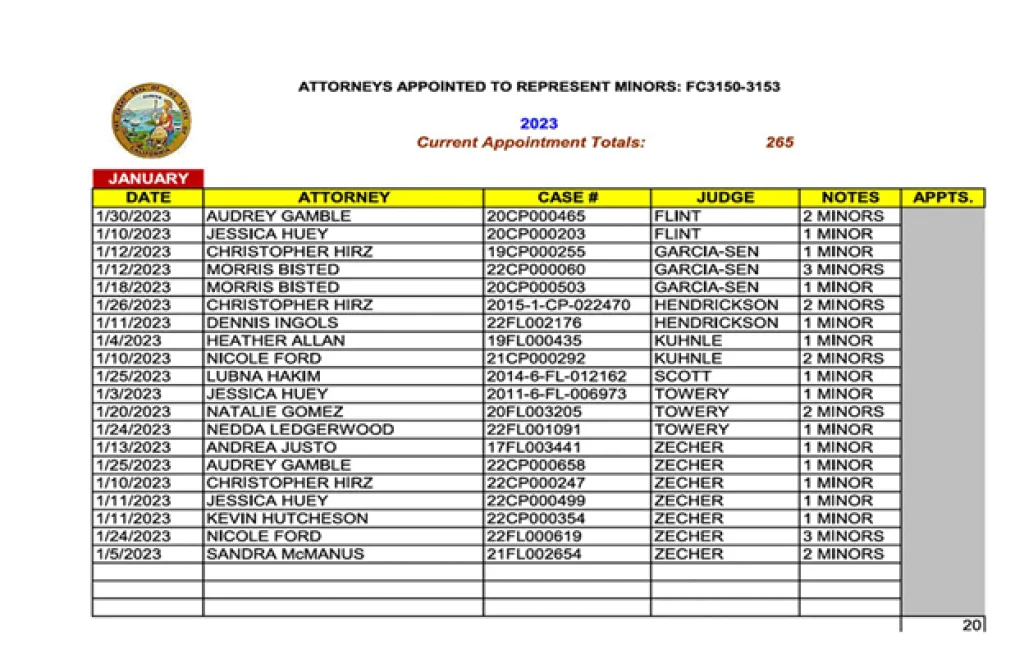
Santa Clara County Superior Court records show attorney appointment by case and judge.
How the System Works — and What It Costs
California Family Code Section 3150 allows judges to appoint a lawyer for a child whenever they believe it is “in the best interests of the child.” The statute does not define the term.
Once an attorney is appointed as minors counsel, they are required to file certain paperwork, under penalty of perjury, stating they are qualified to serve and have malpractice insurance.
Minors counsel are also required to submit applications for payment before they can be paid for any work they do on behalf of a child client.
In each case where minors counsel is appointed, a family court judge must make a determination as to how minors counsel’s fees will be paid.
If a judge rules parents have an ability to pay minors counsel fees, payment will be ordered at the attorney’s private hourly rate.
According to published minors counsel information throughout the state, attorneys court appointed to represent children have private rates that range from $250 to $1200 per hour.
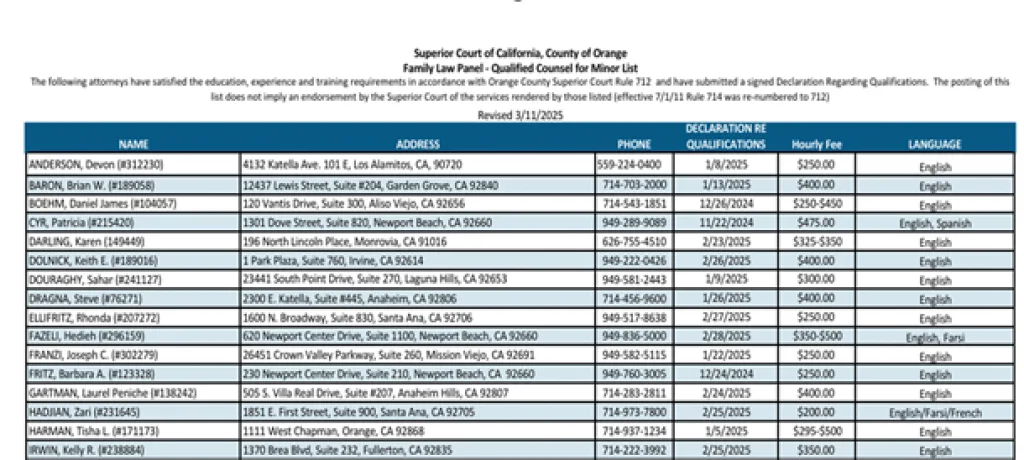
Partial List of Orange County Superior Court Minors Counsel Panel Shows
Private Fee Rates
When a judge finds parents unable to pay minors counsel’s fees, the child’s attorney is paid at a reduced rate ranging from $75 to $125 per hour, as set by the local court, and payment is made from the county court’s general fund.
A judge must approve minors counsel’s payment applications before parents are ordered to pay minors counsel fees or before the child’s attorney is paid from the court’s general fund.
Every three months minors counsel are supposed to submit fee applications to the court. Parents are permitted to review and question the application’s billings prior to being ordered to pay. However, some minors counsel only submit applications for payment every 12 months, or longer, hitting parents with unexpected and outrageous fee requests.
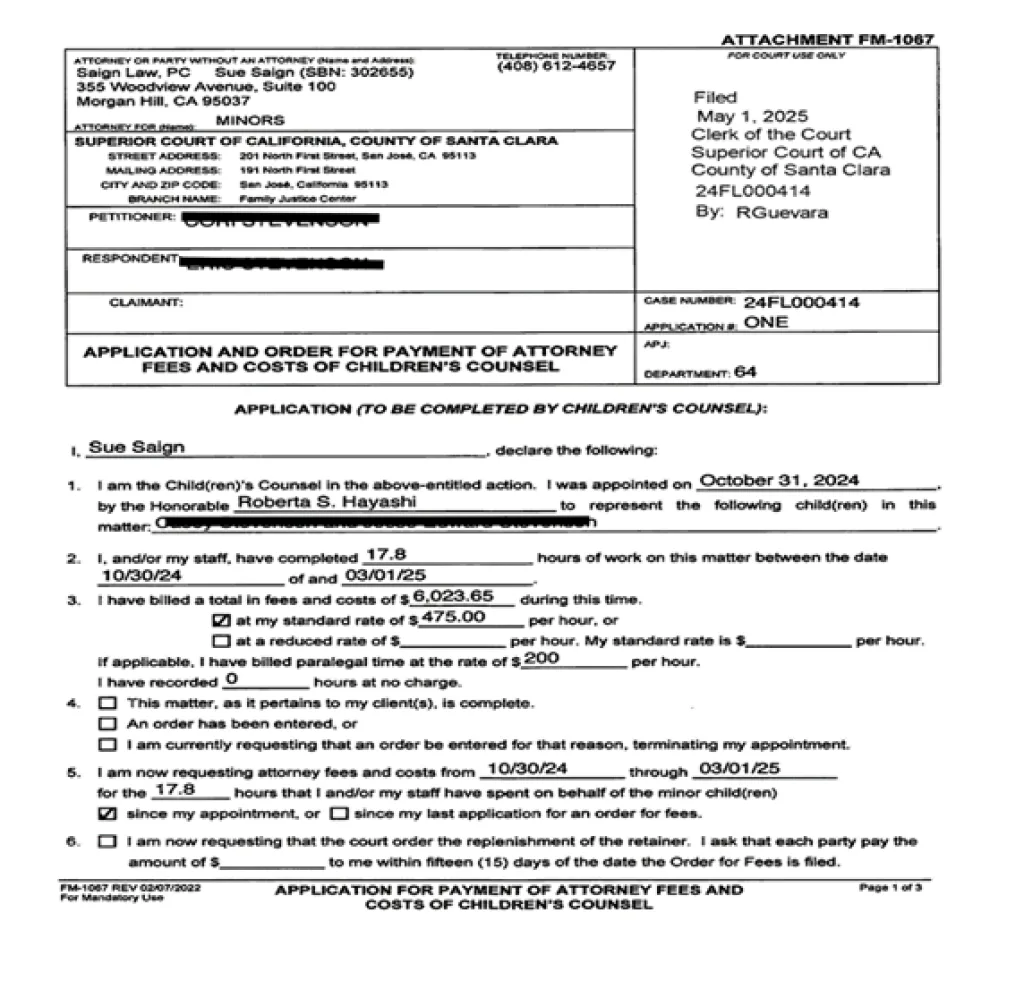
Minors counsel Sue Saign’s application for fees for a five-month period.
Minors counsels are allowed to charge without limitation. Responsible for fact finding for the court, they can bill to read all the court filings submitted by parents and their attorneys in the case. They can charge to visit the child’s school or to sit in on parent- teacher meetings. They can charge to write and file court documents and to speak with a child’s therapists or medical doctors.
Additionally, they can charge for their private staff and travel time.
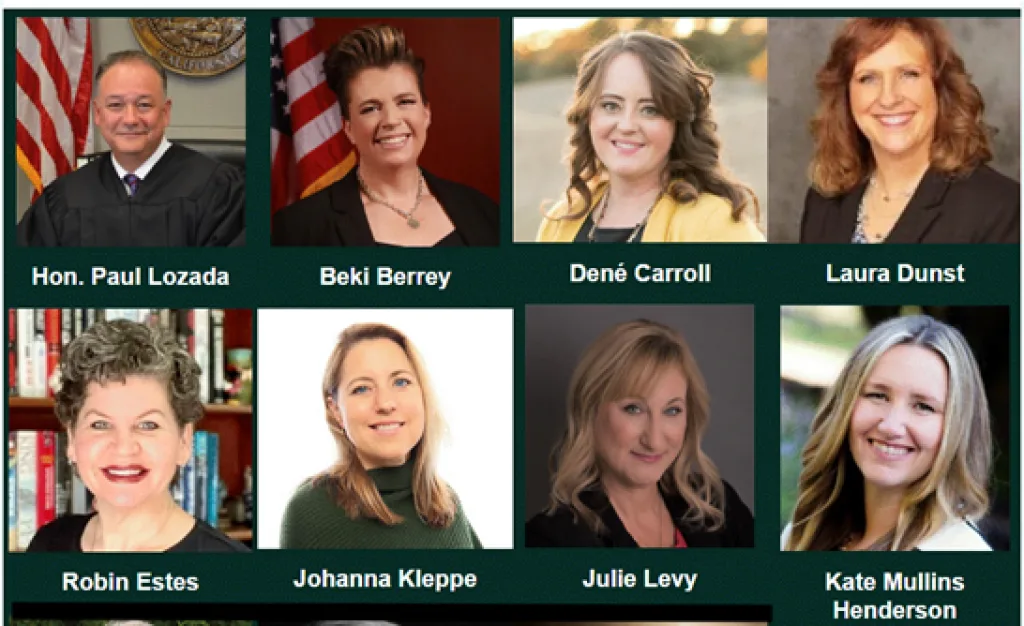
Minors Counsel Julie Levy (bottom second from right) and now Sonoma County Superior Court Judge Paul Lozada (top left) on Sonoma County Bar Association Speaker Panel for Minors Council Training in 2024.
Allegations in Sonoma County: Julie S. Levy
In a Sonoma County divorce case, a mother and her attorney sought to remove Julie S. Levy as minors counsel for a child with autism.
Court documents allege that once appointed, Levy aligned herself with the child’s father and acted in ways that advocated for the father, rather than the child she was appointed to represent.
The filings allege Levy influenced multiple judges to strip the child’s mother of care and custody of her special needs son, even though she was a highly trained and credentialed special education teacher.
According to court files, it was the recommendations and influence of Levy that resulted in the mother being labeled an “unfit parent” despite her having no criminal history, or adverse psychological findings in the public court file.
Additionally, court filings seeking Levy’s removal alleged she supported the use of costly supervised visitation providers and failed to consistently communicate with the child’s medical and educational providers, resulting in delayed decisions critical for the child.
Emails submitted as exhibits in support of Levy’s removal show lengthy gaps in Levy’s communications which allegedly frustrated, delayed, and added unnecessary costs to the proceedings.
One of the most serious allegations in the removal request involves money.
The mother’s attorney warned that Levy’s continued involvement raised the prospect of syphoning legal fees from the child’s special-needs trust — funds intended for the child’s lifelong care, not legal bills.
Sonoma County Superior Court Commissioner Paul Lozada appointed Levy and denied the motion to remove her.
Further, he ordered the child’s mother, who was on a fee waiver and legally indigent, to pay a disproportionate amount of Levy’s fees at her private billable rate. Justification for having the mother pay more than father was based on mother’s request to have Levy removed and the cost Levy incurred opposing the request.
Levy later withdrew from the case and was replaced by minors counsel Dan Beck.
Court records indicate Beck is now being paid with public funds at a rate significantly reduced from what Levy charged to represent the same child.
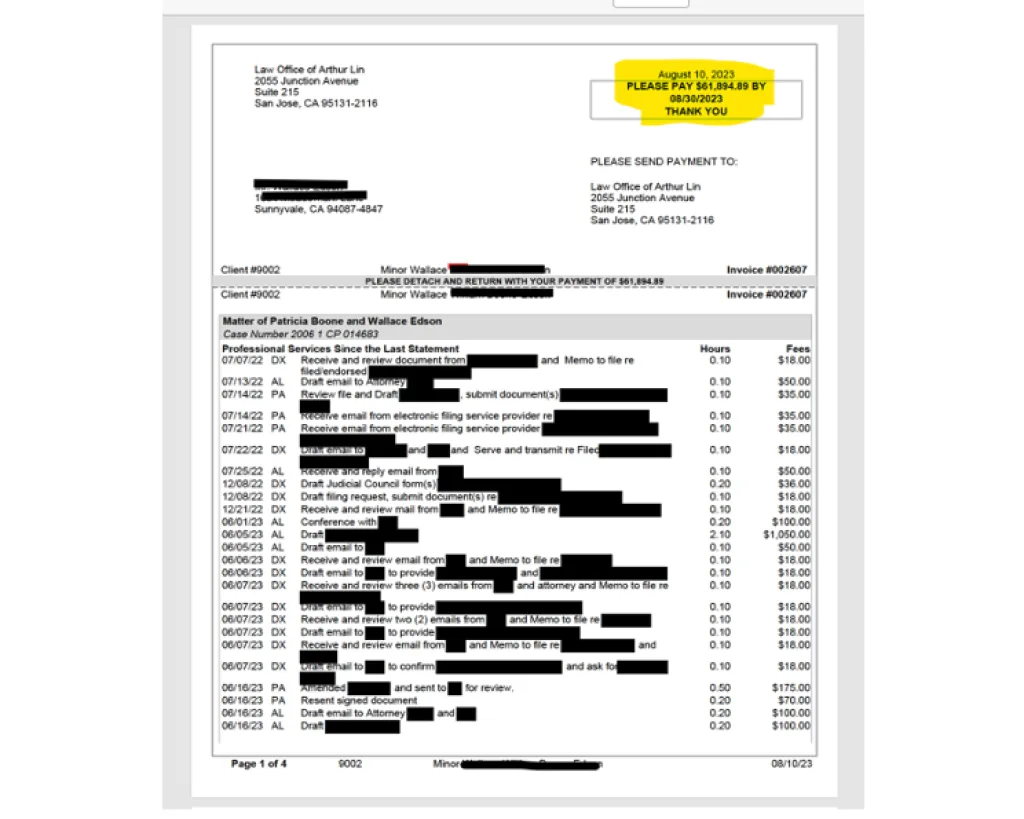
Allegations in Santa Clara County: Arthur Lin
In Santa Clara County, a mother involved in a custody dispute spanning nearly 17 years said Arthur Lin was appointed as minors counsel after her son reported abuse by his father to social workers at the Bill Wilson Center and to the Mountain View Police.
According to court records, Lin dismissed the abuse allegations his client raised and recommended removing the child from his mother’s care and custody, accusing her of “gatekeeping” and “alienation” to justify his recommendation.
Court filings show Lin billed for efforts to shut down the mother’s legal fees crowdfunding campaign, strip her of custody, and obtain a lifetime restraining order against her weeks before her only son turned 18.
In his request for a lifetime restraining order, Lin claimed his child client was “fearful” of his mother and requested the restraining order be extended to the child’s father, who was self- represented at the time of the request.
The restraining order Lin sought was issued against the mother following a hearing before Santa Clara County Superior Court Judge Jessica Delgado, where there was no court reporter. Lin’s child client never even testified to support the hearsay statements Lin made when requesting a lifetime restraining order against his child client’s mother.
During the time the restraining order was being litigated, Lin’s child client was criminally prosecuted and was ultimately convicted for sexually abusing a teenage girl in Los Altos. A fact the mother says was concealed from her and Judge Delgado when Lin sought the restraining order.
While the mother timely appealed, the appeal was dismissed after it became clear it could not be pursued as no court reporter was present at the hearing to create a transcript for appellate review.
Lin sought roughly $60,000 for his fees in the case, billing at his private open rate. Several judges approved Lin’s fee requests and ordered the mother to pay Lin’s fees, at his private rate, despite her being on a court fee-waiver and responsible for supporting two young daughters. The father’s share of Lin’s fees were paid by the court, at a reduced rate.
When the mother could not pay Lin’s fees, he placed a lien on the house left to her by her son’s grandmother.
Lin has repeatedly refused to comment on the practice of placing a lien on the homes of parents of children he is paid to represent.
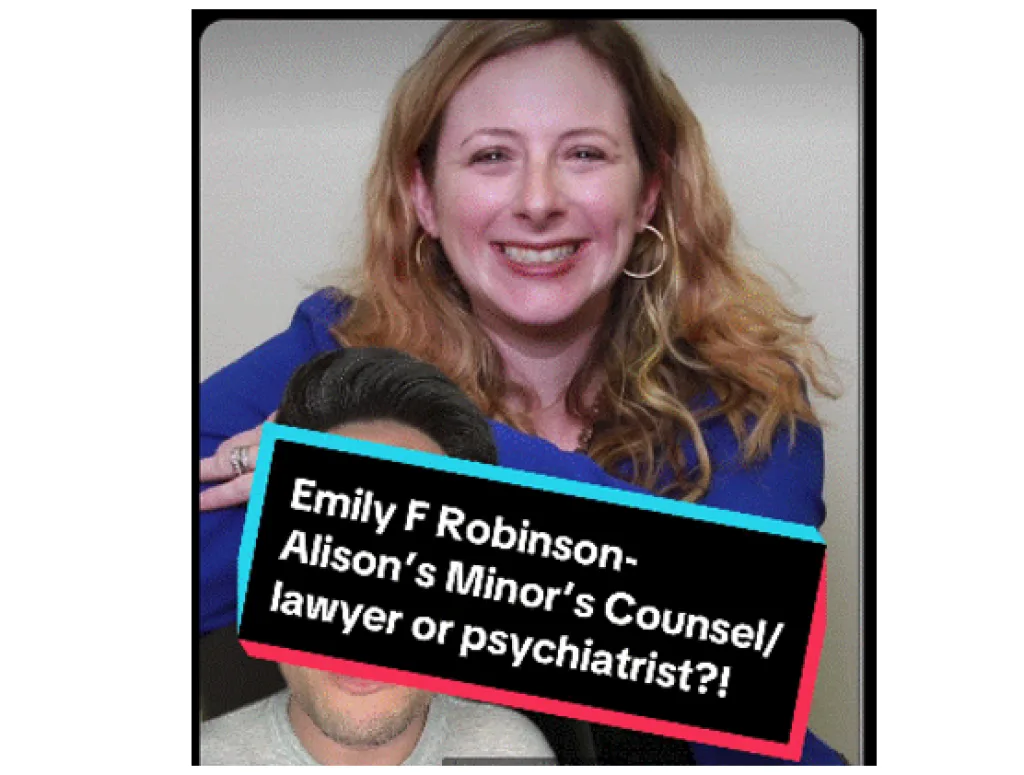
Allegations in Los Angeles County: Emily Faye Robinson
Emily Faye Robinson is a controversial minors counsel in Los Angeles. She has been the subject of several social media posts pointing to an appearance of unethical conduct while representing kids.
Presently a mother is seeking to remove Robinson as minors counsel for her three children.
Robinson was appointed in the case in May 2025, after a domestic violence restraining order was issued against the children’s father. According to the removal request, Robinson allegedly favored the father and represented all three children despite sharply divergent needs and expressed preferences.
Court filings allege one child feared a sibling following reports of physical abuse, another sought no contact with one parent and a third requested a different living arrangement.
Under California law and ethics rules, such conflicts typically require separate minors counsel for each child.
The removal motion further alleges Robinson refused to withdraw or support appointing additional minors counsel as she exercised extensive control over the siblings’ visitation, therapy and confidential records, in some instances without court orders.
Robinson has not yet responded to the request for her removal.

Minors Counsel Conflicts Reach Federal Court
In late 2024, a federal lawsuit was filed against minors’ counsel B.J. Fadem and Nicole Ford arising from a Santa Clara County child custody dispute.
According to the lawsuit’s first amended complaint, Fadem was appointed to represent two children with differing needs: a young girl and a young boy. The father, who was representing himself, repeatedly sought Fadem’s removal, alleging incompetence and bias. The father’s pro se motions and requests were never ruled upon and were effectively ignored.
The lawsuit alleges that after the father challenged Fadem’s appointment, Fadem persuaded the court to order the father to refer to his daughter, Faith, as “Alex” and to use male pronouns when addressing or describing his child.
Fadem allegedly provided no therapy records or other evidence to support his claim that the Faith wished to identify as a boy. The complaint further alleges that after the issue was raised, Fadem failed to disclose that he himself is transgender.
Ultimately the lawsuit alleges that contrary to Fadem’s claims, the young girl never wanted to be a boy and continued to use female pronouns and her birth name at school and on social media.
According to the lawsuit, after asserting that his young client wanted to be a boy, Fadem continued to recommend that the father be subjected to costly supervised visitation and reunification therapy with Marcia Clark who is also a defendant in the federal lawsuit.
The lawsuit further alleges that Fadem failed to withdraw from the case or recommend the appointment of separate minors counsel for the other child. Fadem allegedly claimed that the son he was appointed to represent had untreated mental health issues after he was removed from the father’s care and custody during a post-divorce custody dispute.
The lawsuit also names minors counsel Nicole Ford as a defendant, alleging that Ford disclosed confidential information about Fadem’s child clients to third parties. In federal court filings, the father claims that the confidential information Ford allegedly disclosed could only have originated from Fadem or from reunification therapist Marcia Clark.
Fadem, Ford and Clark deny the allegations and have moved to dismiss the federal lawsuit.
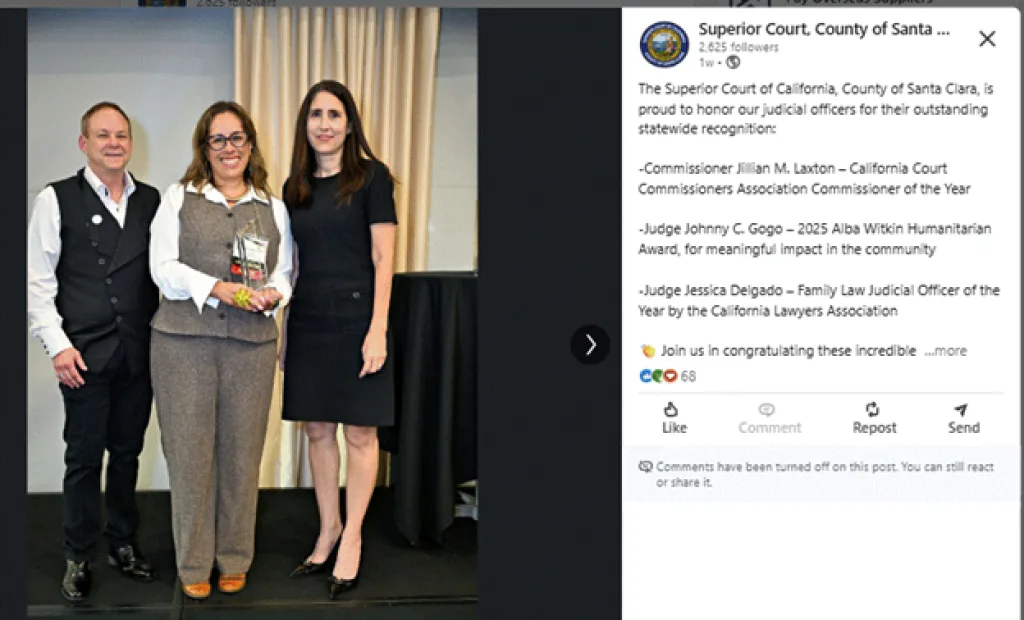
Minors Counsel BJ Fadem (left), Santa Clara County Superior Court Judge Jessica Delgado (center), California Supreme Court Chief Justice Patricia Guerrero (right). Screen shot from LinkedIn.
A System with Few Guardrails
Minors counsel are not required to show that their appointment improved legal or emotional outcomes for the children they represent during a divorce or custody dispute.
In practice, there are few meaningful checks and balances on the actions of minors counsel. Children cannot dismiss their appointed attorneys and have no independent right to file complaints with the State Bar, or the court, regarding minors counsel’s misconduct.
Most counties rely on local panels, or formal lists, of “qualified” attorneys available and willing to accept family court appointments.
In Santa Clara County, Local Rule 9 governs the minors counsel panel. Attorneys listed on the panel attest that they have completed the required education and training and are willing to serve as counsel for children. Although all panel attorneys are considered qualified and available, public records show that judges appoint minors counsel at highly disproportionate rates.
Between 2018 and 2024, for example, Jessica Huey received more than 240 minors counsel appointments. During the same period, Nicole Ford, who represented Huey in her personal divorce case, received more than 140 appointments. By contrast, other, more experienced attorneys received as few as four or five appointments over those six years.
By 2022, Nicole Ford was no longer listed on the court’s minors counsel panel. However, public records show judges continued to appoint her, nonetheless, bypassing other attorneys who remained more qualified and willing to represent children.
While judges can appoint attorneys who are not on the panel, they are required to make findings, on the record, as to the reason for an off- panel appointment. In cases where Ford was appointed after she was no longer listed on the panel, no findings were made on the record to legally justify an off-panel appointment.
Critics say the most significant problem lies in family court judges’ broad discretion to select favored attorneys as minors counsel.
Public records show that certain judges frequently appoint the same attorneys and place them in high-asset cases, where fees can be five times higher than in cases involving indigent parents. In cases where minors counsel are appointed for indigent parents, their fees are paid at reduced rates with public funds.
Family court judges rarely disclose conflicts of interest with the attorneys they appoint as minors counsel, leading to an appearance of unfairness and violations of due process.
The California State Auditor warned in 2011 that such patterns risk court resource mismanagement, problematic conflicts and erosion of public trust.
No Court Reporters, No Record
Oversight of minors counsel appointments is further weakened by the absence of court reporters in many California courtrooms.
According to a court reporter shortage lawsuit filed in late 2024 against the Santa Clara, Los Angeles, Contra Costa County and San Diego courts, brought by Bay Area Legal Aid and the Family Violence Appellate Project (FVAP), more than one million family law hearings are held in California each year without a court reporter creating an official transcript of the proceedings.
Hearings conducted without a court reporter effectively foreclose meaningful appellate review, as appellate courts lack a record to examine potential judicial misconduct or legal error. Without transcripts, decisions to appoint, retain or remove minors counsel are rarely reviewable by courts of appeal.
Children subjected to minors counsel appointments who later allege harm may also find there is no record to support malpractice or civil rights claims.
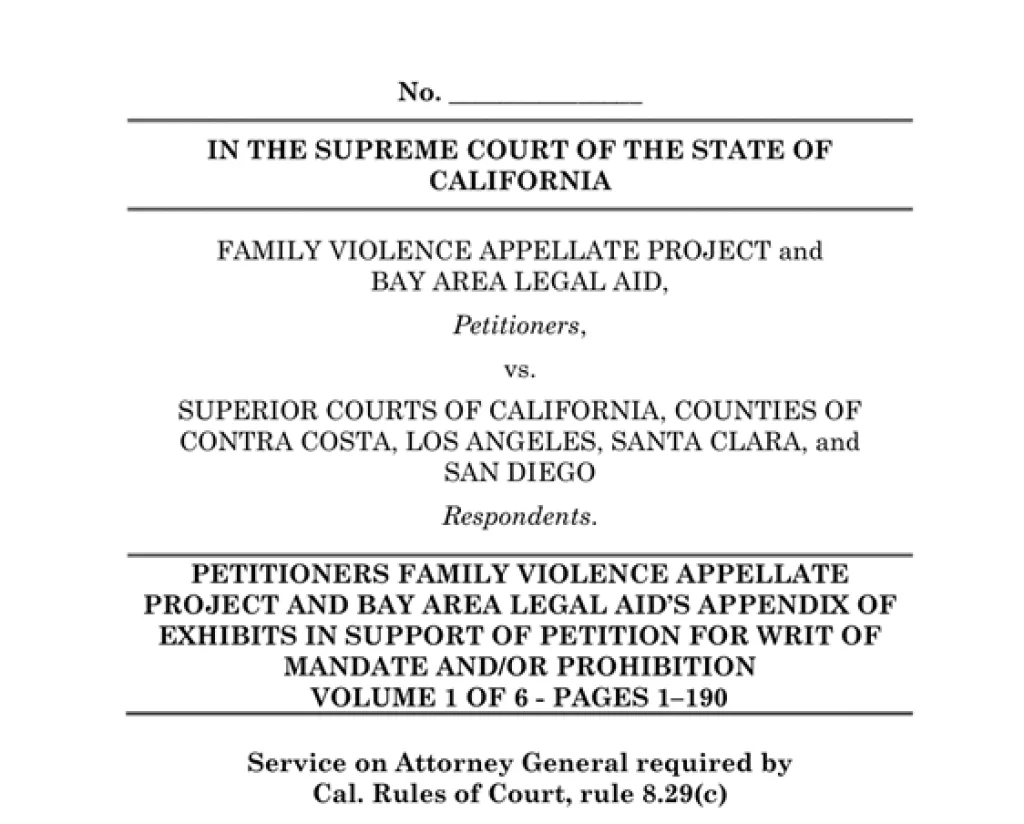
Court Reporter Shortage Lawsuit filed in 2024 remains pending in the California Supreme Court.
A Reckoning Long Deferred
Court filings, public records and lawsuits across Sonoma, Orange, Los Angeles, Contra Costa, San Diego and Santa Clara counties depict a family court system that concentrates power in the hands of a few court-appointed attorneys with little transparency or effective oversight.
The cases involving Julie S. Levy, Emily Faye Robinson, B.J. Fadem and Nicole Ford — all of whom deny wrongdoing — illustrate structural flaws that advocates say cannot be addressed solely by disciplining individual lawyers.
Minors counsel were created to give children a voice in family court. For many families, that voice is now filtered through court-appointed attorneys who operate with limited accountability, wield extraordinary influence and impose significant financial costs on families and taxpayers.
Note: This article is part of an ongoing investigative series examining the cost and use of attorneys appointed to represent children in family court proceedings. Our next installment will analyze how much minors counsel have been paid from court budgets across California, at a time when court administrators assert they lack sufficient funding to provide court reporters in family law cases.
Please consider supporting The Vanguard through donations and by sharing and supporting our reporting on Susan Bassi’s social media as we continue to investigate and report on these important issues.
Follow the Vanguard on Social Media – X, Instagram and Facebook. Subscribe the Vanguard News letters. To make a tax-deductible donation, please visit davisvanguard.org/donate or give directly through ActBlue. Your support will ensure that the vital work of the Vanguard continues.

Incredibly disturbing. Judges can no longer profit by shipping innocent children to prisons for slave work. They found this method of slavery profitting. Thank you for this thorough reporting, Susan. What’s happening here is a criminal form of child human trafficking. Using innocent children who are in homes of high conflict separation/divorce to make profit for attorneys is criminal and should be criminalized. I feel sick reading these details.
Margaret Petros
Professional Victim Advocate