

By Susan Bassi, Fred Johnson and Lexi Logan
California parents are paying hundreds of dollars per visit to see their own children under court-ordered supervision that can last for years. The unregulated industry providing supervised visits profits from family court dysfunction through secretive business training funded by taxpayers.
The state’s supervised visitation system operates like a legalized extortion scheme, forcing parents to pay private monitors $40 to $250 per hour plus fees for intake, reports, travel and even meals, while courts explicitly disclaim responsibility for vetting providers.
“We are under costly orders to be scrutinized with our own children longer than felony convicted child abusers are on probation,” said one Sonoma County mother, speaking anonymously to avoid retaliation in ongoing custody proceedings.
A Davis Vanguard investigation of over 1,000 cases across California reveals a shadowy system where financial incentives mirror the Pennsylvania “Kids for Cash” scandal, where private businesses profit from extended family separation as attorneys, therapists, judges and providers maintain undisclosed financial relationships that keep lucrative court orders flowing.
What is Professional Supervised Visitation?
Supervised visitation is when a parent is court ordered to have third-party monitored interactions with their own children during short scheduled visits in connection with a divorce or custody dispute.
Allegations of abuse, domestic violence, excessive drug or alcohol use, or that a parent is engaging in custodial interference can be used by family court judges to justify stripping one parent of legal and physical custody of their children, placing an allegedly offending parent under limited supervised visitation, “out of an abundance of caution”. A legal outcome commonly referred to as a “custody flip” that strips one parent of legal and physical custody while placing them on court ordered supervised visitation, which limits the parent’s contact and interaction with their children.
Nonprofessional v. Professional Visitation
Nonprofessional supervised providers are typically family members or friends who supervise visits without pay. Their main obligation is to read the Judicial Council’s guide for nonprofessional providers and follow the court’s order. A nonprofessional provider cannot have any criminal record related to child abuse crimes, nor have been subject to prior supervised visitation orders, or any civil or criminal restraining orders in the 10- year period prior to appointment.
These unpaid supervisors do not have to file annual declarations or keep detailed records and are not mandated reporters of suspected child abuse.
Nonprofessional supervision is only suitable for low-risk cases as it lacks the safeguards and accountability required when child safety and well-being is a concern.
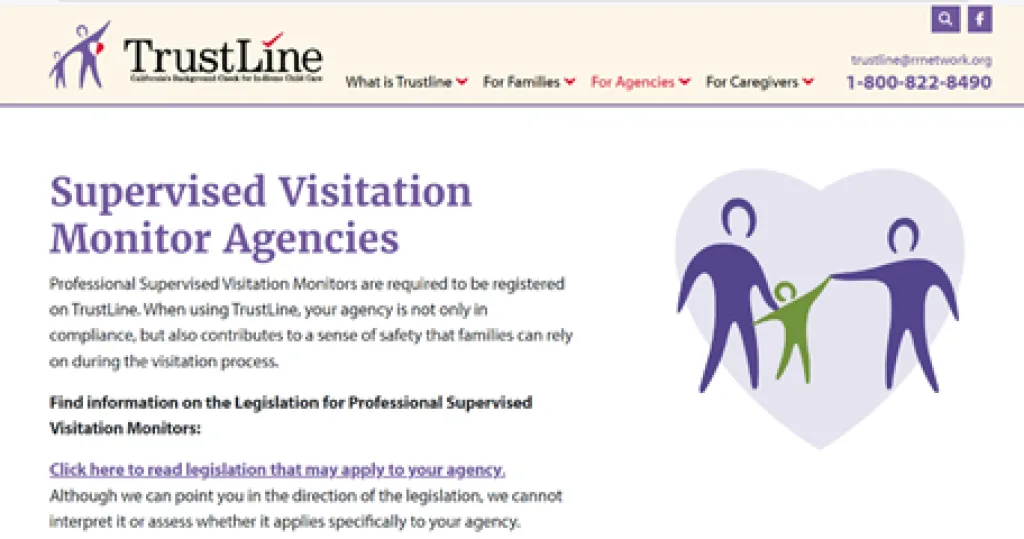
The Trustline website tracks registrations for California’s Professional Supervised Visitation Providers.
Professional providers are paid individuals, who must comply with Family Code section 3200.5 and standards of practice set forth in California’s Rules of Court Standard 5.20.
Every professional provider, or monitor, must complete at least eight hours of annual training, with at least two hours dedicated to issues such as substance abuse, child abuse, sexual abuse, and domestic violence.
They must also pass a background check and register with TrustLine, California’s childcare and provider registry that allows parents to investigate if a provider is qualified to meet their needs and comply with the court’s orders. Parents can also check the background and qualifications of a provider by calling Trustline directly, 800-822-8490, during normal business hours.
Professional providers are required to file an annual declaration (form FL-324(P)), under penalty of perjury, confirming they meet all legal and training requirements.
If there’s any change in their eligibility, they must update the court within five days. Providers must also keep detailed records of each visit, and if a visit is terminated due to safety concerns, or rule violations, a provider is required to document the reason, notify both parties and their attorneys, and, submit a report to the court.

Since 2022, California courts have updated their procedures for maintaining lists of professional providers. As a matter of law, courts must now ensure that every provider on a published list has filed the required annual declaration stating the provider has completed the necessary training. However, the court does not evaluate, monitor, or endorse the quality of the providers, or their training, nor does it inspect their facilities.
The responsibility for selecting and vetting a provider remains with the parents, their attorneys and a court appointed child’s attorney, also known as minors counsel.
Professional supervised visitation offers structured, legally compliant, and monitoring at a cost, in high-risk or contentious cases. Nonprofessional supervision is cost-free and informal but lacks the training, documentation, and legal protection of professional services.
Parents frequently complain that when providers appear untrained or don’t follow court orders or rules, judges and court appointed minors counsel do not hold them accountable, nor protect the children providers are paid to serve in the name of child safety.

Screenshot of Leaked Judicial Council Documents from 2022.
State-Supported Business Training Creates Provider Industry
In addition to providing provider training, California’s Judicial Council uses grant funding, and staff, to teach providers how to operate businesses that profit from family dysfunction. Using copyrighted training materials, the state agency promotes supervised visitation as a business opportunity, rather than child protection.
“When Setting Up a New Supervised Visitation Program or Business, it is key you explore whether this is a good fit – a good match for you?” states the Judicial Council’s “Implementation Road Map” training, authored by Judicial Council staffer Shelly La Botte, J.D. and private Reunification Services Consultant, JaDawn Bean, MSW.
JaDawn Bean’s LinkedIn page describes her as a self- employed family reunification services consultant with a history of social work and consulting for Kaiser Permanente, Zuckerberg San Francisco General Hospital, and Highland Hospital in Oakland.

Screenshot from JaDawn Bean’s LinkedIn account.
LaBotte has worked for the state’s Judicial Council for nearly thirty years. Her title on LinkedIn states she serves as the agency’s Grants Coordinator and Program Manager.
In addition to her public salary, she and Bean claim to hold the copyright on materials the state uses to train monitors who are not required to be licensed or certified.
According to Transparent California, in 2022, Shelly La Botte earned over $179,000 in public pay and benefits as she conducted trainings using materials where she and Bean hold the copyright.

The taxpayer-supported training includes “Business and Professional Considerations” that guide providers through strategic planning, financial funding plans, and business development strategies. The copyrighted material effectively teaches people how to monetize court-ordered family separation.
The training explicitly instructs providers to “conduct needs assessment and create business-program logic model” as well as to “examine business finances, start-up funds and options, and financial funding plan,” treating children’s safety as a revenue opportunity.

Notes from 2022 Judicial Council sponsored Professional Supervised Visitation Training.
In a 2022 presentation, La Botte and JaDawn, encouraged new providers to network with local attorneys to expand their businesses opportunities, stating in a presentation to new providers:
“I cannot stress enough you better have your business game on here because between the attorney and disgruntled clients your game better be tight.”
Unlike police training that is produced in public records requests, the Judicial Council has repeatedly refused to produce provider training and associated financials records that would show how much La Botte was paid for use of her copyrighted materials, in addition to her public salary.
Parents provided copies of leaked Judicial Council training records expressed outrage after viewing training notes. Most were highly offended that trainings refer to the business of providing supervision as a “game”. Others were outraged they were labeled as “disgruntle clients” as part of a strategic business plan.

Portion of the Professional Supervised Visitation List published on the Santa Clara County Superior Court website.
Few Options for Poor and Working- Class Families
Public records show Healthy Families Happy Families, a Santa Clara County provider supported with state and federal funding, offers free 1.5-to-2-hour visits to eligible families. For parents who cannot afford supervised visits, the agency only provides weekday courthouse visits and offers no options on weekends for working-class parents. Additionally, local court rules established by judges and attorneys have restricted parents under court ordered supervision from taking photographs with their children during courthouse visitations.
“Seeing my child one hour a week inside a sterile courthouse feels as if he is visiting me in prison”, one mother described after using the agency for protracted court ordered visits.
The agency also provides services to parents who can afford to pay $90 per hour. If authorized by court orders, the agency offers private paying parents 2-8 hours of visitation that can take place outside the courthouse.

Screen shot of Venmo payments a parent under supervised visitation made to Beth Wanamaker in 2022.
Cash Payments and Court Reports
Beth Wanamaker, a Sonoma County privately paid provider, once subject to a federal lawsuit for allegedly issuing false reports as a court-appointed mediator, now operates her business through Compassion Divorce in Santa Rosa. A business founded by family law attorney Joann Campoy. Parents directed to use Wanamaker as a professional provider by minors counsel Julie Levy have complained about Wanamaker’s business practices, and quality of reports she issues for Levy and the court.
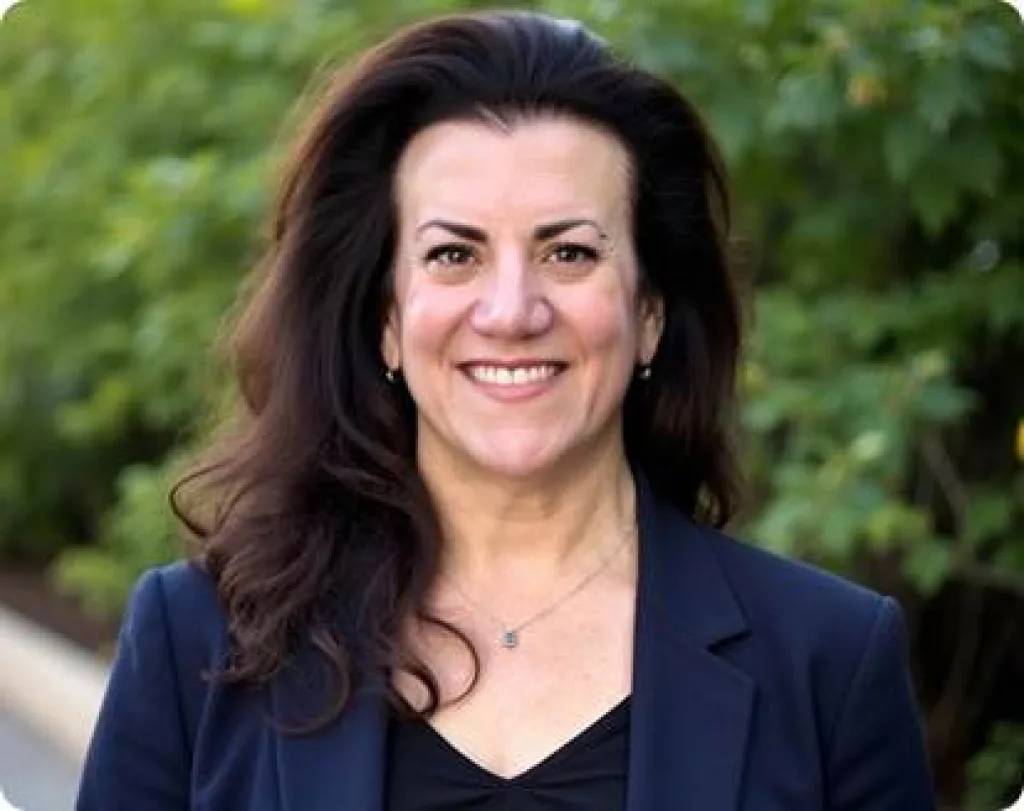
Sonoma County Provider, Beth Wanamaker. Screenshot- Compassionate Divorce Lawyers in Santa Rosa website.
Wanamaker is known to demand Venmo or cash payments and reportedly refuses to issue parents invoices or requested tax records. Parents subject to protracted supervised visitation orders, have also complained about Wanamaker’s reports and cozy relationships with Sonoma County judges and attorneys who act as minors counsel.
Information provided to the Vanguard’s investigative reporting team shows that Wanamaker’s Venmo account reveals payments of $210 and $300 for individual visits, with notations like “Visit 61” and “Visit 40” suggesting some parents have been under long term supervision, paying thousands in cash transactions that appear to circumvent tax reporting requirements.

2022 Small Claims Lawsuit filed in Santa Clara County Superior Court
Provider Sues Minors Counsel in Small Claims Court
In 2022, professional supervised visitation provider Lorainne Ruiz sued minors counsel Nicole Ford in Santa Clara County Small Claims Court. According to court documents, Ruiz alleged Ford, and other attorneys closely associated with Ford, engaged in unfair business practices and conspired to interfere with Ruiz’s provider business and client contracts.
Ruiz’s lawsuit exposes how attorneys working in a tightknit family law community can negatively impact provider business and increase litigation costs to families and taxpayers.
Emails published in connection with the litigation indicate, Nicole Ford launched a vicious campaign designed to exclude Ruiz, the only sliding-scale provider serving low-income Spanish speaking families in the county.
The lawsuit further reveals that in cases where Ford and her associates were regularly appointed as minors counsel, Ford led a sophisticated scheme consistent with public corruption and bad faith litigation.
Court documents reveal Ford wrote to her associates stating: “Please make it VERY clear to the clients if there is ever an event wherein we need to use an alternative supervisor for exchanges Lorraine Ruiz is NOT an option.”
The professional provider’s small claims lawsuit further reveals how Ford was assisted by her legal associates. Gretchen Z. Boger, Partner at LONICH PATTON ERLICH POLICASTRI wrote to a father client: “Nicole Ford, stepped in and requested to change providers immediately”. . . . “No one should use Lorraine any further for exchanges.”
Attorney Yanna Sukhodrev at Morgan Tidalgo Sukhodrev & Azzolino LLP allegedly wrote to a client about Ruiz’s removal from a case at Ford’s request: “You were not notified. This was something that Nicki decided at the last minute this morning.”
Jessica L. Huey, Esq. wrote: “My firm has a conflict of interest with Ms. Ruiz’s agency and therefore I cannot agree to use her in this case.”
In 2022, as Ruiz’s small claims lawsuit was pending, Jessica Huey was represented by Nicole Ford in her personal divorce case. Court documents in the divorce case, and interviews with attorneys familiar with the case, reveal Jessica Huey-Gregg secured a domestic violence restraining order (DVRO) and custody flip after her ex-husband accused her of exploiting minors’ counsel appointments for profit.

The DVRO was granted by Santa Clara County Judge James Towery who frequently appointed Ford and Huey-Gregg as minors counsel in family law cases assigned to his department.
The DVRO was terminated after Huey succeeded in placing her former husband on professional supervised visitation with VES, a provider not presently listed on the court’s provider list, by stipulated agreement prepared by Nicole Ford.
San Diego Lawsuit: Providers Taking Sides
A lawsuit against ABC Professional Supervised Child Visitation Providers in San Diego reveals how providers abandon neutrality while courts ignore misconduct.
The lawsuit reveals text messages published by provider Monika Konia that show communications about a mother paying for supervised visits:
“She [mother] could care less about her son she just wants to win that’s in her blood. At all costs,” Konia wrote about the mother, adding: “In order to get hired by [mother] you have to check the box that says ‘snake.'”
According to court documents, when confronted with her inappropriate conduct, Konia told another monitor: “The texts I have with you are private. Ok you don’t need to save them.”
Konia also expressed inclination to “blackmail” the mother’s attorney: “With all honesty my inclination is to blackmail him or mention in some way that I should expose him for that incident.”
Despite this documented misconduct, Konia and ABC Monitoring remains listed on San Diego’s court-approved provider list. The lawsuit reportedly settled out of court with no accountability or notice to the public of the provider’s problematic activities.

2017 Lawsuit filed in San Diego County Superior Court
Financial and Emotional Impact of Extended Monitoring
The Vanguard’s investigation reveals that family court judges frequently fail to adequately review supervised visitation reports, in order to determine whether the issues that initially subjected a parent to supervised visitation have been resolved or remain a concern. As a result, some parents are unjustly left on supervised visits for years, resulting in a different kind of harm to children and financial difficulties for their parents.
The financial impact of professional supervised monitoring on families is catastrophic. Professional supervised visitation throughout the state typically costs $40-250 per hour with two-hour minimums. Holiday rates increase to $90-150 per hour, plus monitor mileage fees exceeding $0.50 per mile.
With court-ordered visits twice weekly, families face an average of $1,200-3,000 in monthly supervision costs alone, in addition to paying for transcripts, child support, attorney fees, and court costs.
One mother reported spending over $300,000 in legal and supervision costs in a custody dispute, losing her home equity that went pay the other parent’s attorney fees, while ordered to see her children only under costly monitoring for years.
In the San Diego case, the mother was ordered to pay $175,000 in interim attorney fees while also covering supervision costs that stretched over multiple years.
Beth Wanamaker’s Venmo payment records show some parents reaching “Visit 61,” indicating monitoring that has continued for over a year at $210-300 per visit, generating thousands in revenue from a single case.
Kids for Cash Elements and Conflicts of Interest
Like Pennsylvania’s infamous “Kids for Cash” scandal, California’s supervised visitation industry creates financial incentives for extended family separation through undisclosed relationships between court personnel and private businesses.
The Judicial Council’s copyright training teaches providers to network with family law attorneys and court personnel for referrals, effectively creating a guaranteed revenue stream backed by court orders while avoiding traditional business marketing costs.
Some providers operate without proper business licenses, fail to file DBAs with county clerks, or don’t register LLCs with the Secretary of State, leaving parents unable to verify who they’re paying hundreds of dollars to see their children.
The training’s business focus rather than child protection emphasis reveals the system’s true purpose: creating a profitable industry that benefits from prolonged family dysfunction rather than resolution.
Courts Disclaim All Responsibility
Despite the high stakes for families, California’s 58 superior courts post explicit disclaimers: “The Superior Court has not and does not screen or evaluate the providers, their facilities, or the information they have listed.”
Courts require only that providers sign declarations under penalty of perjury that they meet Standards of Judicial Administration 5.20. No licensing, certification or ongoing oversight exists.
Jennifer Vigna, Director of Court Services for Santa Clara County, wrote to complainants: “The Court is unable to address issues related to purported misconduct by an attorney” and “the Court is not involved in the selection or endorsement of Supervised Visitation and Supervised Exchange Providers.”
Federal funding through the Access to Visitation Grant Program provides only $655,000 annually statewide — a fraction of what’s needed to serve thousands of families requiring subsidized services.
The concentration of expensive providers in affluent areas creates a two-tiered system where wealthy parents can maintain more flexible visitation while low-income families face courthouse visits under restrictive conditions.
Santa Clara County Superior Court Judge Brooke Blecher acknowledged the system’s problems in a Judicial Council podcast: “At $200 an hour it adds up pretty quickly,” warning judges to ensure families can afford visits to avoid creating “no-visit orders” in practice.
However, court records show judges routinely continue supervision orders for months, even years without clear evidence of ongoing safety concerns, while parents exhaust financial resources fighting for basic contact with their children.
“These aren’t easy orders to make, and you’re juggling the safety concerns for the child with ensuring this ongoing relationship between the parents and the child,” Blecher noted, yet the Vanguard’s investigation found parents subjected to professional supervision for up to seven years with no evidence in the court file to justify protracted court ordered parent- child supervision.
