
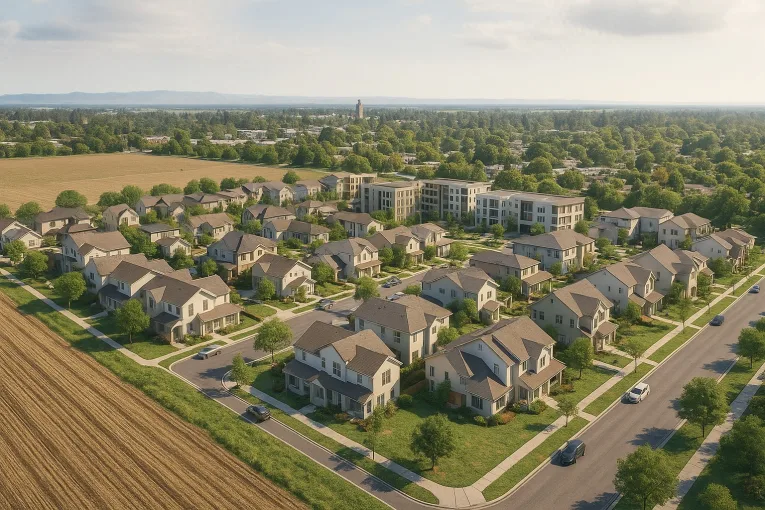
DAVIS, Calif. — The Davis City Council on Tuesday is scheduled to receive and discuss a staff report outlining options for possible amendments to Measure J/R/D, the voter-approved ordinance that requires citywide elections before agricultural or open space land can be converted to urban use.
The report, prepared by Community Development Director Sherri Metzker and Assistant City Manager Kelly Stachowicz, does not recommend specific amendments but instead asks the council to provide direction on which exemption concepts should be researched further and potentially developed into a ballot measure for voter consideration .
Any amendment to Measure J/R/D would itself require approval by Davis voters. Staff outlined two possible election timelines: June 2026 or November 2026. According to the report, a June 2026 standalone ballot measure would likely cost between $150,000 and $250,000, while placing the measure on the November 2026 general election ballot could reduce costs to an estimated $40,000 to $60,000 by sharing election expenses. All costs would be paid from the General Fund, which staff noted is already strained .
The discussion stems from commitments the city made in its current Housing Element, which was reviewed and certified by the California Department of Housing and Community Development. That document includes a program calling for amendments to Measure J/R/D to exempt certain types of projects, including affordable housing or facilities needed for city services, while acknowledging that any such change must go before voters .
In response to those obligations, the City Council formed a subcommittee initially focused on long-range growth, later consolidated into the General Plan Subcommittee, composed of Mayor Bapu Vaitla and Councilmember Josh Chapman. Staff met with the subcommittee in April 2025 to discuss potential revisions to Chapter 41 of the Davis Municipal Code, which codifies Measure J/R/D.
The full council then held a public discussion in May 2025, concluding that a November 2025 ballot measure was infeasible but directing staff and the subcommittee to continue exploring amendment options with input from city commissions .
That commission input came during a joint meeting in October 2025 involving the Climate and Environmental Justice, Fiscal, Open Space and Habitat, Social Services, and Planning commissions.
While no formal votes were taken, commissioners offered a range of perspectives on whether and how the ordinance could be amended.
Staff reported that a consistent theme across commissions was the need for any amendment to be simple, easy for the general public to understand, and based on objective, measurable criteria rather than subjective judgments .
Based on that feedback, staff identified several categories of potential exemptions that could be considered for further study. One concept involves linking exemptions to environmental performance, such as projects that achieve carbon neutrality, zero net vehicle miles traveled, or measurable reductions in greenhouse gas emissions.
Staff cautioned that such approaches would require the city to establish baseline assumptions and standardized evaluation methods .
Another frequently discussed idea was allowing exemptions in exchange for significant contributions to community funds, such as the Housing Trust Fund, Climate Fund, or a new fund to manage city-owned natural areas.
Staff noted that council would need to determine which funds, if any, would qualify and what contribution levels would be required for an exemption to apply .
The most commonly raised concept during commission discussions was the creation of an urban limit line. Under that approach, areas inside a defined boundary could potentially be exempt from Measure J/R/D’s voter approval requirement, while properties outside the line would remain subject to existing rules.
The staff report lists multiple unresolved questions associated with that idea, including how the line would be drawn, what metrics would be used, who would set or adjust it, and how frequently it would be updated, particularly in relation to future Regional Housing Needs Allocation numbers .
Affordable housing-based exemptions were also widely discussed. Some commissioners indicated support only for exemptions tied to projects with very high levels of affordability, with suggestions ranging from 25 percent to 50 percent of total units.
Staff summarized this feedback as reflecting a general consensus that any threshold adopted would need to be both ambitious and realistically achievable .
Additional ideas summarized in the report include tying exemptions to the general plan update process, requiring projects to satisfy a full RHNA obligation; conditioning exemptions on the provision of significant transit or transportation infrastructure benefits; and allowing exemptions on land with lower-quality agricultural soils, provided objective soil metrics could be established .
Staff emphasized that no environmental review is required at this stage of discussion, but warned that depending on the scope of any eventual ordinance amendment, review under the California Environmental Quality Act could be necessary to ensure legal compliance.
Tuesday’s council discussion is expected to focus on whether any of these concepts should move forward for formal analysis and drafting. If the council chooses to proceed, staff would return at a later date with more detailed proposals, at which point the city would need to decide whether and when to place a Measure J/R/D amendment before voters.
Follow the Vanguard on Social Media – X, Instagram and Facebook. Subscribe the Vanguard News letters. To make a tax-deductible donation, please visit davisvanguard.org/donate or give directly through ActBlue. Your support will ensure that the vital work of the Vanguard continues.

This is going to be a complete self defeating waste of time, will result in nothing improving in housing construction and is likely to be used as an argument against the current proposals coming to the ballot in 2026.
I agree.
Yup. Though I’m not pro-growth nor anti-growth, “modifying” J/R/D isn’t even a thing. It’s scrapping what we have and replacing it with something new still requiring a vote on some things, and not on others, just with more “others”, based on quite squishy concepts in some cases. Those not wanting to move outward will still do so, we’ll continue to get developer-driven planning and public-focused (pea brain level) campaigns to “win” projects. Davis will continue to be ‘difficult’ and the bad law will be replaced by another bad law.
Measure J is about voter control of land use. In my opinion the only reason to consider modifying it is to enable the city to meet RHNA requirements. My take on the modification options offered by staff:
ACHIEVE CARBON NEUTRALITY: “Satisfy a goal unrelated to the purpose of Measure J and you can circumvent it.” Not acceptable.
RENEWABLE ENERGY: “Satisfy a goal unrelated to the purpose of Measure J and you can circumvent it.” Not acceptable.
PAYMENTS INTO COMMUNITY FUNDS: “Satisfy a goal unrelated to the purpose of Measure J and you can circumvent it.” (Why didn’t they just say, “Bribe us.”?) Not acceptable.
URBAN LIMIT LINE: “Let’s set a line well outside the city limits and allow developers to go wild up to the line. When they reach that line we’ll move it out some more.” Not acceptable.
AFFORDABLE HOUSING: This could meet my criteria for acceptability if the affordable requirement were high enough. 25% is way too low, 50% looks a lot better to me. My response to the inevitable feasibility complaint is that the voters need to get a substantial benefit in return for giving up the right to veto a project. At 50% affordable we’d be allowing twice as much peripheral development as we want in order to meet the RHNA requirement.
GENERAL PLAN UPDATE PROCESS: “Propose a project that meets 100% of the RHNA requirements and you can circumvent Measure J.” This looks like an invitation for massive development: “We’ll meet all of your RHNA requirements! And by the way, we’ll be building 10,000 executive homes that we’ll sell to Bay Area refugees while we’re at it.” Not acceptable.
TRANSIT / TRANSPORTATION INFRASTRUCTURE: Although land-use-adjacent, this is another bribe effort that would inevitably involve squishy criteria. It’s too far removed from the Measure J purpose for me. Not acceptable.
AGRICULTURAL SOIL QUALITY / MITIGATION: This is a hair-splitting option. Peripheral development is peripheral development, regardless of which soil types are involved. Not acceptable.
JF say, “that would inevitably involve squishy criteria.” (re: transportation)
You can say that again!!! The way these things are usually satisfied in government is someone on staff fills out a form and says, “meets goal of increasing public transportation improvement” squish squish
It’s an interesting analysis by Jim. The main problem I see with the 50 percent proposal is that I don’t think it will generate any more applications than the current exemption and if that’s the case, it doesn’t legally buy the city anything.
I like the idea of an urban limit line tied to RHNA – that’s probably the most legally defensible against the state. Anything else is likely to still get challenged and removed by a court.
Rather than speculate as to what you’d like to see happen (elimination of Measure J by a court), perhaps those who would consider kowtowing to the state should take your earlier suggestion to wait and see if that ever actually happens, and THEN address a “replacement” for Measure J.
In other words, for something that’s never going to happen in the first place.
Any effort to eliminate Measure J is ALREADY experiencing a “credibility problem”, since EVERYONE who is suggesting this was already opposed to Measure J. There is NO ONE who is trying to “save” Measure J by eliminating it.
I’d suggest that you listen to the guy who is the biggest opponent to Measure J of anyone in Davis, who has also submitted a comment on this thread (and shares my first name).
By the way, Bapu ran on a campaign of “infill” – and yet is immediately pursuing the opposite.
But for sure, it’s going to be a cake walk to defeat any effort to eliminate Measure J, and we’ll throw in the two Measure J proposals while we’re at it. Hopefully, simultaneously, to save money and effort on multiple campaigns.
Seems like some people on the council are tone-deaf.
Clearly the city (not me) is looking into options to preempt the state coming in. If the state comes in, the city may have a lot less discretion then if they are being proactive. (It’s also cheaper).
Again, there are people on the council who are OPPOSED to Measure J. They are not trying to save it. Do you actually believe that this fact isn’t going to be relayed to households, when we’re knocking on doors and handing out flyers?
The same people on the council who are in full-throated support of the EXISTING Measure J proposals, and are trying their best to rush the first one onto the ballot – when the EIR itself is having problems.
What “may” happen based on pure speculation (especially when coming from opponents) is rarely a good idea to act upon.
There is not a single example (not one) of the state claiming that cities must sprawl outward to address RHNA targets (which are FAILING statewide). And that’s just in regard to the current round; let alone the next round.
The entire state is apparently going to be sent to RHNA prison, if this continues. (And it is continuing.)
There is a part of me that wants to say, “go ahead – make my day” (but it sounds too cliche). I like, “do you feel lucky”, better.
I don’t believe you’re correct on your first paragraph.
Bapu is working against Measure J (I’ve witnessed this, personally), and I don’t believe that Gloria (or perhaps Josh) are supportive of it, either. The other two don’t seem particularly supportive, either.
Ask them how they’re going to vote on the two existing Measure J proposals.
But the real question (beyond whatever the council thinks) is, “why” a voter (who isn’t already opposed to Measure J) would vote to disenfranchise themselves. Good luck trying to “scare” them into doing so – it’s more likely to create anger (including against the two existing proposals that the council is pushing).
People don’t like being coerced into doing something out of fear. So if that’s your campaign strategy, I’ll go back to – “do you feel lucky”.
I believe the state has made it very clear to the council their intentions. As I have stated before I believe the trigger point will be if the two housing proposals are defeated at polls. The council would be derelict in their duties to the taxpayers not to at least contemplate a preemptive solution.
I have read the same report that you have cited, and concluded that it states the OPPOSITE of what you believe.
To be clear, it states that the city cannot count on housing projects that the voters haven’t approved. Which is true.
By the way, voters aren’t the only body who can approve or reject peripheral housing developments.
I don’t know of a SINGLE EXAMPLE where a city council has approved a peripheral housing development BECAUSE of RHNA targets.
But using your same logic, the state would conclude that city councils are also “illegal”, if they don’t automatically approve peripheral developments. In such a case, the state itself would presumably take over such decisions (and I don’t see any support – legal or otherwise) for that.
Again, the state’s efforts were never focused on promoting sprawl in the first place. The state’s efforts are focused within city limits – especially those in the Bay Area – where economic development was pursued beyond the carrying capacity of existing communities.
When I get the latest communications from the state to the city, you’ll be the 650th person to know about it.
The state delivers communications directly to YOU?
But even if you’re correct (that some anonymous bureaucrat in the state doesn’t “like” Measure J, and has trouble interpreting the state’s own laws), that’s something to address when it arises – perhaps in court in several years from now, if necessary.
But I am looking forward to the populace in general telling the state to shove it, when they’ve finally had enough. (There’s another possible example of this arising in San Francisco right now – in regard to a massive high-rise proposed above a Safeway store near the bay).
The actual problem is that the state and its YIMBY friends haven’t yet caused enough damage for widespread, coordinated opposition to arise. (See the situation which led to Proposition 13, which has been under attack and weakened by the political establishment ever since it was approved by voters.)
Ron O
First off what Davis does about Measure J/R/D is none of your business. You live in Woodland with no discernable links to Davis. You clearly do not have the best interests of Davis in mind–you’re focused in justifying your own idiosyncratic view on housing issues.
Second, there are many cities that are now approving peripheral housing developments to meet their RHNA targets as reported in the California Development & Planning Report. I’ve been forwarding these to David as I see them. In addition, the number of builder’s remedy projects is increasing. The state is pressuring cities to meet their housing targets in different ways.
Third, you have not shown any particular expertise to parse the intentions of the City’s Housing Element. Your interpretations are obviously biased and don’t reference any legal requirements or precedents.
Fourth, citizens voting to establish a clear set of criteria for projects to bypass an election is not disenfranchisement. It is moving the electoral approval step up in the planning process. That has many benefits including 1) increasing the likelihood that we will be offered proposals that meet our collective objectives and 2) decreasing both the amount of money wasted on political campaigning and the community acrimony that comes with each development proposal.
As a resident of Davis, I stand against your preferences as an outsider. What I prefer trumps any of your preferences or observations. Keep that in mind.
David,
The urban limit line tied to RHNA makes no sense since it would give RHNA a “blank check” to ask for enormous growth demands.
You think SACOG would do that? They don’t do that for cities without Measure J.
If that’s true, David – then that means they don’t view potential farmland annexation as being related to RHNA targets. And in fact, that’s factually the case – since the majority of cities along the coast (where the population of California is actually concentrated) are not expanding their boundaries onto farmland. You’re acknowledging that SACOG doesn’t consider surrounding farmland outside of city limits regard to their RHNA allocations.
You can’t argue both ways regarding this.
David,
They obviously could do it given the enormous allocation they assigned the City for this last RHNA requirement, when the City is already built out. An Urban Limit line would definitely be a “blank check” for RHNA to assign enormous housing requirement numbers to Davis.
I’m skeptical about that argument.
Ron O
The majority of cities on the coast don’t have adjacent farmland to annex. Where there is open space, it’s largely protected as regional parks. So that’s not an issue.
Eileen.
Why would the urban limit line provide a blank check for “enormous growth”? It sets a acreage limit on growth. If you look at the proposed limit lines, they basically extend to the edges of what is being proposed now. Our group published an earlier article that showed how we can meet a 1% per annum growth target for decades with that type of limit line. That’s not “enormous growth.” Remember that we grew 50% in 10 years in the 1990s. That’s an average of 4% per year or four times faster. 1% per year is only 10% growth or about 6,000 more people in the next decade. That would be 2,600 housing units added over that period.
Richard,
An urban limit line simply become a “goal post” to grow into. How hard it that to understand? Obviously, RHNA would view it that way and pile on even bigger housing allocations to Davis. The last allocation was ridiculously high relative to the minimal amount of available land Davis had for development, yet that didn’t stop them.
The last assessment was far lower than Woodland and West Sacramento. Also it’s SACOG that determines the RHNA allocations in this region. If you really that concerned about it, you could set the limit line to accommodate a set number of units, but there would be a risk if that number is too low that the state could challenge that line as well.
“AFFORDABLE HOUSING: This could meet my criteria for acceptability if the affordable requirement were high enough. 25% is way too low, 50% looks a lot better to me. ”
The problem here is we don’t know what percent Affordable will work economically, so, as far as I can tell, 50% is a pig in a poke. We know empirically that 100% Affordable doesn’t work but its taken us decades to figure that out. My worry is we pick a number that is high enough to pass a vote but is still too high to get anything built.
As if it is not bad enough that here it is the holidays and the the City is trying to push through the disastrous Village Farms project with its toxics issue including carcinogenic PFAS’s, a 200-acre floodplain and flooding potential, unprotected vernal pools, enormous infrastructure costs, unaffordable housing and massive traffic. Village Farms does not even have a Final EIR, because one of its many flawed Draft EIR sections is being re-circulated because it had incorrect information about the wastewater treatment capacity. Yet, the City and Council are fast-tracking the project through this aberrant “process”. Village Farms also, still does not have a finalized development agreement nor the Measure J/R/D baseline project features that would go on the ballot. Yet, the City keeps rushing the project forward to accommodate the developers wishes to be on the June 2026 ballot to the detriment of our community.
So now, on top of all that Village Farms chaos, the City and Council want to sneak though discussion and decisions on amending Measure J/R/D in the middle of the holidays as well, when the community is busy with holiday activities. The timing is just another insult to the public trust.
50% Affordable housing in peripheral developments: A ring of isolated, publicly-funded high-rise slums (so to speak) surrounding a somewhat wealthier city.
Basically, a “gauntlet” for existing residents to negotiate on their way to Costco and back.
Sounds like terrific planning.
I always appreciate how Ron says the quiet parts out loud
I figured you might like that one. :-)
Just stay off any public transportation serving or going past the “facilities”, if they’re anything like what HUD has funded in the past. (Though truth be told, this doesn’t seem to apply regarding Affordable housing these days – depending upon the city/location.)
Seems more likely to be UCD student housing, in such a scenario.
Regardless, still a challenge to get to Costco or Home Depot and back.
Also, this Measure J/R/D “amendment” concept did NOT come from the citizen-based Housing Element General Plan update committee that discussed and made some recommendations for the Housing Element. This amending of Measure J/R/D concept came from the City. Mayor Bapu Vaitla has been advocating for this and is now on a subcommittee with Council member Josh Chapman targeting the “amending” of Measure J/R/D.
Measure J/R/D already has exemptions for affordable housing. Any amending of it would weaken and endanger it. Measure J/R/D was carefully drafted including the help of an attorney from a prestigious San Francisco environmental law firm. The City attorney was also involved with drafting it as well.
Measure J/R/D does not need amending and any amending of it would undermine the Davis citizen’s right to vote on every future large development, including egregious projects like Village Farms. This is incredibly strident of the City to be trying to diminish or eliminate voting rights of Davis citizens, particularly at this time.
Eileen
The current Measure J/R/D exemption is a shill so that those who oppose any new housing can claim that they have created a “pathway.” But that pathway is infeasible. It was created when redevelopment agencies still existed and the City could funnel money from that agency into affordable housing. That source no longer exists and there is no other viable funding source available. It’s an obsolete provision undone by a dramatic change in state policy. It needs to be terminated for this reason.
Similarly, a 50% provision is infeasible because it is not possible for a developer to create that housing and finance it from the sale of other houses in the development. So that provision is a non starter.
A 25% (or even 20%) requirement creates an strong incentive for a “donut” development that fails to provide any “missing middle” housing because to finance that high level of subsidized Affordable housing requires the sale of high priced McMansions that require household incomes in excess of $200,000 to purchase. That’s precisely the OPPOSITE of what Davis needs going forward.
Measure J/R/D was NOT carefully crafted. It has created a bunch of unintended consequences are ruining Davis and sapping the vitality by driving young families away. (I would not rate highly the then City attorney’s competence and other have agreed with me.)
We are not proposing to undermine the right of Davis citizen’s to vote on future developments. We would have them vote on the criteria needed to gain an exemption. And if a developer chose not to meet that criteria, then the citizens would have the right to vote on each development. So in fact, we’re giving voters TWO (2) opportunities to vote on future developments, one at the beginning and one what the end if needed, whereas now they only have one at the very end of the process. As a result we would be getting development proposals that we actually want rather than ones that the developers are guessing that they might get 51% of the vote. We’re not getting the ones we want because Measure J/R/D has ruined the incentives that we are giving developers.
Richard,
First of all, you were not involved during the drafting of Measure J so you have no idea about how it was developed. It was drafted with the help of an attorney from the prestigious San Francisco environmental firm and the City attorney and some very experienced citizens who collected and studied similar ordinances.
And who are “we” that you are talking about? Are you working with the City in this “amendment” issue?
And how ever you try to couch your Measure J/R/D “amendment” pitch, what you are proposing would in fact undermine and disenfranchise Davis voters. And don’t think that the community can’t see that.
Finally, we are getting terrible projects proposed (such as Village Farms) because the City is going along with that process and that why the projects that have not passed were voted down. Don’t blame Measure J/R/D for lousy planning and terrible projects being put on the ballot by the City. That is the City’s job to help guide good projects to be proposed.
But that’s not what happens . . . . .
“The most commonly raised concept during commission discussions was the creation of an urban limit line. Under that approach, areas inside a defined boundary could potentially be exempt from Measure J/R/D’s voter approval requirement, while properties outside the line would remain subject to existing rules.”
Uh….that’s sort of what the sphere of influence is. Usually it’s an area adjacent to a city that has been agreed upon by a city and the county for future development.
“50% Affordable housing in peripheral developments: A ring of isolated, publicly-funded high-rise slums (so to speak) surrounding a somewhat wealthier city.”
The RHNA affordable numbers include not just Very Low-income units (likely to be high-density apartments), but also Low- and Moderate-income units. “Moderate” is up to 120% of the Area Median Income ($163,100 for a family of 4), so 50% affordable doesn’t translate to a slum.
“a 50% provision is infeasible because it is not possible for a developer to create that housing and finance it from the sale of other houses in the development.”
Source: Developers.
For all of those arguing that the City should not amend Measure J/R/D, you are saying that the City should break state law. That is a perilous argument, especially as the state has acknowledged that it is in a housing crisis because too many of its cities have restricted housing growth. The state and the courts are stepping and forcing cities to end their restrictions and accept higher housing development, either through abrogation of restrictions or imposing builder’s remedies. It is no longer possible to deny that these actions are taking place.
So we have two choices. We can continue to require Measure J/R/D as is until the state steps in and wipes it from the books. (And we have wondered if this is the actual strategy of the Village Farms developer to get rejected at the ballot box and then sue to implement a builder’s remedy–this is Ron G’s dream outcome) or we can modify the measure to be truly viable for developers and gain a sufficient number of successful proposals that we stave off state action. There are no other choices. Anyone saying otherwise is living in a fantasy.
Richard,
Sounds like this far fetched builder’s remedy is your dream. Or maybe this is your strategy to try to manipulate others into supporting amending Measure J/R/D?
Furthermore, builders remedy only applies to land within the City.
Or voters step in and stop Weiner with an initiative
Just put a project on the ballot. If the voters approve it, this whole issue is moot. Davis voters are not uninformed. They will weigh the possibility of state intervention as they evaluate the projects that are moving forward.
Jim Frame’s observations synch closely with my reaction to this current vanguard post, particularly in regard to “PAYMENTS INTO COMMUNITY FUNDS” being akin to bribery. That was my initial reaction also. Granted the city is in a financial crunch and could use the cash, but it’s as if the long game has been to deplete City coffers with spending on increased salaries, pensions and a fancy new fire truck. Thus selling the idea of added housing kickbacks being a financial savior of sorts became easier. In my 45 years in Davis, the attempt to throttle down the peoples’ J/R/D prerogative is the most extreme form of Shenanigans I have ever witnessed. And a Council meeting to attempt this during the busy Holiday season is more than insulting.
I totally agree with John here.
“(And we have wondered if this is the actual strategy of the Village Farms developer to get rejected at the ballot box and then sue to implement a builder’s remedy–….)”
That is some totally crazy speculation on your part. Nothing could be farther from the truth. I find it shameful.
Oh please! Developers understand that circumventing the healthy infrastructure of a city is a chess game. As per Village Farms, millions of dollars of planning and negotiations have already occurred. It is NOT shameful to point out that the strategy is to play the long game to get rejected with a measure J vote and pursue legal remedy. What is shameful is the fact the developers are likely playing the odds that
they will land a legal default victory for their pocketbooks at the expense of the citizens of Davis.
Both your and McCann’s speculations about the motivations of the developers are completely off base. Your use of the term developers as a generic term to malign a profession instead of referring to the owners and developers of this specific project reveal your lack of understanding as to the motivations of the people involved in this particular project. Honestly, I’m not sure how much I should say about the property owners without revealing more personal information about them then they would welcome so I’m simply going to condemn this line of speculation as unfounded, jaded, self serving and wrong.
RG, “I’m not sure how much I should say about the property owners without revealing more personal information about them then they would welcome”
That’s quite a statement :-|
Not really.
I am well aware of the motivations of the Whitcombe and associated “multigenerational “ Davis families. They are behind Village Farms. I’ve been to an intimate “Pizza Restaurant”presentation held by Tandem properties and associated family member owners. The sales pitch was because the family feels, by
being a civic contributor to the city for decades, their profitable and giant land development would necessarily be a positive addition to the city. I have attended scoping meetings for the proposed Peripheral Real Estate “opportunities” at Village Farms and Willowgrove. I’m a novice in this political battle against urban sprawl, but a convert as to why we should NOT abandon the “Legacy “ of controlled growth in Davis. I admit, I’ve only been here for 45 years, but with a second generation living in town.
Only been Herr
Richard: “We are not proposing to undermine the right of Davis citizen’s to vote on future developments. We would have them vote on the criteria needed to gain an exemption. And if a developer chose not to meet that criteria, then the citizens would have the right to vote on each development. So in fact, we’re giving voters TWO (2) opportunities to vote on future developments, one at the beginning and one what the end if needed, whereas now they only have one at the very end of the process.”
On whose behalf are you speaking here? Who is the ‘we’ you have referenced in these comments?
“Staff reported that a consistent theme across commissions was the need for any amendment to be simple, easy for the general public to understand, and based on objective, measurable criteria rather than subjective judgments .”
Sorry to miss the commentary yesterday… but the above quote from the article is where the discussion at council is already tragically flawed.
THERE IS NO SIMPLE FIX. – we cannot, and WILL not have a “good” fix to measure J that is also simple and easy to understand.
POLICY is not a substitute for PLANNING, and what is lacking is planning.
Measure J helps us defeat “bad development” that is what it is for. None of these alternative help in that regard. An urban limit line will no matter what just get filled up with single-family mcmansions that serve outbound commuters ( exactly the kind of housing we least need)
If the council puts any of these on the ballot, the measure will fail. There are no simple answers here, any simple solution will fail… trust me, we have had YEARS of conversation on this topic with LOTS of people across this community asking what the best and simplest solution might be… and there is none.
If you want good housing you have to PLAN it. Its a combination of density, location, transit, affordability etc.
The upshot is that a “plan” is NOT a difficult thing to describe to voters like the staff thinks it might be, in fact, I think it will be easier because people WILL fill the gaps in these policy suggestions with their worst fears.
The measure J ammendment that we have been discussing for years on the vanguard is simply a map that shows where housing goes, where transit goes and what kind of housing needs to be built… there is no mystery. Its not complicated, but trying to subsitute a policy feature for an actual plan with a map will simply never work.
“ POLICY is not a substitute for PLANNING, and what is lacking is planning.”
What’s lacking is a viable plan and a viable policy. After reading the staff report, I’m not hopeful we can get either.