
By Journalist Malik Washington, Destination Freedom Media Group | Davis Vanguard
In District 10, policy is not an abstraction. It is felt in the weight of keys that no longer unlock a front door, in the empty storefronts that once anchored neighborhood life, and in the uneasy silence that settles when public safety becomes a slogan rather than a lived reality. For residents of Bayview–Hunters Point, Potrero Hill, and Visitacion Valley, solutions are judged not by press conferences, but by whether they change daily life.
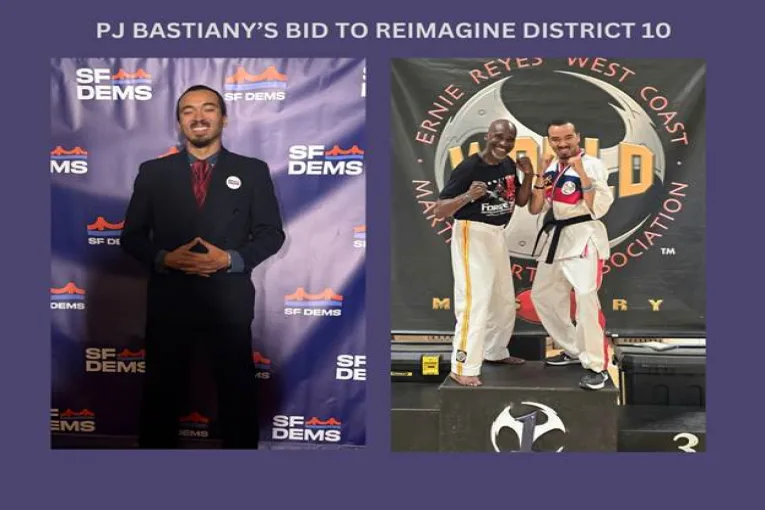
Into this landscape steps Pearci “PJ” Bastiany, a new-generation candidate for District 10 Supervisor whose life experience places him squarely at the intersection of policy, discipline, and community service. At 30 years old, Bastiany represents a cohort of San Franciscans who came of age amid economic instability, rising inequality, and a growing distrust of institutions that promised opportunity but delivered displacement.
Born in San Jose to a mixed African American and Mexican American family and shaped by parents who worked in the defense industry at Texas Instruments and Lockheed Martin, Bastiany’s early life exposed him to both structured systems and their vulnerabilities. Those experiences, combined with years of civic engagement, inform a platform that challenges San Francisco’s conventional playbook on housing and public safety.
At the center of Bastiany’s housing vision is a proposal that breaks from the city’s fixation on ground-up development alone. His Strategic Implementation of Modular and Maritime Housing Solutions argues that San Francisco cannot build its way out of homelessness fast enough using traditional methods. Instead, it calls for the immediate use of underutilized assets—vacant commercial lots, Port of San Francisco piers, and even historic maritime vessels—to create transitional housing communities. What distinguishes this proposal is not simply its creativity, but its insistence on integration. Housing, in Bastiany’s framework, is inseparable from workforce development, community-led security, and economic dignity. The goal is not warehousing people out of sight, but stabilizing lives while creating pathways toward permanent housing and employment. In a district long subjected to displacement disguised as redevelopment, that distinction matters.
Bastiany’s emphasis on structure and discipline is not theoretical. A first-degree black belt in both Taekwondo and Karate, currently training for his second-degree test with aspirations of competing for Team USA in the 2028 Los Angeles Olympics, he approaches public policy with the mindset of preparation, restraint, and accountability. That philosophy carries directly into his most controversial—and most discussed—proposal on public safety.
In August 2024, Bastiany announced the Martial Arts Community Policing Initiative (MACPI) through his company, Martial Artists For Hire (MAFH) Security, LLC. Framed as a response to both rising public safety concerns and persistent staffing shortages within the San Francisco Police Department, MACPI proposes deploying trained martial artists as visible, unarmed security personnel in retail corridors, schools, and neighborhoods.
These martial artists would serve as storefront security, school hall monitors, and overnight patrols, equipped not with firearms but with emergency alert systems designed to summon SFPD when necessary. The theory is straightforward: deterrence through presence, de-escalation through training, and intervention without lethal force.
It is a model that challenges San Francisco’s binary debate between over-policing and under-protection. By emphasizing discipline, physical control, and restraint, MACPI seeks to occupy a middle ground—one where safety does not automatically translate into escalation.
Bastiany’s language around the initiative is unapologetically direct. Drawing from martial arts philosophy and lived experience, he frames the program as a rejection of violence rather than an embrace of it. “Martial artists do not kill people,” he has said, positioning the initiative as a rebuttal to a public safety system too often defined by tragic outcomes rather than preventative success.
His broader résumé reinforces that framing. A graduate of the University of San Francisco with both undergraduate and Master of Public Administration credentials—earned through a dual-degree pathway with the University of Southern California—Bastiany has operated in nonprofit, media, and business spaces. His work with organizations in the Fillmore District, his service with the SF NAACP Young Adult Committee, and his reporting for the SF Bay View reflect a consistent throughline: civic engagement paired with accountability.
For District 10 residents, the question is not whether these ideas are bold—they clearly are—but whether they can be operationalized equitably and responsibly. The district has seen no shortage of experimental policies imposed without community consent or long-term accountability. Any alternative model, especially one operating alongside traditional law enforcement, will demand rigorous oversight, transparency, and clear boundaries.
Still, what cannot be dismissed is the coherence of Bastiany’s broader argument: housing without safety is unstable, and safety without dignity is unsustainable. His proposals attempt to address both simultaneously, rooted in the belief that communities are safest when they are housed, employed, and treated as assets rather than liabilities.
As the 2026 District 10 race takes shape, voters will have to decide whether innovation is a risk worth taking—or whether the greater risk lies in continuing with systems that have already failed them. What Bastiany offers is not incrementalism, but a challenge: to imagine a district where shelter and safety are not privileges negotiated through bureaucracy, but rights enforced through accountability.
In a city long trapped between caution and crisis, District 10 may soon decide whether it is ready for that kind of departure.
As always, here’s our song/video for this article:
Trey Pendley – Daddy’s Son (Official Music Video)
ABOUT THE AUTHOR
Malik Washington is a journalist, community advocate, and co-founder of Destination Freedom Media Group. He has been a published journalist for over 14 years. His reporting focuses on criminal justice, housing, environmental justice, and the lived experiences of communities too often marginalized or ignored. He is a regular contributor to the Davis Vanguard and other independent media outlets. You can reach him via email: mwashington2059@gmail.com or call him at (719) 715-9592.
Suggestions or leads on stories are always welcome.
Please follow us on:
Facebook: https://www.facebook.com/destfreedom13
Instagram: https://www.instagram.com/destinationfreedom13/
X: https://x.com/dest_freedom
Follow the Vanguard on Social Media – X, Instagram and Facebook. Subscribe the Vanguard News letters. To make a tax-deductible donation, please visit davisvanguard.org/donate or give directly through ActBlue. Your support will ensure that the vital work of the Vanguard continues.
