
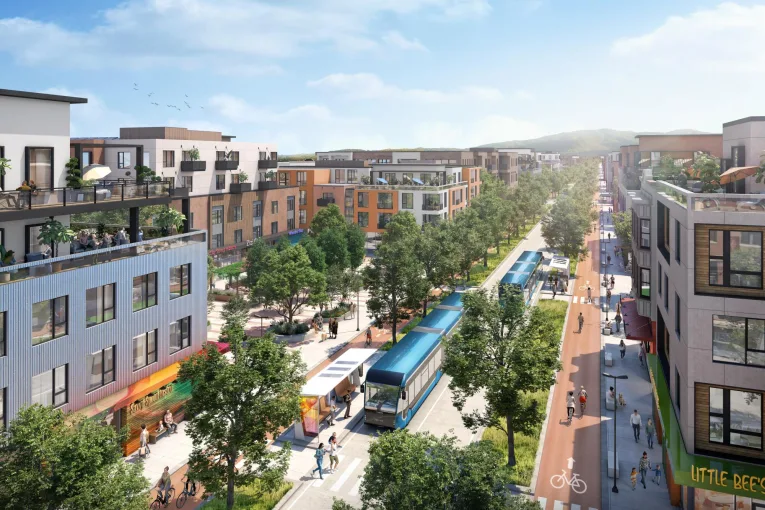
A recent Los Angeles Times op-ed by UC Davis law professor Chris Elmendorf and an extensive public response from Solano County resident and educator Jim DeKloe have brought renewed attention to a central question in California’s housing politics: what should the state learn from the California Forever proposal, and who should decide the fate of transformative land-use projects?
Although both pieces address the same controversy, they offer sharply different interpretations of what is at stake, where the real problems lie, and what lessons policymakers should take from the ongoing debate.
The contrast between the two perspectives is not simply a disagreement over one development proposal. Instead, it reflects a deeper tension between statewide housing goals and local governance, between academic models of planning reform and the lived experience of communities navigating rapid change, and between abstract theories about how to fix California’s housing shortage and the granular realities of a project proposed for a highly specific and historically protected landscape.
Elmendorf’s Los Angeles Times piece places California Forever within the larger context of California’s decades-long housing underproduction. His core argument is that California’s fragmented land-use system—where counties, cities, special districts, and multiple regulatory layers all hold veto points—makes it nearly impossible to approve large-scale projects that could meaningfully expand the state’s housing supply.
He draws parallels to renewable energy, citing legislation in Massachusetts and California which allows a single state-level official to approve projects deemed to have statewide significance. For Elmendorf, innovations in housing governance that reduce veto points could be essential to solving California’s affordability crisis.
From this vantage point, the California Forever proposal is not primarily a referendum on the viability of a new city in eastern Solano County but rather a case study in how difficult it is to build anything ambitious under existing rules. Elmendorf does not endorse every aspect of the proposal, but he suggests that the resistance it has encountered—legal, political, and procedural—illustrates why California needs new tools for approving housing.
His piece argues that localized opposition, even when rooted in legitimate community concerns, has contributed to the statewide shortage; thus, a reform that shifts some decision-making to the state could provide a more predictable, coherent path for large housing projects.
In contrast, Jim DeKloe’s lengthy response—sent directly to the op-ed authors and circulated widely within Solano circles—focuses not on the theoretical problem of housing scarcity but on the specifics of this project: how the land was acquired, how the community was engaged, what the environmental constraints are, and what financial burdens may fall on existing residents.
He emphasizes that Solano County’s Orderly Growth initiative has guided development for decades by encouraging housing within existing city boundaries rather than through leapfrog expansion. From his perspective, the proposal’s location under the Travis Air Force Base flight path, far from transit, and at the edge of the county’s agricultural core undermines the central planning principles that local residents and officials have long supported.
DeKloe documents a series of events—secret land purchases, litigation against farmers who resisted selling, shifts in messaging from the developer, and public information sessions that generated heated reactions—that he argues eroded trust.
He also cites polling indicating widespread opposition among Solano County residents and points to the company’s failed effort to win voter support in a previous initiative attempt.
To DeKloe, these episodes show not just flaws in the proposal but a broader disconnect between the project’s backers and the community they hope to build within.
Where Elmendorf focuses on systemic housing barriers, DeKloe highlights the fiscal risks of creating a sprawling new city with extraordinary infrastructure demands.
He argues that sewer systems, schools, transportation networks, and emergency services for a city of the size envisioned by California Forever could cost tens of billions of dollars—far more than the property tax revenue the new city might generate.
For him, this raises the question of who would ultimately bear those costs and whether the proposal’s benefits would justify the burden placed on Solano County taxpayers.
These two essays, taken together, illuminate why the California Forever proposal has become a symbolic battleground in California’s broader housing debate. Supporters of state intervention often view local resistance to projects—whether infill, suburban, or exurban—as part of a pattern that limits housing production statewide.
From that perspective, the specifics of any single project matter less than the structural dynamics that prevent supply from keeping up with population and economic growth. Elmendorf’s piece articulates this view: the state cannot achieve affordability without mechanisms to overcome local gatekeeping.
But critics of California Forever, including DeKloe, question whether this particular project is an appropriate example to use in making that argument.
They note that Solano County is not a high-opposition jurisdiction in the mold of many Bay Area cities.
Several Solano cities have certified Housing Elements, have rezoned industrial land for housing, and are pursuing infill growth in downtowns and transit corridors.
For those residents, the proposal to build an entirely new city far from job centers, in a location with significant noise and airspace constraints, is not a test case for statewide housing reform but an outlier whose flaws have little to do with the typical challenges facing infill or suburban housing projects.
The debate also raises a fundamental question about democracy and governance: should California empower a state-level authority to approve transformative development proposals over the objections of local voters and officials?
Elmendorf frames such authority as a necessary reform to address the mismatch between local incentives and statewide housing needs. DeKloe sees it as a troubling centralization of power that could force communities—especially those with limited resources—to absorb projects that carry long-term costs and uncertain benefits.
It is this clash of frameworks, rather than any single factual disagreement, that makes the exchange noteworthy.
One side emphasizes urgency, scalability, and statewide outcomes; the other stresses place-based planning, procedural legitimacy, and community trust. Both raise legitimate points.
California’s housing crisis is real, and many communities have resisted needed growth. At the same time, the specifics of large proposals matter, and ambitious visions can falter if they fail to address local concerns or demonstrate transparent, feasible plans.
The California Forever debate is still evolving, with environmental review and regional discussions underway.
But the exchange between Elmendorf and DeKloe reveals how far apart stakeholders remain on the question of how to balance the state’s housing mandate with local autonomy.
Whether or not the proposal ever moves forward, this tension will continue to shape California’s housing policy in the years ahead.
Follow the Vanguard on Social Media – X, Instagram and Facebook. Subscribe the Vanguard News letters. To make a tax-deductible donation, please visit davisvanguard.org/donate or give directly through ActBlue. Your support will ensure that the vital work of the Vanguard continues.

Every time I see mention of California Forever I’m reminded of a similar effort that took place in 1912, when Patrick Calhoun, the grandson of Vice President John C. Calhoun, and a group of investors working under the name Solano Irrigated Farms bought up 175,000 acres in the same area and proposed a new city as the next Big Thing. Solano City was intended to have 75,000 residents, and would be served both by rail from the Bay Area and by canal to the Sacramento River. They got hopelessly overextended and went bust in 1913, but not before building a temporary hotel and bringing out prospective buyers to choose their lots.
In 2001 I was hired to survey a ranch on Creed Road west of Highway 113. You could still see (and probably still can see) the remains of the enormous reservoir that was intended to serve Solano City.
An article on Solano City that Jerry Bowen wrote for the Solano Historian is a great read. I ratholed a copy of it here for anyone interested:
https://members.dcn.org/jhframe/Solano%20City%20Article.pdf
I generally support Elmendorf’s overall critique of California’s housing policies, but California Forever has too many warts and potential pitfalls to be a vehicle to address this issues. Other cities are building housing in Solano–Vacaville housing in Pena Adobe that will dramatically change the characteristics of that valley. Elmendorf should look elsewhere for better examples that fit into a model that doesn’t expand sprawl. He could start here in Davis by supporting changes to Village Farms and Willowgrove that could make these more acceptable to local residents.
I understand from Elemdorf’s own self-description on Twitter that he’s a “denizen” (resident) of San Francisco, not Davis. As such, why should he have any say regarding what occurs in Davis (or anywhere outside of San Francisco), per your own “qualification requirements”?
Also, there’s a good chance that Elmendorf is a benefits from rent control, unless he owns the building that he lives in.
And along those same lines, why are YOU chiming in regarding a proposed city that’s in an entirely different county than the one that you live in? Doesn’t that violate your own commenting standards?
I guess you missed the point of his analysis: “From this vantage point, the California Forever proposal is not primarily a referendum on the viability of a new city in eastern Solano County but rather a case study in how difficult it is to build anything ambitious under existing rules. “
I asked what gives Richard (or Elmendorf) the “right” to comment on developments in cities/counties that they don’t live in, using Richard’s own criteria for commenting.
What makes him think that his comments are “welcome” in those locales? (As a side note, some Davis residents don’t agree with Richard even though they live in Davis. With Village Farms being a perfect example of that.)
And why would Richard be encouraging Elmendorf to put forth comments regarding specific proposals in Davis, when he apparently doesn’t even live in Davis?
Why the lack of consistency regarding Richard’s “rules” for commenting?
This isn’t a one-time occurrence – it’s a pattern with Richard regarding “me” in particular. And it’s something that YOU have encouraged.
Again, you seem to have missed my point about what Chris is actually commenting on. You and Richard can argue over who can comment on what.
You have enabled the scenario in which Richard and I can “argue” over who is qualified to comment. Is this actually something that you want to continue to encourage?
The Vanguard has also permitted you to comment, so it’s moot.
Regardless I’m more interested in discussing several facets of Elmendorf’s piece. I tend to not believe that the Forever California is the right approach, but if you’re correct that the current statewide efforts have “failed” (which I believe is premature at best), then the state is going to have to go outside of the box to address the housing problems.
“but rather a case study in how difficult it is to build anything ambitious under existing rules.”
It is a case study in how not to go about it.
Definitely true. But we can still learn a lot of very interesting things from it. One of the points, I think Keith Echols raised in other contexts is the idea of simply creating a new city as a means to attempt to sidestep local neighbor concerns is worth considering. And I believe that’s part of Chris’ point as well.
“…simply creating a new city”
I would remind you how Measure A came into being in Solano County in the first place: it was a direct response to the Manzanita city proposed by developer Hiram Woo in the 1980s. It would have been right next to Winters, but in Solano County.
We voted it down. We passed Measure A and we renewed Measure A. Look at the margins of those votes.
Please change “sidestep” to “impose nearby development onto” and your sentence will be more accurate.
Just for a little background as to why nobody trusts this development team: https://ca.news.yahoo.com/history-lesson-mega-rich-bullies-040120894.html
Here are the land buyers per the NY Times:
“Michael Moritz, the billionaire venture capitalist …
Jan Sramek, a former Goldman Sachs trader …
Reid Hoffman, the LinkedIn co-founder, venture capitalist and Democratic donor;
Marc Andreessen and Chris Dixon, investors at the Andreessen Horowitz venture capital firm;
Patrick and John Collison, the sibling co-founders of the payments company Stripe;
Laurene Powell Jobs, founder of the Emerson Collective; and
Nat Friedman and Daniel Gross, entrepreneurs turned investors. Andreessen Horowitz is also a backer.
It was unclear how much each had invested.”
https://www.nytimes.com/2023/08/25/business/land-purchases-solano-county.html
DS say, “Measure A came into being in Solano County in the first place: it was a direct response to the Manzanita city proposed by developer Hiram Woo in the 1980s.”
Allendale could have simply annexed Manzanita City to bypass Measure A :-|
Note: that’s a joke based on the sickening tripping over themselves of Suisun City and Rio Vista to Annex C-Forever.
And can we stop calling it by that stupid developer-driven name? Instead, how about: Catastrophia Forever, Congestifonia Forever, CommuterHellia Forever, Craptastopia Forever, Carmageddia Forever, Crapifornia Forever, CramItInofornia Forever, Crowdefornia Forever, Cramifornia Forever, Votes?
” . . . but if you’re correct that the current statewide efforts have “failed” (which I believe is premature at best), then the state is going to have to go outside of the box to address the housing problems.”
Regarding being “correct”, it’s not me who is noting that the state’s mandates are failing (the current round, let alone the next round). It’s the YIMBY group itself that’s noting that. Some locales don’t even have an approved housing element, years after they were supposedly “required”. I haven’t even seen any locale that’s “on track” to adhere to the fake requirements.
https://cities.fairhousingelements.org/
Regarding “California Forenever”, I can’t help but note some parallels with DISC. That is, the same type of people who want to “create” housing shortages (by supposedly adding/creating jobs) are the same people who then complain about housing shortages. Which tells me that they weren’t actually concerned about “housing shortages” in the first place.
That’s how you get Silicon Valley and housing that low/middle-wage workers can’t afford, assuming, of course, that the jobs are actually created (and not subsequently eliminated).
It is you making the argument and you’ve done so repeatedly.
It’s worth noting, that the developers seem to be willing to invest billions in belief that you’re wrong about the need for housing.
You haven’t ever been able to actually respond to that observation (regarding DISC, for example).
As far as investing billions, THAT’s your measurement regarding whether or not housing is needed? (Apparently, New York also “needs” more high-rise luxury apartments displacing current residents, as well.)
Seems to me that they expect to make billions more than they invest from those same future residents, unless they’re running a charity.
1.6 kids per woman – nationwide. That’s not a recipe for housing need, going forward.
What you’re referring to is (as usual) “poaching” of people who currently live somewhere else. Housing doesn’t “create” people.
For the most part, these people would likely come from an area where they currently have less environmental impact.
For sure, that applies regarding the environmental impact of creating a new city on ranchland.
They are betting money that someone will buy their homes… otherwise they wouldn’t be willing to do it.
So?
How does that relate to ANYTHING I just said?
I’m pretty sure there’d be a market demand for new housing in Yosemite, as well. Probably should just go ahead and build it based on that, right?
Trump might be willing to sell it off for such a purpose – I think you should write a letter telling him of your alignment with that type of thinking. You, the YIMBYs, and Trump – all making the same type of arguments. Let the market decide.
“I haven’t even seen any locale that’s “on track” to adhere to the fake requirements.”
There’s a button on the side that allows you to select the ones on track, it’s not a ton but more than twenty including Dixon
O.K. – I figured there might be some (didn’t know it can be filtered).
Out of how many cities/counties with such “requirements”?
I’m guessing that Dixon and possibly Citrus Heights (haven’t seen them lately) supports sprawl regardless of state “requirements”. They’d probably be “on track” (or exceeding the requirements) if there weren’t ANY “requirements”.
Don’t know about Fort Bragg – did the state “require” something like 3 low-income housing units, there?
By the way, when government funds are used to create Affordable housing in one locale, that means (BY DEFINITION) that those same funds are not available for use in other locales where the actual need might be greater.
Did you look to see how many locales don’t even have an approved housing element, at this point? Apparently, they’re waiting for the next round to submit it?
You know what else Dixon has? No visible homeless! And it’s NOT because they meet their housing ‘quotas’ :-|
“You know what else Dixon has? No visible homeless!”
How do you know?
“Visible”
All seven cities in Solano County, and the County, have Housing Elements that are in compliance.
“and who should decide the fate of transformative land-use projects?”
“Transformative” . . . hah that’s a good one :-(
This week, I got a tour of Mountain House, California’s newest city. 8000 new homes, many with ADU’s. 8000 kids in the new public schools. It occurred to me that the only thing keeping Davis from being a vibrant community is the lack of will to build. Current conditions in Davis are self inflicted.
RG say, ” . . . will to build”
You say that like it’s a good thing.
You and I agree that J/R/D should be scrapped. Not so much that Davis should massively expand or that new cities should be built in open areas with already-clogged auto-centric transportation. What we need is a massive (many tens of billions) expansion of our rail transportation network so people are incentivized off the highways, not forced into parking-maxiimum neighborhoods with no decent alternatives. I’m not talking about the soccer-mom trips, I’m talking about the intercity trips that we actually can make a dent in if we shift away from highways dominance. Then we can talk about growth. In about a half-century. When cities can grow around rail lines again, rather than highways trying to ever-expand while California leaders talk the talk, but do not fund the fund.
I want to compliment the Davis Vanguard for their willingness support a true debate over the California Forever proposal. There is no real debate here in Solano County – the planning, politics, and maneuvering are being carried out behind closed doors within the tiny city of Suisun City. Information dribbles out to the public on a minimal need-to-know basis. And the plan changes every time it’s presented to the public – in the Silicon Valley spirit of “move fast and break things,” they forget that the public didn’t attend the last meeting in the smoke-filled room (although now they are latte filled). Thanks.
Since this is primarily a Davis/ Yolo County audience, let me see if I can Yologize the narrative. Do this thought experiment. Let’s say that the billionaire Silicon Valley nouveau robber baron land speculators had picked on you rather than us. Let’s say that this billionaire investment group secretly purchased a hundred square miles in Yolo County – double the geographic size of the City of San Francisco – and they would like to build a self-contained, mixed-use utopia in your county. They secretly acquired the land – zoned for ag – and sued the family farmers who wouldn’t sell.
We are talking about a huge scale. They are going to plop a city into the middle of Yolo County the size of Oakland. If that doesn’t resonate, these cities are the same size: Minneapolis, Bakersfield, Tulsa, Tampa, Arlington TX, Aurora CO, Wichita. And these cities are smaller: New Orleans, Cleveland, Honolulu, Anaheim, Lincoln, Riverside, Stockton, Orlando, Newark NJ, Cincinnati, Pittsburg PA, Durham NC. This city would be the biggest city in 19 states. You didn’t plan for this. Surprise.
There are no plans for the new city, of course, in the Yolo County General Plan, and it isn’t on the RADAR of any of the cities. Surprise. But it’s announced, and a poll shows that a supermajority of the citizens oppose – partly because it’s considered urban sprawl, and partly because no one trusts the proponents. (BTW – the City Manager of Suisun City said publicly “we don’t trust California Forever either.”)
So the proponents go to the Yolo County Board of Supervisors. They don’t like the answers that they get (the County requires an agriculture mitigation ratio that’s too high for them) or they think that it will take too long, so they bypass the county and shop for a cash-strapped city (all of them are cash-strapped) willing to annex the property. Davis doesn’t want anything to do with it, so the proponents play Esparto against Winters and decide on Winters. So the proposal is to make Winters the ninth largest city in California. And the investors will pay Winters $10 million if this goes through.
The proposed city site is 7 miles away. So Winters is going to have to cherry-stem annex the new city to create a New Winters that has two lobes separate by undeveloped land – the old town and the new city separated by blank space. And annex some ranchers along the way that aren’t excited about the prospect of being in a city.
The traffic (which will be minimal because this city is self-contained) will be channeled to Interstate 505 and Highway 113 through the Yolo County country roads
What the LA Times Op Ed got wrong, is that the County doesn’t really have a say. This decision will be made by the Local Agency Formation Commission (LAFCO). The Op Ed argued that “the County shouldn’t have a veto power.” They don’t. Winters applies to LAFCO and can get the annexation over the objection of Yolo County. The land is currently unincorporated under County jurisdiction, but the County doesn’t really have a say – it’s LAFCO. The neighboring cities don’t have a say – except through their two representatives on LAFCO.
Winters is going to ultimately administer a city of over 400,000 people. They are going to have to build 70 schools and expand their school population from 2,000 to 65,000. They are going to go on the hook for a minimum of $49 billion in infrastructure. And remember, this is a self-contained city and clearly not a bedroom community for commuters to Sacramento or the Bay Area. The 160,000 million dollar houses – a quarter of which will immediately be snapped up by investors – will clearly help with housing affordability.
I don’t imagine that the citizens in the charming City of Winters would be too excited about becoming a mega-city. But it doesn’t matter. You just need 3 votes in Winters and 3 votes on LAFCO. And if you don’t get those votes there is a proposal floating around to have a statewide land use czar that could overrule this pesky democracy stuff that might come up with an answer different than land speculators or armchair urban planners.
I hope that this comment didn’t come off as snarky; my original title was “A Modest Proposal” but I cut out the poor attempt at Swiftian satire. I thought that this Davis Vanguard article fairly presented both sides. The opposition to California Forever contains many die-hard housing advocates. And I travel the County advocating for economic development (biomanufacturing) on behalf of the County. It’s just that we don’t think that this is anything but a land speculation scheme.
If they could win a county-wide election, I would shut up and help them build it. Solano County is rewriting its General PLan next year – they could have gone through that process. There has been no public input – no public process. The Deputy City Manager for Suisun City – he is working full time on California Forever and his whole salary and benefits are being paid by them – said last Monday, “this isn’t our proposal, this is the applicant’s proposal.” OK, so there isn’t even input from elected officials. I meant the above as a satire, but building this city in Yolo County would actually make more sense. It wouldn’t be under the flight path of Travis Air Force Base for a starter. And it wouldn’t be in a traffic cul de sac. The site was chosen because the land was cheap and because its commutable to SF and Sac – and the land was cheap because it was (and remains until the annexation) the best protected farmland in California.
Here’s what I wrote to LAFCO: Force Base makes that land undevelopable.
“We have always been proud to hail from Solano County whose Orderly Growth Initiative
showed the rest of California how growth can be accommodated while minimizing sprawl. This
approach was copied by Napa County to preserve their wine industry by preventing McMansions
on “Wine Country Estates.” It has been echoed in Ventura County, an area in the path of the Los
Angeles sprawl pressure. This echoes the approach of the Greenbelt Alliance of encouraging
growth within city limits and excluding development outside. Many of us serve as housing
advocates and others of us advocate for industrial development within existing cities. The
actions of Suisun Valley could hamper these efforts.
We lament that the twin threats of California Forever and now Suisun City’s sprawl
proposal threaten to trigger a renewed growth war. We lament that Suisun City has placed Rio
Vista into the position that they are in. We do not want Solano County to gain a reputation of
being “anti-growth,” a reputation that could stymy infill development.” And I will add that if California Forever fails, it will feed the narrative of “California Can’t Get Anything Done” or the narrative that “California isn’t business friendly.” This idea to have Suisun City (population 29,000) expand to 430,000 when they can’t even run their small city is just dumb. I call it Worthy of Ridicule. I know that the Abundance Doctrine hates talking about process, but there is a planning process that should involve the public that isn’t being followed – and this is a big decision – you don’t want to make a mistake.
I’m wondering how the vote will actually go down with LAFCo. I don’t know how many voting members Solano LAFCo has, but if the county reps oppose the plan and enough of the city reps join them, then the plan may not be a done deal. Recall that LAFCo is charged with promoting orderly development, and if the cherry-stem nature of the connection to Suisun City is as transparently disorderly as it sounds, LAFCo may have a hard time making an “orderly” finding.
My guess – and this is merely a guess – is that it’s going to be close. If I were to handicap it right now, I would give it 50-50. We have a pretty fair LAFCO. Did we mention that this land is not yet within the Suisun City Sphere of Influence – they have to do that too. Again, the whole proposal just came out of the blue – it isn’t in any planning document. So my prediction is that the LAFCO staff is just going to pummel the “worthy of ridicule” proposal. If you read the Knox-Cortese-Hertzberg Act that established LAFCO, this proposal violates ever premise. It violates all of the mandatory standards and most of the discretionary standards – the staff will flail it. But that doesn’t necessarily predict the LAFCO vote. LAFCO is made up, of course, of two mayors, two members of the Board of Supervisors, and a public member – the current public member is a former mayor. Mayors often side with the other cities. The Suisun City Mayor is an alternate on LAFCO. If the ongoing recall against her succeeds, it might alter the calculus. Of course no one is publicly stating their position – it would disqualify them.
There’s another interesting rumor floating around – and I don’t know how to grade it. Again, this proposal would have Suisun City (population 29,000) swell to 430,000 – the size of Minneapolis, Bakersfield, Tulsa, Tampa, Arlington, Aurora CO, Wichita and bigger than Cleveland, New Orleans, Honolulu, Anaheim, Lincoln, Riverside, Stockton, Orlando, Newark NJ, Cincinnati, Pittsburg PA, Durham NC. There’s a rumor that LAFCO doesn’t think that they could handle the governance. Of course they cannot. City argues that the growth into that size will occur over 40 years and they will grow into it. Does LAFCO believe them.
There is an interesting new development – a war of words between the City of Rio Vista and the City of Suisun (currently the lead agency). Again, picture the geography of the proposal. The proposal is to build a Minneapolis sized city in the middle of Solano County. Because of Travis Air Force Base, the city would be 7 miles across an expanse of undevelopable land from Suisun City and next to Rio Vista. California Forever went through Suisun City because they had an ambitious Mayor and City Manager looking to make a name for themselves; Rio Vista didn’t really want a city of that size next to them. But, when Suisun City initiated the effort to annex the land (screwing over Solano County too) Rio Vista got dragged along and entered into discussions with CF with rhetoric like “if we aren’t at the table we will be served for dinner.” Here is the Mayor of Rio Vista: https://www.facebook.com/reel/2252605821816405 There was an amazing “update” from the City Manager at last week’s Rio Vista City Council meeting. The City Manager said, “We have not been able to come to an agreement on a revenue sharing agreement with Suisun City despite extensive efforts and being the closest and most impacted community. Due to concerns regarding impacts of added traffic, air quality, noise, aesthetics, population growth and water use — without any of the benefits of development such as increased property tax revenue, economic development or development contributions via a development agreement — the city expressed its interest in annexing the full 22,873 acre project area,” and she called it“final ditch effort” to protect Rio Vista’s interests, since the city has the “potential to experience all of the negative impacts and none of the potential benefits” of the Suisun City expansion. She said that California Forever “rejected that idea and stated they will continue to negotiate with Suisun City, due to (its) being the first to initiate discussions.” So Rio Vista is out so far – even though annexation by distant Suisun City (the current proposal) makes zero sense and if you were to do this project annexation by adjacent Rio Vista would make the most sense. I expect this to end up in court – possibly with each city suing the other.
Does this change the argument? “Less than one in five Suisun City likely voters support California Forever’s annexation and development proposal in their city, according to polling data released Wednesday by Fairbank, Maslin, Maullin, Metz & Associates (FM3) and opposition coalition Solano Together.
According to FM3, total support for the proposal sits at 19 percent (10 percent of respondents strongly support, and 9 percent somewhat support), and total opposition sits at 58 percent (48 percent strongly oppose, and 10 percent somewhat oppose). Undecided voters account for the remaining 23 percent of responses.
California Forever built strong recognition in the community during the last three years, according to the study, as 75 percent of residents indicated that they have heard something about the proposal. However, pollsters note that the familiarity appears to have largely bred contempt. More than two in five voters (42 percent) reported hearing “a lot” about the proposal, which pollsters called “a notably broad level” for a local development project.
“Voters are well-aware of the California Forever development in Suisun City,” the release reads. “That familiarity has yielded remarkably broad, strong and durable public opposition — which changes very little after voters are exposed to messages from supporters and opponents of the development annexation plan.” https://www.solanotogether.org/post/poll-shows-solano-county-voters-overwhelmingly-reject-california-forever-solano-together-calls-for
So basically, after a year-plus and god knows how much spent on public relations, they’re polling even worse than they did countywide when they pulled it from the ballot.