
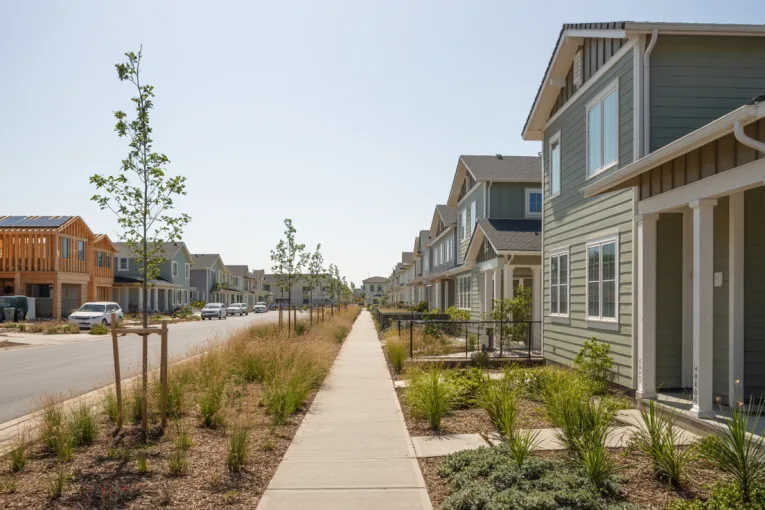
A persistent argument from one of the more extreme critics of new housing is that the statewide mandates have already failed. I couldn’t disagree more, and the proof of the pudding is coming up. If anything, what we are seeing now is the predictable turbulence that comes when a decades-long status quo finally starts to give way.
We’re only about halfway through the RHNA cycle, and yes, a good number of communities have not made significant progress — including Davis. But to take Davis as an example, the fact that the city is currently off track doesn’t mean the cycle is lost. Everything could change very rapidly in 2026 if voters approve two peripheral projects. You could argue that approval is unlikely, but again, that’s where the state stick might come into play. For the first time, cities face serious consequences for failing to zone and approve sufficient housing: HCD oversight, Housing Accountability Act enforcement, and the looming threat of the builder’s remedy.
Those tools barely existed during previous cycles. Now they are part of the daily vocabulary of planning departments across the state. And while critics like to claim that the mandates are toothless, the reality is that we are only in the early stages of cities adjusting to an entirely new regulatory landscape.
My recent drive along Highways 680 and 101 reminded me of this. Construction cranes are still sparse, but they’re visible again in places where nothing at all was building a few years ago. In California’s slow-moving development world, the appearance of cranes is often the first sign that policies are beginning to bite.
But the much bigger point is this: housing systems don’t shift in smooth, linear increments. They move in sudden leaps. One cycle sets the conditions, the next cycle delivers the results. That is the pattern in every state that has attempted a major overhaul of its housing regulatory framework, from Oregon to Massachusetts to New Jersey.
California is no different. And two news stories this week — from two completely different parts of the state — illustrate why pronouncing failure halfway through the cycle is both inaccurate and premature.
Start with San José. This week the Mercury News reported that the city has approved the first project under its new streamlined infill policy. It’s a 540-unit mixed-use proposal at Stevens Creek Boulevard — not monumental in scale, but monumental in timing and process.
Nearly one year after adopting the policy, San José cut the approval time from the typical 20 months to just eight. That is an astonishing achievement in California permitting terms.
The Holland Partner Group project replaces six commercial buildings on a 4.72-acre site and includes two eight-story structures, nearly 60,000 square feet of open space, podium parking, and about 14,000 square feet of retail. While most units are market rate, 27 will be affordable at 50 percent of AMI. Crucially, the project meets the criteria that allow it to bypass public hearings and CEQA review — a cornerstone of the city’s strategy to accelerate infill housing production.
Mayor Matt Mahan captured the stakes clearly: “It takes longer to get a permit to build housing in California than it does for a couple to bring new life into the world. That’s absurd — and it’s why we’re moving faster.”
The city has to plan for 62,200 new units by 2031. It is not remotely on pace. But unlike in past cycles, the political leadership is not shrugging. They are rewriting their processes, lowering barriers, testing new tools, and signaling to developers that the city intends to say yes to infill unless there is a compelling reason to say no.
The first project under a new framework is always the hardest. The next ones come faster. That is how systems change.
Then there is Fresno — a completely different kind of story, but one that reflects the same underlying dynamic.
According to the Fresno Bee, the Southeast Development Area (SEDA), a massive plan for 45,000 homes on 9,000 acres, is nearing approval after decades of false starts. If it moves forward, it would be one of the largest housing expansions in California.
SEDA is controversial. It faces organized opposition from labor groups, environmental justice advocates, Assemblymember Joaquin Arambula, and neighborhood coalitions. Critics warn about a $3 billion infrastructure gap, long-term financial risk, and the potential to draw resources away from existing neighborhoods. Some describe it as financially unsustainable and environmentally questionable.
But the fact that Fresno is seriously considering a proposal of this magnitude — and that it has progressed through the planning commission with a 4-3 vote — tells us something important. Cities that for years resisted growth are now confronting the reality that the state will require them to plan, approve, and ultimately construct large volumes of housing.
Supporters, including Mayor Jerry Dyer, argue that Fresno cannot meet its RHNA goals or its regional housing needs without major new development areas. Opponents argue that Fresno should grow inward rather than outward, and they may litigate or pursue a referendum.
Either way, Fresno is not ignoring the mandates. It is wrestling with them.
That’s what the beginning of a statewide shift looks like. Not harmony — conflict. Not smooth progress — contested decisions. Not immediate compliance — incremental momentum that eventually becomes hard to reverse.
So yes, many cities are off target. Some badly. Some defiantly.
But off target does not mean the system has failed. It means the system is doing exactly what large regulatory shifts always do: creating pressure, forcing change, and destabilizing long-standing patterns of inaction.
California did not arrive at this crisis in one eight-year cycle, and it will not climb out of it in one. But it is finally moving. San José experimenting with aggressive streamlining. Fresno debating 45,000-unit expansions. Los Angeles approving record-setting ADUs. Sacramento dramatically cutting permit times. Even cities like Davis, long resistant to significant growth, may soon face decisions they cannot avoid.
The critics want to freeze the score at halftime and declare the game over.
But the real test will come at the end of the cycle — and perhaps more importantly, in the cycle after that, when the rules are no longer new, the consequences are clearer, and the culture of local planning has fully absorbed the fact that housing production is now a legal obligation, not a polite suggestion.
Rumors of the demise of state housing mandates are exaggerated, if not altogether premature.
The story of this RHNA cycle is still being written. And from where I sit, the direction of movement — slow, uneven, and politically messy as it is — shows progress, not failure.
Follow the Vanguard on Social Media – X, Instagram and Facebook. Subscribe the Vanguard News letters. To make a tax-deductible donation, please visit davisvanguard.org/donate or give directly through ActBlue. Your support will ensure that the vital work of the Vanguard continues.

A planning commissioner told me that Davis is on track to meet its 2029 RHNA goal. The question then is what happens after that as the City acknowledges that it has exhausted its available space within current city limits. But given that we have until 2029, that also means that we don’t need to urgently approve additional housing without fully considering better options.
I’d be interested to see how they arrived at that