
By Nadia Lathan, CalMatters
This story was originally published by CalMatters. Sign up for their newsletters.
Fridge-less apartments dotting the pricey California rental market will soon be a head-scratching relic.
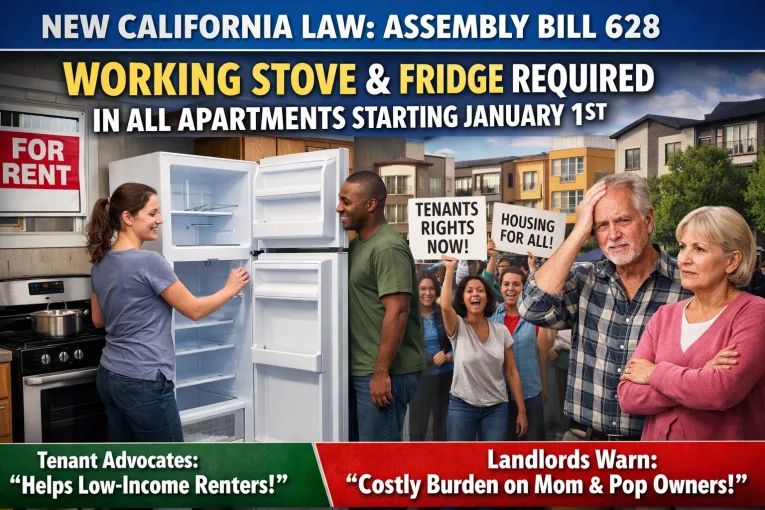
Beginning Jan. 1, landlords will be required to provide all apartments with a working stove and refrigerator thanks to a new state law.
It marks the end of an unusual, decades-long phenomenon mostly in the Los Angeles area where some tenants have had to buy their own appliances after signing a lease.
The law, Assembly Bill 628, takes effect Thursday, and of the numerous housing reform measures passed by the Legislature in 2025, is one of the more unusual ones.
“A working stove and a refrigerator are not luxuries,” Assemblymember Tina McKinnor, a Democrat from Inglewood, said in a statement earlier this year after she introduced the bill. “They are a necessary part of modern life.”
California has the fewest available apartments with refrigerators in the country, according to a 2022 report from the Los Angeles Times that was cited in the bill proposal. There is not a clear reason why, and the mysterious trend is largely region-locked to Los Angeles and Orange counties.
Most tenants don’t have to buy their own bulky appliances. But California law previously required only plumbing, heat and certain other utilities be available. Apartments without the staple appliances will now be illegal unless they are part of housing with communal kitchens, single-room occupancy units or hotels.
Tenant rights groups say the law will help reduce housing costs for low-income residents who have to pay for a refrigerator — which can easily run in the hundreds of dollars — in addition to the first month’s rent and a deposit before moving in.
“To have an added cost of trying to buy a refrigerator and a stove is really economically unfeasible for many tenants,” said Larry Gross, executive director of the Los Angeles housing advocacy group Coalition for Economic Survival.
Realtor groups have said it will spur burdensome litigation for mom-and-pop landlords.
The requirement “will lead to heavier burdens on the courts and a dramatic reduction in the state’s availability of rental housing supply,” Bernice Creager, a lobbyist for the California Association of Realtors, said at a Senate judiciary committee hearing earlier this year.
Enforcement will be up to local governments. In Los Angeles, residents will be able to file a complaint with the city’s housing department if a landlord refuses to provide cooking and refrigerated storage appliances.
Tenants can still bring their own refrigerator and stove if they please, but they will be on the hook for maintenance if they do.
This article was originally published on CalMatters and was republished under the Creative Commons Attribution-NonCommercial-NoDerivatives license.
Follow the Vanguard on Social Media – X, Instagram and Facebook. Subscribe the Vanguard News letters. To make a tax-deductible donation, please visit davisvanguard.org/donate or give directly through ActBlue. Your support will ensure that the vital work of the Vanguard continues.

Honestly not seeing a lot of difference between this type of thing, eviction prevention (aka “no rent” for an extended period of time), or rent control. All of these things are in the same category, and yet the YIMBYs object to rent control (exclusively, it seems). A refrigerator costs next-to-nothing for landlords, and a lot of low-income tenants might qualify for a “free” (subsidized) one in the first place. You don’t necessarily have to own a unit, to qualify for that type of subsidy.
The text of the law mentions “safe” operation: It’s clear to me that this is inclusive of ventilation. Ventilation requirements are already part of the building code, but who enforces this in Davis?
There are no third party inspections during tenant turnover…
I’ve lived as a tenant with a lease and an informal housemate in dwellings here without required ventilation… And I’m an air equity nerd: especially with a lot of younger tenants already overwhelmed with a lot of new responsibilities, how many know what’s going on or to ask their landlords?
This is part of a larger holistic issue, that of interior air equity. Due to regulations and Market expectations, newer multifamily rental housing has filtration and so on… But there’s no follow-up to see how well it works or to see what’s happening in older apartments. Recently, some local government entities and partner organizations have given away things like HEPA, air cleaners and rubber door seals… But it’s somewhat performative if they’re not actually doing a health check on the places where people live. It’s more explicitly performative if landlords aren’t actually required to provide this stuff.
Obviously I’ve asked the City council, County supervisors, the Air District and relevant commissions about this and no one is interested… Inclusive of all the performative equity flag waivers.
For the record, I’m a renter and my stove and oven have required ventilation systems.