By Matt Stone
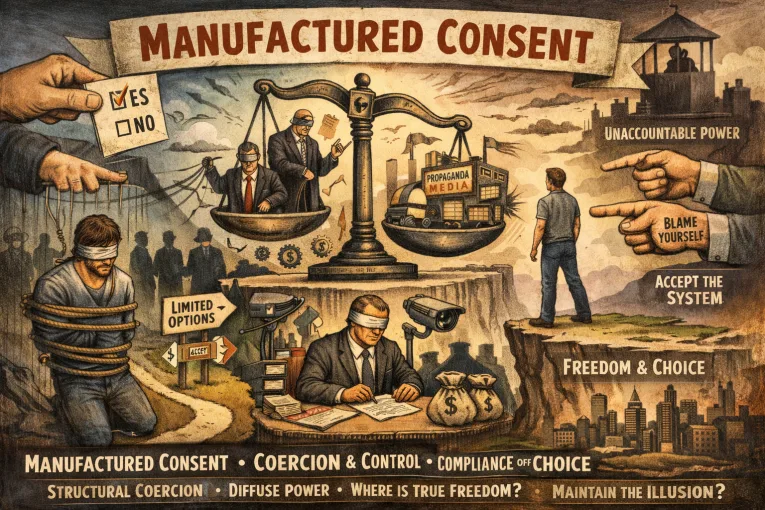
Consent is often treated as proof of freedom. If someone agrees, signs, votes, or clicks accept, the assumption is that the outcome reflects their will. This logic runs deep in modern political and economic life. It underpins elections, labor contracts, housing markets, and consumer culture. Yet consent, as it is currently structured, is frequently mistaken for choice.
Choice implies the presence of viable alternatives. Consent, by contrast, can be extracted under constraint. When options are limited, shaped, or preselected by forces outside individual control, agreement becomes procedural rather than meaningful. The appearance of autonomy remains, but the substance erodes.
This distinction matters because many contemporary systems rely on consent to legitimize outcomes that would otherwise provoke resistance.
In electoral politics, citizens are told they have a choice because they can vote. The act of voting is framed as the ultimate expression of agency. But the field of options is often tightly constrained long before a ballot is cast. Candidates must clear financial, institutional, and media hurdles that filter out most viewpoints. Party structures narrow ideological range. Debates focus on tone and personality rather than policy boundaries.
The result is not a contest of visions, but a managed selection between pre-approved paths. Participation is real but limited. Consent is registered, but power remains insulated. When voters choose between options that differ marginally on substance while preserving core structures, their agreement cannot reasonably be interpreted as endorsement of the system as a whole.
Labor markets operate on similar logic. Employment contracts are entered into voluntarily, at least on paper. Workers consent to wages, schedules, and conditions. Yet the context in which that consent is given is rarely neutral. Healthcare is often tied to employment. Housing costs demand steady income. Savings are thin. Social safety nets are limited.
Under these conditions, refusal is not a realistic option. The choice is not between good and bad jobs, but between employment and precarity. Consent is produced through dependency. The language of freedom persists, but it rests on an implicit threat of loss.
This dynamic is especially visible in gig work and at-will employment, where flexibility is celebrated while risk is shifted downward. Workers are told they can leave at any time, which is technically true. But leaving without alternatives carries material consequences. Consent becomes a survival strategy rather than an expression of preference.
Housing provides another clear example. Renters sign leases agreeing to rising costs, restrictive terms, and limited security. Homebuyers accept long-term debt at inflated prices. These agreements are framed as choices made in a free market. Yet housing scarcity is not a natural condition. It is shaped by zoning, speculation, and policy decisions that limit supply and prioritize investment returns.
When affordable options are systematically constrained, consent becomes coerced by circumstance. Agreeing to unaffordable rent is not an endorsement of the housing system. It is an attempt to remain housed. The contract records consent, but it does not reflect meaningful choice.
Consumer life operates on the same principle at a different scale. People click through terms of service, accept privacy policies, and purchase products designed for planned obsolescence. These actions are voluntary in form but compulsory in function. Participation in modern life often requires access to digital platforms, financial services, and subscription models that offer little room for refusal.
Alternatives exist in theory. In practice, opting out can mean exclusion from employment, communication, or basic services. Consent is gathered through interfaces that prioritize speed over understanding and convenience over agency. The act of agreement becomes habitual, stripped of deliberation.
Across these domains, a pattern emerges. Systems maintain legitimacy by preserving the formal mechanisms of consent while constraining the conditions of choice. People are allowed to agree, but rarely allowed to decide the terms under which agreement occurs.
This arrangement produces a specific kind of compliance. Not enthusiastic support, but resignation. People adapt to the available options, internalize constraints, and frame their decisions as personal responsibility. When outcomes are unfavorable, the burden of explanation falls on the individual. You chose this job. You signed the lease. You voted.
Structural forces disappear behind procedural consent.
This has cultural consequences. When consent is conflated with choice, dissent is reframed as ingratitude. Complaints are met with reminders of voluntary participation. The possibility that the system itself limits options is sidelined. Accountability shifts downward, while power remains diffuse and unaccountable.
Over time, this erodes trust. People sense the gap between formal freedom and lived constraint. They participate because they must, not because they believe. Cynicism grows, but withdrawal is risky. The system remains stable, but hollow.
Recognizing the difference between consent and choice does not require rejecting responsibility or agency. It requires acknowledging context. Meaningful choice depends on the availability of alternatives, the ability to refuse without severe penalty, and the capacity to influence the rules that shape options.
Without these conditions, consent functions less as an expression of will and more as a mechanism of compliance.
A society that values freedom must interrogate not just whether people agree, but how that agreement is produced. It must ask whether consent reflects preference or constraint. Whether participation signals endorsement or adaptation.
Until those questions are taken seriously, consent will continue to be used as evidence of legitimacy, even as genuine choice becomes increasingly rare.
And systems built on that distinction will continue to mistake acquiescence for freedom.
Follow the Vanguard on Social Media – X, Instagram and Facebook. Subscribe the Vanguard News letters. To make a tax-deductible donation, please visit davisvanguard.org/donate or give directly through ActBlue. Your support will ensure that the vital work of the Vanguard continues.