
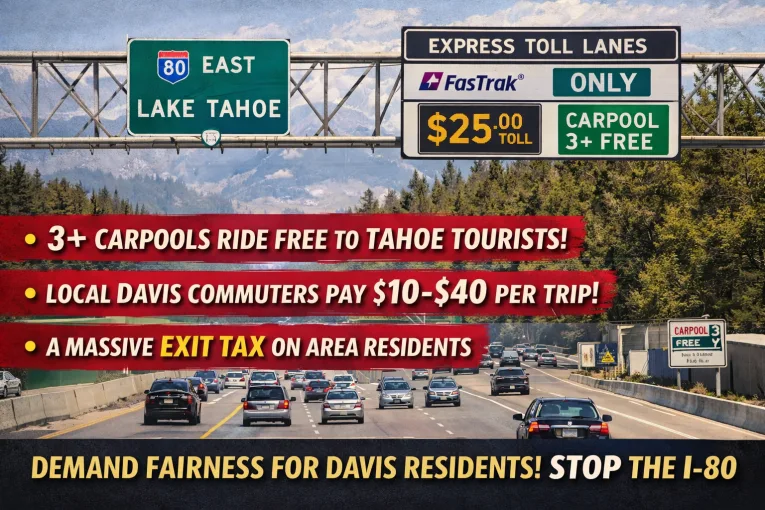
As the region moves toward implementing tolling on Interstate 80, a quiet but devastating policy decision has been made that will fundamentally change the cost of living for every Davis resident. The Capital Area Regional Tolling Authority (CARTA) and YoloTD are moving forward with a plan that prioritizes weekend recreational travelers over the daily workers who keep this community running.
The core of the issue is the 3-plus carpool rule. Under current proposals for the Yolo 80 Managed Lanes, vehicles with three or more occupants will be allowed to use the express lanes for free. While this is marketed as an environmental win to encourage carpooling, the data tells a different story.
Most Davis residents commuting to Sacramento or the Bay Area travel alone or in two-person households. In contrast, the traffic that clogs our freeway on Friday afternoons and Sunday evenings consists largely of Bay Area groups and families heading to Lake Tahoe. By allowing 3-plus person vehicles to ride for free, our local leaders are essentially subsidizing the vacations of out-of-town tourists while placing the entire financial burden of the project on local commuters.
The financial impact is not trivial. Tolls on these managed lanes are dynamic, meaning they increase as congestion rises. Experts and agency staff have discussed peak-hour tolls reaching 10 to 40 dollars per trip. For a Davis worker who does not have two other people to carpool with every morning, this is not a choice; it is a daily exit tax.
Furthermore, by exempting such a large portion of freeway traffic from paying, the agencies are slashing the very revenue intended to fund local transit. Estimates suggest that the 3-plus free policy could cut available toll revenue for transit and social equity programs by as much as 60 percent. This creates a vicious cycle: we have less money to improve the bus and rail systems that would actually get people out of their cars, while simultaneously charging those same people more to drive.
Our local representatives on the CARTA and YoloTD boards must be held accountable for this inequity. To date, there has been no secured guarantee for a Davis Resident Toll Credit or a transponder-based discount for Yolo County workers. Since every vehicle must use a FasTrak transponder, the technology already exists to identify local residents and protect them from these predatory peak rates.
We cannot allow I-80 to become a tiered system where the wealthy and the weekend tourists ride in the fast lane for free, while the people who live here are stuck in the back or forced to pay a king’s ransom just to go to work. It is time for Davis to demand a tolling policy that prioritizes residents over Tahoe tourists.
Michael Curro is 68 year Davis resident
Follow the Vanguard on Social Media – X, Instagram and Facebook. Subscribe the Vanguard News letters. To make a tax-deductible donation, please visit davisvanguard.org/donate or give directly through ActBlue. Your support will ensure that the vital work of the Vanguard continues.

“In contrast, the traffic that clogs our freeway on Friday afternoons and Sunday evenings consists largely of Bay Area groups and families heading to Lake Tahoe.”
Oh, oh. Those Bay Area people again…
“Most Davis residents commuting to Sacramento or the Bay Area travel alone or in two-person households.”
I’ve been told that it’s the other-way around; no workers can afford Davis (and there are no jobs in Davis), so they’re commuting from other communities to UCD.
But the author actually does have a valid point. (Those living in the Bay Area likely view places like Davis as “in their way” in regard to traveling to the Sierra.) One person I spoke with years ago “humorously” wished that the entire valley was permanently flooded, so that they could take a boat across it. But I guess it would have to be a ferry boat to accommodate vehicles, in that case.
Then again, Davis doesn’t own the freeway, or have much say over it. If folks were serious about curtailing vehicular traffic, they’d be protesting developments like the one occurring in Lagoon Valley right now, not to mention Natomas, Elk Grove, Rancho Cordova, Folsom, Roseville, etc.
On the bright side, one of my most-satisfying activities is to observe the backup on I-80 from one of the overpasses in Davis.
First, this is only a tax if a driver chooses to use the toll lane. The remaining (majority of) lanes will still be free. They won’t have to pay anything–they’ll just get to work at about the same pace as they do today.
“Tolls on these managed lanes are dynamic, meaning they increase as congestion rises.”
This means during commute hours, the tolls will be quite low unless there is significant congestion. By its nature, recreational travel to Tahoe occurs after the Friday commute hours to Sac and doesn’t impact the Friday afternoon commute back.
And of course there’s a discount for high occupancy cars. Those cars relieve the need for transit services.
Oh. From the way the article is written it sounded like they were turning the causeway into a toll bridge. No? Then ignore half of what I said . . . and the author should be more careful with their words. If this is just a managed lane, who cares?
This op-ed is misleading and Richard is correct. They are not outright tolling the causeway for all cars. In each direction, they are adding one managed lane and keeping the three existing regular travel lanes. Only the managed lane will have a fee and only during certain days and times. The three regular travel lanes will remain free to anyone who prefers to use them.
I drive across the causeway for my daily commute. I very rarely encounter congestion on the causeway traveling eastbound in the morning. There is more regular congestion coming home westbound in the evening. Most of it seems to be caused by the I-80/ Biz 80 merge or construction, the latter of which should resolve once the project is complete.
I don’t plan to pay to use the managed lanes once they’re open. My commute won’t change, and it should actually improve with the additional capacity from the managed lanes. I’d imagine most Davis residents commuting into Sacramento would similarly simply choose to continue to use the regular lanes for free.
Regardless of your thoughts on the project, I think we can all agree we hope it doesn’t result in the wrong-way driving shown in the AI header image!
Your statement about watching I-80 backups from the Davis overpasses is very naughty. And yes, I admit I’ve done so on a few occasions myself. 🤠
Only if the Majority of Lanes means three, with an added 4th for 3-plus and Toll. Many argue an extra lane induces more auto trips. I’m trying to stay neutral. Retired now, but I’ll admit to commuting to Sac from Davis for 40 years (school and work). I remember it being 2 lanes in each direction on the Causeway.
F it. I’ll drive up to I-5.
But seriously, this is all wrong. If you try to discourage driving, you have to have workable alternatives, or you are just taking people’s money. We already know that all the toll revenue they could possibly make isn’t a drop in the bucket for what meaningful rail transit improvements will cost, nor would those be implemented for many years after even if there was sufficient money. We also know that Sacramento destinations are far too dispersed for a large majority of those traveling by car to switch to bus travel without adding hours to their commute each day, or even for one trip to Sac. There may be a terrifying revolt to these tolls. And after putting up with all this construction for many many years, we should get a least a decade of toll-free travel.
My understanding was the pro-growth factions in Davis will eliminate the need for weekday commutes out of the City. So I guess problem solved. Right?
Good one! That’s what many of the YIMBY’s are claiming anyway.