
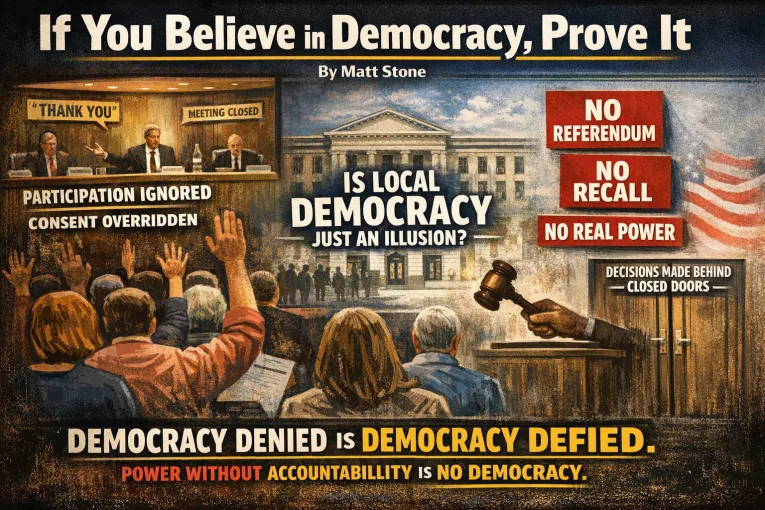
At a certain point, restraint stops being responsible and starts protecting abuse of power.
Local governments love to describe themselves as democratic while doing everything possible to avoid democratic constraint. They solicit input, host workshops, and thank residents for their passion. Then they vote the way they intended to all along. When challenged, they point to process. When pressed, they invoke expertise. When cornered, they appeal to patience.
This is not governance struggling to hear the public. It is governance operating exactly as designed to prevent the public from deciding anything that carries real consequence.
The longer this continues, the harder it becomes to pretend the problem is civic disengagement. Residents show up. They speak clearly. They organize. They return again and again. What they encounter is not indifference, but insulation. Participation is permitted so long as it does not interfere with outcomes.
At that point, the question shifts. It is no longer whether the public is informed enough, civil enough, or patient enough. It is whether those in power are willing to be bound by public will at all. Participation that can be ignored is not participation. Consent that can be overridden is not consent. Democracy that exists only at the discretion of officials is not democracy.
If local leaders genuinely believed in democratic principles, they would welcome limits on their own authority. They would not fear binding referenda. They would not resist participatory budgeting with real financial weight. They would not design recall processes so burdensome they function as deterrents. They would not treat public mandates as optional once the room empties.
Instead, avoidance is framed as responsibility.
Officials warn about risk, complexity, and unintended consequences. What goes unsaid is that the most serious risks are already being imposed without public consent. Displacement, unaffordable housing, environmental harm, and institutional inertia are not abstract dangers. They are lived outcomes of decisions made behind closed doors and justified after the fact as unavoidable.
Democracy is not meant to be comfortable for those in office. It is meant to constrain them. It is meant to slow decision making, force compromise, and make unilateral action impossible. A system that allows leaders to govern smoothly in the face of sustained opposition is not suffering from excess democracy.
It is suffering from a lack of it.
There is a reason meaningful democratic tools remain just out of reach. Binding votes threaten predetermined outcomes. Budget control threatens entrenched priorities. Recall authority threatens political careers. Enforceable mandates threaten the strategy of waiting out public attention until frustration fades.
That is the real line being defended. Not expertise. Not efficiency. Power.
So, the confrontation is simple and unavoidable. Either local government believes residents are capable of governing themselves, or it does not. Either officials are willing to be constrained by the people they represent, or they are not. There is no neutral middle ground where democracy exists in rhetoric but not in practice.
If the public cannot force outcomes, democracy is a brand, not a system.
And if those in power are unwilling to relinquish any of their authority, then the demands for deeper democracy are not radical. They are corrective.
This is the moment where restraint stops being a virtue and starts being a shield.
Follow the Vanguard on Social Media – X, Instagram and Facebook. Subscribe the Vanguard News letters. To make a tax-deductible donation, please visit davisvanguard.org/donate or give directly through ActBlue. Your support will ensure that the vital work of the Vanguard continues.

“If the public cannot force outcomes, democracy is a brand, not a system.”
Force what outcomes? Outcomes that a minority of activists want?
What if the elected officials are doing what they campaigned on and were voted into office for by the majority?
True. I showed up at a meeting in Woodland some time ago, regarding “how much growth” participants would like to see.
The choices presented were as follows:
1. A lot.
2. A REAL lot.
3. Every single inch of land in Yolo county.
I believe that #1 “won”, but I don’t recall any changes as a result of that.
(This is only a slight exaggeration – the meeting actually did occur, and those were the type of choices presented from my perspective. Well, maybe not exactly #3.)
Reminds me of the ‘visioning exercise’ the city put on for the development north of Central Park a few decades back. They wanted what was built, but the Design Guidelines had just passed and they couldn’t do it, so they had this ‘community visioning process’ in which they had what was built as #1, a much larger project as #2, and a massive project at #3. I said #1 was too much, and the whole process was rigged, and I asked that a forth option of leveling the houses that were there, digging a 40′ hole in the ground filling it with water be added to counteract their obviously rigged poll.
The thought has occurred to me that when voters have ACTUALLY had enough with being controlled, they bypass the system that the politicians try to protect (and enact something like Proposition 13).
Ever since that occurred, politicians have attempted end-runs around it (and have been somewhat successful with that).
It will be interesting to see if something similar happens regarding the state’s “growth mandates” at some point. It doesn’t seem likely that they will stand the test of time, when constituents oppose what politicians attempt to force.
So far, it does seem that voters have been asleep at the wheel (and are often “surprised” when something is proposed near them). At which point, they sometimes take it out on the local officials – to no avail. (I’ve seen a couple of examples of the latter across the state.)
This did happen in Davis when voters got sick of the City Council approving periphery project after periphery project and passed Measures D,R & J to override the Council and restrict the ability to expand to the voters. That’s much more democracy-esque. Since you mentioned “unaffordable housing” I’m guessing that wasn’t the ‘democracy’ outcome you had in mind with this article, though you also mentioned ‘environmental harm’ so maybe it was. So many tradeoffs . . .
Measures D, R, and J are exceptions that prove the rule. They were forced into existence precisely because the ‘democratic’ process of City Council hearings had become a rubber stamp for development. Relying on the public to mount a ballot initiative as a last resort when their representatives stop listening isn’t a sign of a healthy democracy; it’s a symptom of its failure.
I’m not suggesting that direct democracy guarantees perfect outcomes, nor that voting always leads to the ‘right’ result regarding housing or the environment. My argument is about the structure of power, not specific policies. There are certainly tradeoffs, but the tradeoff I’m critiquing is the one where citizens are allowed to speak so long as they can’t actually change anything. A system that only respects the public will after they’ve spent years organizing a ballot initiative isn’t democracy… it’s managed dissent.