
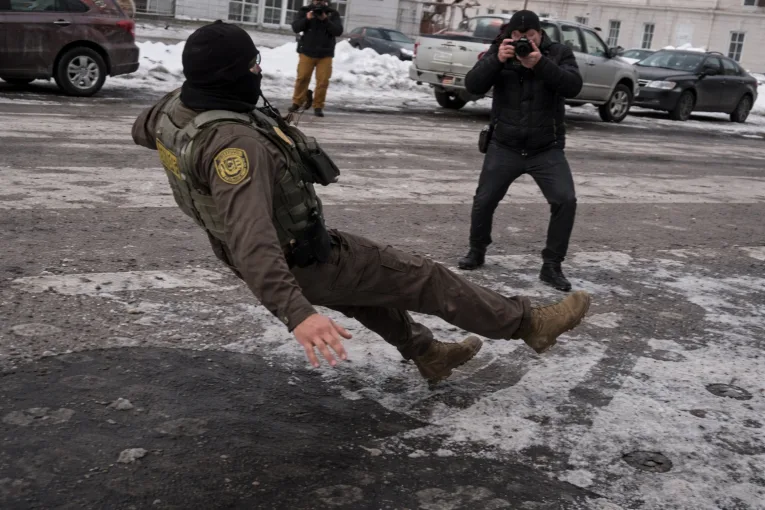
MINNEAPOLIS, Minn. — A viral video showing an Immigration and Customs Enforcement agent slipping on ice while chasing protesters has intensified scrutiny of ICE’s tactics, training and accountability, as federal authorities clash with Minnesota officials over control of the investigation into the fatal shooting of Renee Nicole Good.
The video, posted by NPR and recorded during protests earlier this week, shows an ICE agent losing his footing and crashing onto a frozen street while attempting to chase demonstrators. The clip spread rapidly online, sparking renewed debate over ICE’s claims of professionalism. “It looks like satire,” one viewer wrote online. “But it’s real, and this is a federal officer.”
Civil rights advocates said the reaction reflects a broader erosion of public trust in ICE, an agency that has spent decades cultivating an image of tactical expertise and discipline.
“Law enforcement has always managed public perception very carefully,” said a former police public affairs official. “The idea was that professionalism would justify authority.” Critics argue that image is unraveling amid a steady stream of public failures.
“This is not a single embarrassing moment,” said a former Department of Homeland Security official. “It’s a pattern.”
In October, an article from The Intercept showed video from Whittier, California, displaying ICE agents attempting to detain a handcuffed man during an operation. The man broke free and fled, with two agents chasing him before one collapsed mid-chase and fell to the ground. “Keep going,” bystanders can be heard shouting as the man escaped.
“That incident raised serious safety concerns,” said a policing expert. “Physical readiness is a baseline requirement.”
The piece from The Intercept describes that weeks earlier, an ICE operation in Prince George’s County, Maryland, drew national attention after an agent dropped his handgun during a struggle in the middle of a busy street. The weapon hit the pavement before the agent retrieved it and appeared to raise it toward nearby onlookers.
“It could have gotten way out of control very quickly,” said Raphael Talisman, who recorded the encounter.
A Department of Homeland Security spokesperson later said the individual was resisting arrest, but firearms instructors said the footage showed a clear lapse in weapon retention.
“That’s one of the most basic rules,” said a former law enforcement trainer, according to The Intercept. “You do not lose control of your firearm in public.”
The same article from The Intercept states that other incidents have further damaged ICE’s credibility. In one widely circulated clip, an ICE agent appeared to lock himself out of his own vehicle during an operation. “It’s not funny when you realize these agents are armed,” said a retired federal agent.
The Intercept explains that ICE operations have also raised concerns about training and coordination with other law enforcement agencies. During enforcement actions in Chicago last fall, ICE agents deployed tear gas and pepper balls that struck Chicago Police Department officers.
“They hit their own people,” a CPD source said. “That should never happen.”
As ICE’s street-level conduct draws criticism, the agency is also facing mounting scrutiny over how it is handling the investigation into the killing of Renee Nicole Good, a 37-year-old U.S. citizen and mother shot by ICE agent Jonathan Ross during an encounter in Minneapolis.
Last week, the FBI informed Minnesota’s Bureau of Criminal Apprehension that it would take sole control of the investigation, excluding state authorities from joint oversight.
“I’m not aware of any circumstance in Minnesota where there has been a division like this,” said Amy Sweasy, a former prosecutor with the Hennepin County Attorney’s Office and an adjunct professor at the University of Minnesota Law School.
Homeland Security Secretary Kristi Noem argued that Minnesota authorities “don’t have any jurisdiction” to investigate the shooting, a position echoed and escalated by President Trump, who claimed the FBI withheld materials because state officials were “crooked.”
The Intercept reports that legal experts said the move away from a joint investigation is highly unusual and risks undermining public confidence in the outcome.
“Joint investigations add legitimacy,” said Thaddeus Johnson of the Council on Criminal Justice. Minnesota officials have already questioned the credibility of the federal inquiry. NPR reports that Gov. Tim Walz said it would be difficult to achieve a “fair outcome.”
The Intercept details that on Sunday, Trump referred to Good as a “radical,” saying she was “very, very disrespectful to law enforcement.” Multiple federal prosecutors in the U.S. attorney’s office for Minnesota resigned this week over concerns about how the investigation was being conducted.
Minnesota officials have also condemned the FBI’s refusal to share evidence, including shell casings, witness interviews and Good’s vehicle. Former prosecutors warn the lack of access could cripple any state case. “It is already very difficult to prosecute officers,” said Sweasy.
Legal scholars emphasized that Minnesota retains jurisdiction to investigate potential violations of state law. “There is no blanket immunity,” said Deborah Ramirez of Northeastern University School of Law.
Former FBI special agent Chris Swecker said refusing to collaborate harms justice.
“It’s better to have both agencies working together,” Swecker said.
As ICE faces growing scrutiny for viral missteps, internal failures and an increasingly opaque investigation into a fatal shooting, critics say the agency’s long-cultivated image of professionalism is eroding.
“The problem isn’t embarrassment,” said a former police trainer. “It’s what happens when incompetence meets deadly force.”
Follow the Vanguard on Social Media – X, Instagram and Facebook. Subscribe the Vanguard News letters. To make a tax-deductible donation, please visit davisvanguard.org/donate or give directly through ActBlue. Your support will ensure that the vital work of the Vanguard continues.
