
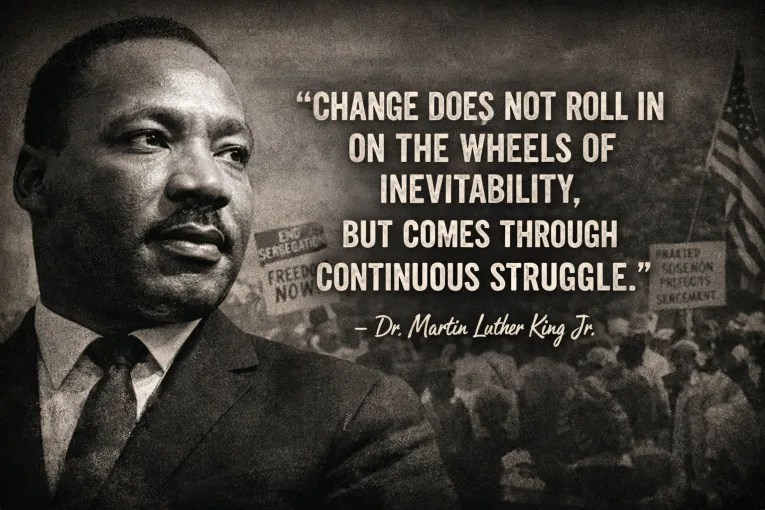
- Martin Luther King, Jr., is often sanitized as a prophet of harmony, but his true legacy is more complex.
- King argued that injustice is sustained by silence and passivity, not just open hatred.
- King believed that riots were the result of systemic injustice, not irrational behavior.
Martin Luther King, Jr., has been carefully domesticated by history. Each January, he is celebrated as a prophet of harmony, a champion of love over hate, a dreamer who asked only that Americans judge one another “by the content of their character.”
What is less frequently recalled—and more frequently resisted—is King’s insistence that injustice is sustained not only by open hatred, but by silence, passivity, and the polite refusal to confront power.
King did not misunderstand disorder. He understood powerlessness. Long before contemporary debates about antiracism, neutrality, and “color blindness,” King articulated a devastating moral diagnosis of American society: that when people are systematically ignored, excluded, and exploited, unrest is not irrational—it is a crying out in the wilderness.
“A riot,” King wrote, “is at bottom the language of the unheard.”
That was not an endorsement of violence but rather a condemnation of a society that had refused to listen by any other means.
King’s argument remains unsettling because it rejects easy moral binaries, condemning riots as self-defeating and destructive while locating their origins in slum conditions, educational deprivation, and economic exploitation.
Touring Watts after the 1965 uprising, King and his colleagues encountered young people who declared joyfully, “We won.” When asked how they could claim victory amid death and devastation, the response was chillingly precise: “We won because we made them pay attention to us.”
In this telling, the riot was not a solution but an act of desperate visibility.
Perhaps King’s most provocative insight was his observation that “the amazing thing about the ghetto is that so few Negroes have rioted.”
This was not praise of restraint for its own sake but a warning about endurance pushed to the breaking point. A society that normalizes exploitation should not be surprised by eruptions of desperation; that they occur so infrequently is not evidence of justice, but of how much injustice people have learned to bear.
This moral framework—centering systems, power, and policy rather than individual animus—finds a clear contemporary echo in the work of Ibram X. Kendi.
In recent years, Kendi has argued that rejecting prejudice without opposing racism merely disguises neutrality, a political posture whose logic is older than its terminology.
Kendi’s core argument—that “not racist” is an inadequate identity because it implies neutrality—maps closely onto King’s critique of white moderates who preferred order over justice and abstract harmony over structural change.
King’s famous rebuke from the Birmingham Jail was aimed not at overt racists, but at those who claimed sympathy while opposing disruption.
The problem, King wrote, was not simply hatred, but a devotion to “negative peace which is the absence of tension,” rather than a positive peace grounded in justice.
Kendi gives this moral insight a systematic vocabulary. In How to Be an Antiracist, he argues that racist ideas function to redirect blame away from institutions and toward the people harmed by them, manipulating society into seeing individuals as the problem rather than the policies that ensnare them.
Racist ideas, he writes, are powerful precisely because they rationalize inequality while appearing neutral or even benevolent. They allow injustice to persist without requiring explicit cruelty.
Crucially, Kendi defines racism not primarily as personal malice, but as a system that produces unequal outcomes—what we call structural racism.
Racism, in his formulation, is the marriage of racist policies and racist ideas that normalize inequity.
There is, he argues, no such thing as a race-neutral policy.
Policies either sustain racial inequity or advance racial equity.
The idea that neutrality is possible—or desirable—becomes, in this view, one of the most effective tools of preservation.
This is where King and Kendi converge most forcefully: in their shared rejection of color-blind liberalism.
King understood long before it became a culture-war flashpoint that treating people “the same” in an unequal society does not produce justice.
“Giving a man his due may often mean giving him special treatment,” King argued, unsettling liberals who clung to formal equality as a moral refuge.
A society that had done something special against Black Americans for hundreds of years could not plausibly undo that harm by pretending history did not matter.
Kendi makes the same argument in contemporary terms.
He criticizes color-blind and race-neutral language as forms of passivity that obscure inequity rather than remedy it.
The refusal to name race does not dissolve racial hierarchy but instead protects it. Claims of neutrality, whether in governance, education, or law, often function as mechanisms of delay—ways to defend the status quo while appearing principled.
Both thinkers also reject the tendency to explain racial inequality through behavioral or cultural narratives.
King was acutely aware of how appeals to “personal responsibility” could be weaponized to obscure structural injustice.
Kendi makes this explicit, arguing that racist outcomes are routinely explained away as cultural deficiencies rather than as the predictable results of policy choices.
Individual behavior may shape individual outcomes, he argues, but policies determine group outcomes—and collapsing the distinction is a political act, not a mistake.
What distinguishes Kendi is not that he departs from King’s moral vision, but that he systematizes it for a society more adept at rationalization.
Where King spoke in prophetic language, Kendi speaks in analytic categories.
Where King exposed the moral cost of silence, Kendi describes its mechanics.
Silence, in Kendi’s account, is not passive—it is an active form of complicity that allows racist norms to persist uncontested in workplaces, families, and civic life.
Importantly, neither King nor Kendi offers comfort.
King warned that social progress without disruption was a myth; Kendi insists that antiracism requires discomfort and sustained effort.
Both reject the fantasy of painless racial healing; moral clarity, in their shared vision, requires confrontation not only with institutions and policies, but with the comforting stories societies tell to avoid responsibility.
Much of the backlash against antiracism rests on a misreading of King, whose words are routinely repurposed to oppose race-conscious remedies he plainly rejected.
The irony is that what is now derided as radical would have been legible to King as corrective, because he understood injustice as structural and repair as necessarily deliberate.
What is at stake is not merely language but moral orientation: King asked whether America was willing to tell the truth about itself, Kendi asks whether Americans are willing to move from self-conception to action, and the throughline is unmistakable—neutrality is not innocence, silence is not peace, and order without justice is fragility disguised as virtue.
On Martin Luther King, Jr., Day, the truest way to honor King is to resist sanitizing him into passive unity and to recognize that Kendi’s insistence on action over neutrality is not a break from King’s legacy but its continuation—a demand for structural honesty that has not expired, but only become easier to evade.
Follow the Vanguard on Social Media – X, Instagram and Facebook. Subscribe the Vanguard News letters. To make a tax-deductible donation, please visit davisvanguard.org/donate or give directly through ActBlue. Your support will ensure that the vital work of the Vanguard continues.

Fortunately, I am an anti-racist and therefore routinely speak out about racist policies such as Affirmative Action.
I am vehemently opposed to subjecting my Asian brothers and sister to different (more difficult) requirements in order to reduce their presence at universities, for example.
Join me, will you? I’m thinking of starting an old white panther party to oppose such racist policies. (Also, we don’t discriminate – despite our name. Even men are welcome, for that matter.)
We are also not a sexist organization, since we do not support policies which would reduce the percentage of women on campus (despite their over-representation).
What you said yesterday: “ This is also related to the reason that I’d never become an “anti-racist”,”
I’ve since thought about the actual meaning of that phrase, and concluded that those who call themselves anti-racists are using an inaccurate phrase to describe themselves.
I think Ibram would disagree
Don’t know who (or necessarily care about) that is, but the great thing about language these days is that it often means the exact opposite of the definition.
Like the “Inflation Reduction Act”.
Then there’s phrases/words that have simply lost all meaning (and/or never had much meaning in the first place), such as “racists”, “transphobia”, “men”, “women”, etc. (Actually, a couple of those words also sometimes have an opposite definition these days as well.)
Clearly didn’t read the article then since it’s mostly about Ibram Kendi.