
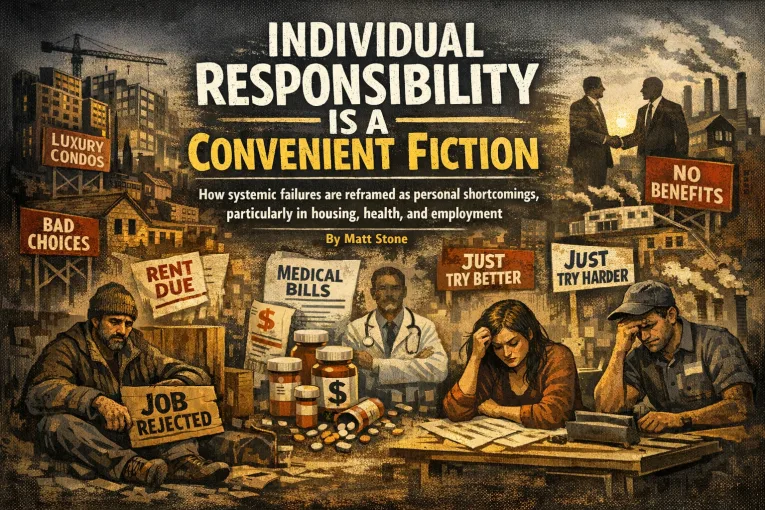
How systemic failures are reframed as personal shortcomings, particularly in housing, health, and employment
There is a familiar move in American life. When systems fail, we blame individuals. When policies hollow out basic stability, we call it grit. When institutions collapse under their own design flaws, we offer lectures about discipline, resilience, and personal responsibility. It is tidy. It is comforting. It is wrong.
“Individual responsibility” has become a catch-all explanation that absolves power while punishing people. It reframes structural harm as personal weakness and then demands gratitude for the lesson. This framing shows up everywhere, but it is most visible and most destructive in housing, health, and employment.
Start with housing. We are told that if someone cannot afford rent, they made bad choices. They should have worked harder, moved sooner, planned better. This story ignores the obvious. Wages have not kept pace with housing costs. Zoning laws restrict supply. Private equity treats homes like poker chips. Entire regions are reshaped for investors, not residents. When rents jump by hundreds of dollars overnight, nothing about that is a personal failure. It is a market doing exactly what it was designed to do under policies that prioritize extraction over shelter.
Yet the narrative persists. People sleeping in cars are labeled irresponsible. Families doubling up are said to lack foresight. The moral judgment is the point. If we accept that homelessness is a systemic outcome, then we have to confront zoning boards, tax incentives, and financial actors. If we call it a character flaw, we get to move on.
Health follows the same pattern. Americans are told that wellness is a matter of willpower. If you are sick, you did not eat right. If you are exhausted, you did not try hard enough. If you are poor and unwell, you must have failed twice. This ignores a health system that ties care to employment, prices medication beyond reach, and treats prevention as optional. It ignores environmental exposure, chronic stress, and the reality that time itself is a privilege.
Consider who this framing harms most. Disabled people. Chronically ill people. Trans people navigating hostile or inaccessible care. People whose bodies do not conform to what the system finds convenient. When care is fragmented and gatekept, suffering becomes invisible, then moralized. The system washes its hands and tells people to take responsibility for outcomes it engineered.
Employment completes the triangle. We are told that anyone can succeed if they just work hard enough. Meanwhile, jobs are automated, outsourced, or turned into gig work without benefits. Productivity rises; security falls. Employers demand flexibility while offering none. Workers are praised for hustling and punished for needing rest. If you burn out, you lacked balance. If you cannot find work, you lacked initiative. If you cannot survive on full-time wages, you lacked ambition.
This is not accidental. The language of personal responsibility is a shield. It protects institutions from scrutiny. It converts political choices into moral judgments. It tells people to look inward while the damage comes from above.
The fiction holds because it flatters those who are doing well. It reassures them that their stability is earned and therefore deserved. It suggests that empathy is optional, since failure is self-inflicted. This is how inequality maintains itself without constant force. People internalize blame. They police each other. They thank the system for lessons that never needed to be taught.
But systems are not abstractions. They are built. They are funded. They are maintained by laws, budgets, and enforcement priorities. When housing is unaffordable, that is policy. When healthcare is inaccessible, that is design. When work does not provide dignity or security, that is a choice, not a law of nature.
None of this denies agency. People make decisions every day. They adapt. They survive. But agency exists within constraints. Pretending otherwise is not realism; it is ideology. It is a way to demand heroism from individuals while excusing negligence from institutions.
There is also a cruelty in how selectively responsibility is applied. Corporations receive bailouts. Banks are deemed too big to fail. Executives are rewarded for risk that others absorb. At the top, failure is systemic. At the bottom, failure is personal. That asymmetry tells you everything you need to know.
If we want a society that actually values responsibility, we should start where the power is. Responsibility should mean building systems that do not require constant sacrifice to survive. It should mean housing that is treated as shelter, healthcare treated as care, and work treated as a human exchange rather than a moral test.
Blaming individuals for systemic collapse is easy. Fixing systems is hard. The fiction persists because it is convenient. It lets us look away. It lets us call suffering a lesson instead of a warning.
But warnings ignored do not disappear. They compound. And sooner or later, even the most comfortable myths run out of people left to blame.
Follow the Vanguard on Social Media – X, Instagram and Facebook. Subscribe the Vanguard News letters. To make a tax-deductible donation, please visit davisvanguard.org/donate or give directly through ActBlue. Your support will ensure that the vital work of the Vanguard continues.

“None of this denies agency. People make decisions every day.” This does deny agency.
People do make decisions every day and they need to have the consequences associated with them, both good and bad.
With the estate tax exemption now at $30 million the decisions that some people get to make are easier than for others.
In Bizarro-Libertarian-World, all decisions are the result of rational, enlightened self-interest. No one with diminished capacity (children, mentally ill, demented) exists. Of course there’s no theft, and great fortunes are all always entirely earned by the shining goodness of their possessors. The mere presence of wealth blesses the possessor with immunity from observing the rapacious predation that produced it. (“Behind every great fortune is a great crime” – Balzac [apocryphal])
Yet the real-world irrationality of even sane, well-off people is what’s behind the sentiment that systemic problems don’t exist. And denial isn’t just a river in Egypt.
A relative who worked in philanthropy, and met lots of wealthy people, told me that 90% of them were born on third base, but all of them wanted to act like they hit a triple.
Matt,
On a personal level, was it an actual conscious decision for thirteen-year-old me to start drinking in order to survive my father’s physical and psychological abuse?
You say this does not deny agency. In practice, it does. When you reduce complex survival responses to “people make decisions every day,” you erase the conditions under which those decisions are made. You flatten coercion, fear, fear, and trauma into a tidy abstraction that conveniently absolves systems and adults of responsibility.
That “choice” did not exist in a vacuum. It carried consequences that followed me for decades. By the metrics capitalism cares about, education, income, career trajectory, stability, I was set roughly twenty years behind my peers. Not because of laziness or lack of will, but because trauma extracts compound interest.
Calling that agency without context is not accountability. It is moral bookkeeping that ignores how debt is incurred.
Yes, people make decisions. But children do not choose abuse. They choose survival inside it, and they pay for that choice long after the adults and systems that failed them walk away unexamined.
You knew my father. You now know the environment. Framing childhood survival strategies as freely chosen moral failures is not honesty. It is privilege asserting itself as universal truth.
If you want to talk about responsibility, start by naming who actually had power at the time.
Sincerely,
Matt Stone
Son of Tom
This is a very old debate. The Bible asks “is salvation the product of your good works, or is it a gift (i.e. by ‘grace’)?” The orthodoxy of all major religions answers: “It’s a gift.”
An illustration of a systemic problem: I throw nine bones out my back door, and release ten dogs to retrieve a bone. It doesn’t matter how well-trained, responsible, etc. the dogs are. Dog #10 isn’t getting a bone. Punishing dog #10 is a ridiculous waste of time, but it’s widely promoted as a solution to this problem.
This applies to humans too. You’ve probably seen the headlines when some company offers 50 good jobs and 2,000 people show up to apply.
Currently, the “punishment bureaucracy” dominates the public policy landscape. The US incarcerates at five times the world’s per-capita rate, seven times that rate for Canada or France. The country’s motto is no longer “e pluribus unum,” it’s “The beatings will continue until morale improves.”
France and Canada actually have lower crime rates, too. One suggestive difference: The US has more than a half million medical bankruptcies annually. Canada and France don’t have those. Could treating people better reduce crime? Gosh, I wonder!
“It should mean housing that is treated as shelter, healthcare treated as care, and work treated as a human exchange rather than a moral test.”
Don’t know that it’s treated as a “moral test”, but when those things are guaranteed as a human right – it’s no longer capitalism.
“People whose bodies do not conform to what the system finds convenient.”
I can attest to the truth regarding this, as I have NEVER been able to buy a pair of pants that fit correctly – regardless of my weight at the time. Pretty sure that I was born in a body that wasn’t manufactured to standards, but the return policy is not something I’ve been willing to accept. (Eventually, I’ll have no choice but to return it – just like everyone else.)
It’s socialism when the fire department puts out the fire at your house. It’s capitalism when the insurance company denies your claim.
Perhaps it’s socialism when the fire department puts out a fire for someone who doesn’t pay their “fair share” of the cost, one way or another. (Whatever “fair share” means in regard to a particular population/situation.)
Perhaps those who live in crack houses, squatters, those living in high-risk fire areas etc., create more cost than what they contribute. And are then subsidized by “everyone else”.
Pretty sure there isn’t that much difference between fire departments and insurance companies, regarding a lack of relationship between cost creation vs. cost allocation. (It’s certainly true regarding utilities, such as PG&E. I believe that the rate they charge, by law – is the same for everyone regardless of locale/risk.)
You are describing risk-pooling, not socialism.
Fire departments exist because society decided that letting buildings burn based on a means test is both immoral and dangerous. Fire spreads. Disasters compound. Prevention costs less than aftermath. That is not ideology. That is logistics.
The moment you start asking whether someone “paid their fair share” before responding to a fire, you are no longer talking about public safety. You are talking about selective protection, which fails everyone.
Insurance companies explicitly price people out of coverage. Fire departments do the opposite because the goal is not profit or individual risk accounting. The goal is keeping communities intact.
Utilities work the same way for the same reason. Uniform rates are not about fairness in a moral sense. They are about system stability. Fragmented pricing creates failure points. Failure points cost more in the long run.
People in high-risk situations are not being subsidized out of kindness. They are being included because exclusion is more expensive, more dangerous, and ultimately self-defeating.
That is not socialism.
That is how functioning societies avoid collapse.
I thought about this after submitting my comment, and you’re right – my comparison was not a good one.
But might disagree with you regarding the reason(s) that some people (and some communities) are subsidized.
The essay is a masterclass in saying everything without saying anything. It opens with a dramatic yet passively empty, “There is a familiar move,” then spends a thousand words describing a fog: we are told things, systems fail, policies hollow out stability, institutions collapse, power is absolved. Notice how often the nouns are abstract and unaccountable, “it,” “this,” “the narrative,” “the system,” and how rarely the author names an actual policy, a specific city, a concrete reform, or a measurable tradeoff.
The structure is always the same: announce a moral premise, declare it “obvious,” then toss three gestures in the direction of reality like confetti. Wages didn’t keep pace, zoning restricts supply, private equity plays poker. Healthcare is tied to employment, meds are expensive, prevention is optional. Jobs are automated, gig work is insecure, employers demand flexibility. It’s a robotic rhythm, not an argument: general accusation, vague villain, quick list, moral conclusion.
Yes, institutions can fail. Yes, incentives matter. Yes, bailouts are corrupting. But this essay uses “systemic” the way a bad mechanic uses “electrical problem”: as a way to sound authoritative while avoiding specifics. It never confronts the uncomfortable truth that two things can be true at once. Structures shape outcomes and individuals still make choices inside those constraints. It also pretends the only alternative to the author’s worldview is cartoon cruelty, “just work harder,” so the reader is herded toward the real message, simple enough to fit on a bumper sticker. You could have just said “I like socialism” and saved a lot of words. Because what this ultimately argues for is not reforming incentives or trimming corporatist capture, but shifting moral responsibility away from individuals and onto “systems,” while never admitting that “systems” are built out of the incentives, enforcement, scarcity, and human behavior of the same imperfect individuals that run them.
Some of the lines are so inflated they collapse under their own weight, especially “the reality that time itself is a privilege.” Time is not a privilege. Time is the one thing every person gets at the same rate. What varies is health, money, obligations, and self-discipline, exactly the messy human variables this essay keeps trying to erase. Or: “When care is fragmented and gatekept, suffering becomes invisible, then moralized.” “Gatekept” is doing dishonest work here. In real life, gates exist because resources are finite, fraud exists, and prioritization is unavoidable. The essay treats every boundary as cruelty and every consequence as oppression, which is how you get a safety net that turns into a hammock for the able and a maze for the truly vulnerable that do deserve societie’s help.
This essay promotes an ideology that infantilizes people while pretending it’s protecting them. A sane centrist view is simpler and more honest: curb corporatist capture, stop rewarding failure at the top, keep a strong safety net for those who genuinely need it, and tell any still functional adults the truth: Incentives matter, choices matter, and responsibility by one doesn’t automatically become “violence” against another.
Your comment misses the profound impact of systemic failures on individual lives. When I write about “systems” and “structures,” I’m not avoiding specifics; I’m highlighting the interconnected nature of social, economic, and political forces that shape our reality.
You’re right that individuals make choices, but those choices are not made in a vacuum. The “messy human variables” you mention—health, money, obligations, and self-discipline—are themselves products of systemic conditions. For instance, a person’s health is influenced by access to healthcare, which is tied to employment and economic stability, both of which are shaped by broader policies and market forces.
Your criticism of “gatekeeping” is valid, but it overlooks the fact that resources are indeed finite, and prioritization is necessary. However, the question is not whether gates exist, but who decides where they are placed and who gets to pass through them. The current system often prioritizes profit over people, creating barriers that are not just inconvenient but life-altering.
You suggest a “sane centrist view,” but this view often fails to acknowledge the depth of systemic issues. Curbing corporatist capture and keeping a strong safety net are important, but they are not enough. We need to recognize that the current system is designed to protect those in power while marginalizing the vulnerable. Shifting moral responsibility onto “systems” is not about infantilizing people; it’s about acknowledging the complex web of factors that influence our lives.
In the end, your critique boils down to a false dichotomy between individual responsibility and systemic change. The reality is that these are not mutually exclusive. We can hold individuals accountable while also working to reform the systems that constrain their choices. It’s not about choosing between “just work harder” and “blame the system”; it’s about understanding how the system affects our ability to work and thrive.
That’s a whole lot of words to say “everything is the system’s fault.” You keep claiming you’re not avoiding specifics while giving none, just “systems, structures, forces” stacked into a fog machine. Yes, life is complicated and circumstances matter. Nobody disputes that. But you’re turning “people face obstacles” into “nobody’s responsible for anything,” which is nothing but lowering expectations. If you want this to be an argument, name the actual policy, the actual fix, and the tradeoffs, instead of repeating “profit over people” like it’s analysis.
You keep insisting you’re not dodging specifics, but it’s basically just “systems, structures, forces” on repeat with one generic example about healthcare that could’ve been pulled from any intro sociology handout. Yes, choices aren’t made in a vacuum. People have obligations, health problems, money stress, and bad luck. But you’re doing something slippery: you’re taking “life is complicated” and turning it into “individual responsibility is mostly a myth,” — all while pretending you’re being nuanced.
And the “gatekeeping is valid but…” section, well ‘second verse same as the first’. Of course resources are finite. Of course prioritization happens. The question isn’t some poetic “who decides where the gates are placed,” it’s what you actually want done differently, by whom, paid for how, and what the downside is. If your answer is just “stop prioritizing profit over people,” that’s not a plan, it’s a your second bumper sticker.
The jab at my “sane centrist view” is lazy. I’m not denying systemic issues exist at all. I’m saying your framing is a permission slip to blame everything except the person making the decisions. You say shifting responsibility onto systems isn’t infantilizing people, but functionally that’s exactly what it does: it treats adults like passive objects being pushed around by invisible forces, and then calls that empathy. How do you expect the system you want built, that you won’t describe, will be any more free of human frailty than the system we have now?
If you want to argue for stronger safety nets, better healthcare access, less corporatist capture, fine, make that case. But right now this, and pretty much everything you write, reads like an ideology explainer that never has to touch reality. You can hold two ideas at once: systems matter and incentives matter; reform is needed and personal agency is real. The “false dichotomy” line is ironic, because you’re the one flattening everything into one big moral story where the system is always the villain and the individual is always a victim. That’s not profound, helpful analysis that’s going to help change anything. That’s a worldview and I name thee: socialism.
Speaking of a whole lot of words..
You keep insisting that I provide a specific policy fix because it seems as if you view the article as a legislative proposal. It isn’t. It is an examination of cause and effect.
If a doctor diagnoses a patient with a broken leg, you don’t dismiss them for failing to immediately perform the surgery. You accept the diagnosis so you can treat the problem. My article provides the diagnosis: the “leg” is broken because specific policies—like tax structures that incentivize housing as an asset class rather than a utility—create systemic failure.
You ask for a downside to prioritizing people over profit. The downside is lower margins for capital. That is a tradeoff, but it is a choice we are currently refusing to make. You say I’m being slippery, but you are the one refusing to define the tradeoffs we are currently making, which are trading public health for private wealth.
We cannot implement a “fix” until we agree on the reality of the problem. You seem to want to skip the reality part and get straight to the conclusion that fits your worldview. That isn’t an argument; it’s an assertion.
Sincerely,
Matt Stone