
- “The initial impacts of this policy show that we can reduce the over-policing of communities of color without compromising public safety.” – Mano Raju, the elected public defender of San Francisco
- “San Francisco’s pretext stops policy has been a critical tool to combat racist traffic stops and searches of Black drivers in particular.” – Yoel Haile, director of the Criminal Law and Immigration Project at the ACLU of Northern California
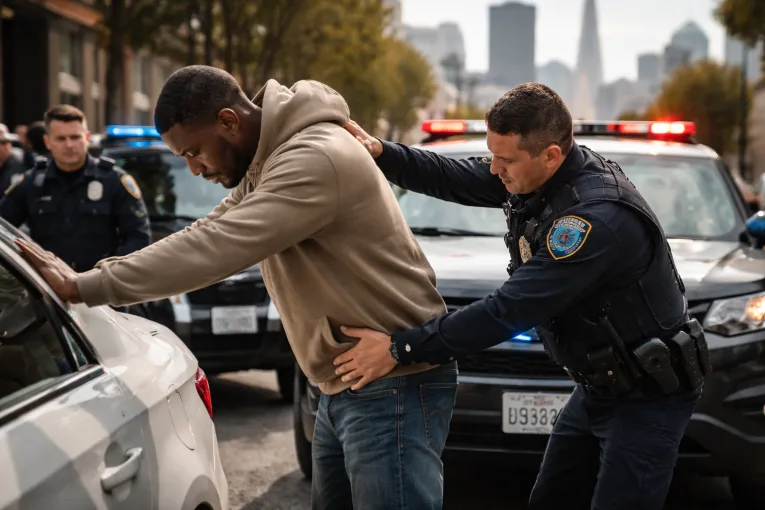
SAN FRANCISCO — Newly released data from the San Francisco Police Department shows a measurable reduction in racially biased traffic stops since the city implemented a policy restricting so-called “pretext stops,” according to analysis and public statements from the Coalition to End Biased Stops.
The policy, known as Department General Order 9.07, limits officers’ ability to use nine nonmoving vehicle code violations as the primary basis for a traffic stop. Those violations, including issues such as broken taillights, have historically been among the most common justifications used to stop, search and detain drivers, particularly Black and Brown motorists.
The San Francisco Police Commission adopted DGO 9.07 following a multi-year process that included community outreach, expert consultation and input from the police department. The policy went into effect in July 2024.
Before the policy’s adoption, SFPD data showed persistent racial disparities in traffic enforcement.
According to the department’s own analysis, officers stopped Black individuals at six times the rate of white individuals, searched Black individuals at more than 10 times the rate of white individuals, and used force on Black individuals at more than 21 times the rate of white individuals.
Those disparities remained largely unchanged for years despite earlier reform efforts, according to advocates.
Data released by SFPD covering January 2024 through September 2025 shows early signs of change following the implementation of DGO 9.07.
According to the data, the percentage of Black drivers stopped for nonmoving violations has dropped by 10 percent. Black drivers are no longer the most frequently stopped racial group for those violations, and while the overall number of traffic stops has increased citywide, the percentage involving Black drivers has declined by 2 percent since the policy was adopted.
“The initial impacts of this policy show that we can reduce the over-policing of communities of color without compromising public safety,” said Mano Raju, the elected public defender of San Francisco. “The Police Commission should continue to uphold and monitor this policy to protect the public from harmful and wasteful pretext stops.”
Advocates say the data undercuts long-standing claims that restricting low-level traffic stops would lead to increases in crime. Coalition members note that the decline in racially disparate stops has coincided with continued decreases in reported crime across San Francisco.
The release of the data comes as the Police Commission prepares to address a Department of Police Accountability audit examining how SFPD collects and reports traffic stop data. While coalition members welcomed improvements in data accuracy, they urged the commission to schedule a separate public meeting focused specifically on the first report evaluating the pretext stops policy.
Pretext stops are traffic stops conducted for minor, non-safety-related violations as a means of investigating unrelated suspicions, even when no other crime has occurred. Civil rights advocates and researchers have long linked the practice to racial profiling and escalations that can result in searches, arrests or uses of force.
Coalition members point to extensive research showing that pretext stops are ineffective at reducing serious crime and disproportionately burden communities of color, while consuming significant police resources.
“San Francisco’s pretext stops policy has been a critical tool to combat racist traffic stops and searches of Black drivers in particular,” said Yoel Haile, director of the Criminal Law and Immigration Project at the ACLU of Northern California. “We know that all too often, these stops can escalate, resulting in serious injury or death. So, a 10 percent decline in stops of Black drivers for non-moving violations like a broken taillight could save lives.”
The coalition said the policy’s early results demonstrate that limiting the scope of traffic enforcement does not undermine public safety and may instead allow officers to focus resources on safety-related concerns.
“The Police Commission, SFPD and DPA should be proud that the policy has resulted in reduced racial disparities while crime has fallen in San Francisco,” said Brian Cox, director of the Public Defender’s Office Integrity Unit. “We must use the success of this research-based policy and model of community engagement as a catalyst to find other ways to reduce racial disparities in the criminal legal system.”
Community advocates also emphasized the broader impact of traffic enforcement beyond crime statistics, particularly on perceptions of safety and trust in public institutions.
“Our community members deserve to feel safe when they drive, bike, or walk down the street,” said Eleana Binder, policy director for Glide Foundation. “As demonstrated by the latest data, the pretext stop policy can help communities of color feel less targeted by police stops and make the entire community safer by focusing resources on promoting safety, rather than non-safety-related traffic stops.”
While the coalition characterized the results as promising, members cautioned that the data remains preliminary and requires continued monitoring. They urged the Police Commission to closely review SFPD’s compliance with the policy, strengthen the policy if disparities persist or new ones emerge, and ensure transparency and data integrity in traffic stop reporting.
The coalition also emphasized that DGO 9.07 includes reporting requirements designed to allow for ongoing evaluation of its effectiveness and enforcement. Advocates said accurate and publicly available data is essential to determining whether officers are complying with both the letter and the spirit of the policy.
In addition to monitoring implementation, the Coalition to End Biased Stops said it will continue public education efforts related to the policy, including training sessions and dissemination of information about drivers’ rights during traffic stops.
The Coalition to End Biased Stops is a broad alliance of civil rights, transportation safety, immigrant rights, legal advocacy and community-based organizations that led the multi-year campaign to limit racially biased traffic stops in San Francisco. Members have described the policy as an evidence-based approach to addressing racial disparities that have persisted in traffic enforcement for decades.
Follow the Vanguard on Social Media – X, Instagram and Facebook. Subscribe the Vanguard News letters. To make a tax-deductible donation, please visit davisvanguard.org/donate or give directly through ActBlue. Your support will ensure that the vital work of the Vanguard continues.

“According to the department’s own analysis, officers stopped Black individuals at six times the rate of white individuals, searched Black individuals at more than 10 times the rate of white individuals, and used force on Black individuals at more than 21 times the rate of white individuals.”
“According to the data, the percentage of Black drivers stopped for nonmoving violations has dropped by 10 percent. Black drivers are no longer the most frequently stopped racial group for those violations, and while the overall number of traffic stops has increased citywide, the percentage involving Black drivers has declined by 2 percent since the policy was adopted.”
My head is spinning, regarding how all of this supposedly fits together.
My guess is that it’s a combination of NO stops whatsoever (for things like broken tailights), and no black people left in San Francisco. The only predominantly black population left in San Francisco is in the remaining housing projects. This population is not comprising the majority of “tech bros”, and barely has any presence there.
How often do we see vehicles with broken tailights in the first place, nowadays?
And who is now the “most-discriminated-against” group, since black people no longer are according to this article?
In any case, if you see some old 1970’s Ford LTD going down the street with no lights, expired tags, etc. – it’s a safety violation, a failure to pay one’s own share, AND a greenhouse gas factory on wheels. So I guess black people should get a “pass” on that to avoid discrimination.
Got it – congratulations.
“No black people left in San Francisco” – except in the jail and hall of justice. The data on that is extraordinary, something like 6 percent of the population and 55 percent of those in the jail.
Your last line conflates issues, the data says that Black drivers are no longer most frequently stopped, it doesn’t say, “discriminated against.”
The entire article suggests that they were discriminated against, as does your new comment regarding the percentage of black people in jail.
But that they are no longer being discriminated-against for traffic violations, at least.
Needless to say, most people probably don’t see it this way (probably not even the majority of black people).
It would be interesting to see an accurate, nationwide survey regarding the percentage of black people who believe that the disproportionate representation of that group in prisons is primarily NOT a result of differences in crime rates.
Maybe they should ask the same group whom the Dilbert author reportedly cited in regard to some of his comments. (Though truth be told, I’m not sure what he was supposedly doing to “help black people” prior to that survey.)
For the record, I’m not doing ANYTHING to help black people, white people, Asian people, Hispanic people, indigenous people, or any other group based on skin color. So I have no reason to feel “betrayed”, I guess.
Frequency of stops is a function of population percentage and discriminatory practice. Just because a group has seen a decline in stops, doesn’t automatically mean that group is no longer discriminated against.
What’s most interesting is that traffic stops overall have gone up, but stops of Black people has dropped.
Traffic stops – does that include “non-pretext” stops (e.g., moving violations)?
In any case, the black population itself is so small in San Francisco (and is likely still declining) that any change would have an enormous impact on percentages.
For that matter, a continuing decline in the percentage of their overall population could impact these percentages on their own.
If there’s only one black person left in San Francisco (and he doesn’t get stopped for the year), there’d be a 100% decline in the percentage of traffic stops for black people.
In any case, who are the cops supposedly going after now that black people have been “displaced” in the percentages?
“ According to the data, the percentage of Black drivers stopped for nonmoving violations has dropped by 10 percent. ”
Nonmoving violations is what they are looking at
“Frequency of stops is a function of population percentage and discriminatory practice.”
You left out “frequency” (percentage of population) with broken taillights, expired tags, overall junk smog-belching cars, etc.
Though if you drive the “right kind” of junk car, you also might not get stopped as often. Old Subarus come to mind. (Kind of surprised that Renee Good wasn’t driving one – she already had the requisite dog in the vehicle.) Then again, you might draw the IRE of ICE in that type of vehicle – especially if you’re blocking their path.
Vehicular discrimination, as it were. (For sure, it’s not going to be some black person from the projects doing something like that. Overwhelmingly white, female buffoons.) The type of people who don’t understand when they’re in danger, since they probably haven’t faced it as often as other groups.