
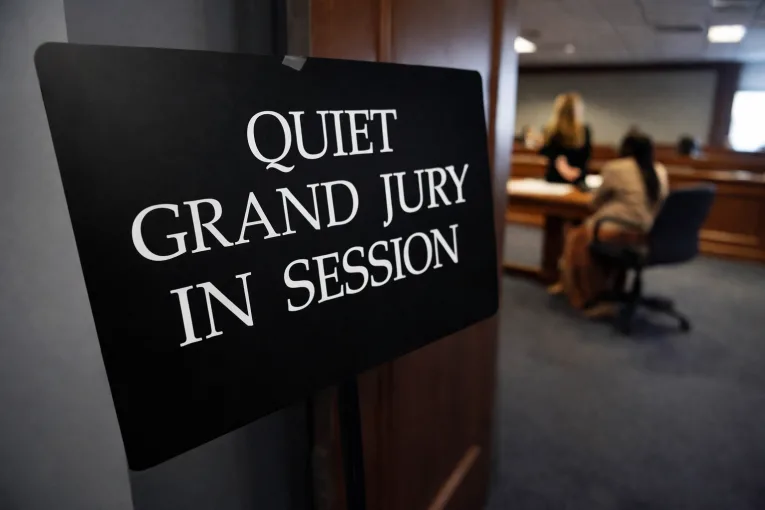
For generations, the cynical wisdom of the criminal courts has been distilled into a single line from former New York Chief Judge Sol Wachtler: a prosecutor, he once said, could “indict a ham sandwich.”
The remark has endured because it captured a widely shared belief — that grand juries, operating in secret and hearing only the government’s case, almost always do what prosecutors ask.
But in recent months, a series of high-profile federal cases has complicated that assumption. Grand juries in Washington, Los Angeles and elsewhere have declined to indict in matters that prosecutors appeared confident would proceed. In some instances, trial juries later acquitted defendants on reduced charges. The pattern has prompted debate over whether a long-dormant constitutional safeguard is stirring back to life.
Mike Fox, a Cato Institute legal fellow who has tracked these cases closely, argues that the shift reflects a growing skepticism among citizens called to serve.
“We saw it in December when grand jurors twice declined to re-indict Letitia James for mortgage fraud,” Fox wrote in a recent Cato Institute essay examining what he called a resurgence of the grand jury’s constitutional role. He pointed to another Washington grand jury that “flatly declined to indict six Democratic lawmakers,” describing it as a rare rebuke of federal prosecutors.
In an interview with the Vanguard, Fox elaborated on what he said were unusual developments.
“The grand jury last week that declined to indict Senator Kelly, Senator Slotkin, and the other four Democratic lawmakers for simply stating policy from the Department of Defense,” he said. “Until that case, I’m not sure it’s ever been the case where a grand jury has unanimously rejected, because it’s a simple majority.”
Federal grand juries typically consist of 23 members, and only 12 votes are required to return an indictment.
According to Fox, the reported rejection in that instance was unanimous — an outcome he called “mind boggling.”
Such unanimity is difficult to verify independently because grand jury proceedings are secret.
“We don’t get grand jury transcripts,” Fox noted, underscoring the opacity that has long insulated the process from public scrutiny.
Grand juries meet behind closed doors, without defense attorneys or judges present during testimony.
As Fox described it, “there’s no judge, there’s no defense attorney, there’s no defendant. It’s just the prosecution and grand juries.”
He added, bluntly, that “the government can lie” in that setting, pointing out that without an adversarial check, jurors must rely heavily on what prosecutors present.
Historically, that imbalance has favored indictments.
Grand juries were originally designed as a buffer between the state and the accused — a community safeguard embedded in the Fifth Amendment — but critics have often described them as rubber stamps.
Yet the recent refusals have come in cases that, Fox argues, were either weak on evidence or fraught with political overtones.
He cited the case of Sean Dunn, who was accused of throwing a sandwich at a federal officer during a protest.
According to Fox, grand juries repeatedly declined to indict Dunn on felony charges. Prosecutors later filed misdemeanor charges instead.
“So the government said, okay, you know what? We’re just going to charge misdemeanors,” Fox said. “And then they both wound up getting acquitted (while) going to trial on misdemeanor counts.”
Fox described a similar trajectory in the case of Sidney Reid, who was accused of assaulting an FBI agent. Grand juries did not return felony indictments, he said, and the subsequent misdemeanor case ended in acquittal.
In the Central District of California, Fox said U.S. Attorney Billy Essayli sought to indict dozens of protesters connected to immigration enforcement actions.
“He tried to indict dozens of people for protesting ICE and border patrol and got very few, I think he got seven out of 38 indictments or something like that,” Fox said. He characterized that as a striking rejection rate.
Not every controversial figure has been spared indictment.
During the interview, Fox confirmed that media personality Don Lemon had been indicted by a grand jury. “Looks like yes … looks like he was indicted,” he said, acknowledging that grand juries continue to return charges in many cases.
The mixed outcomes complicate any sweeping conclusions. Fox himself described the moment as “uncharted territory.”
Part of what makes the situation difficult to assess is structural. Grand jury secrecy, intended to protect witnesses and preserve reputations if no charges are filed, also shields prosecutors from scrutiny.
Fox has argued that greater transparency could strengthen public confidence. The Grand Jury Clause of the Fifth Amendment, he said, “doesn’t say grand juries must be held in secret.”
He suggested that Congress could consider reforms requiring judicial oversight or eventual release of transcripts. Whether such changes would draw bipartisan support in a polarized political climate remains uncertain.
The historical roots of the grand jury system run deep.
Fox often recounts the 1734 prosecution of John Peter Zenger, the colonial printer charged with seditious libel for criticizing New York’s royal governor. In that case, grand juries initially declined to indict before authorities pursued charges by other means.
Ultimately, a trial jury acquitted Zenger, a verdict that became an early milestone in the development of press freedom.
“I normally like to talk about that story because it predates the founding of the country,” Fox said, calling it “a celebrated early example of what you might call jury nullification or a jury rejecting an unjust prosecution.”
Whether contemporary no-bills reflect a comparable assertion of civic independence is difficult to measure.
Federal prosecutors review evidence before presenting cases to grand juries, and declined indictments may signal that jurors found probable cause lacking rather than that they were making political statements.
Still, Fox contends that at least some recent cases reveal heightened skepticism.
“I think grand jurors are smart enough to see it,” he said, referring to matters where he believes “there’s just no evidence that any crime was ever committed.”
He emphasized that grand juries are not the only line of defense. “Grand jurors are just as much as the bulwark against injustice as trial jurors,” he said, adding that trial juries remain a final check if cases proceed.
For now, the available evidence is anecdotal rather than statistical. Comprehensive nationwide data on declined federal indictments are not publicly compiled in real time, and the secrecy of grand jury proceedings obscures context.
But the convergence of several visible refusals has reopened a conversation about the balance of power between prosecutors and ordinary citizens summoned to deliberate in private rooms.
Wachtler’s quip about the ham sandwich captured an era of prosecutorial dominance. If recent events represent even a modest recalibration, they suggest that the old assumption may not be absolute.
Whether this moment proves fleeting or signals a deeper reassertion of the grand jury’s constitutional function will depend on what happens next — in Washington courtrooms and in grand jury chambers that, by design, few outsiders ever see.
Follow the Vanguard on Social Media – X, Instagram and Facebook. Subscribe the Vanguard News letters. To make a tax-deductible donation, please visit davisvanguard.org/donate or give directly through ActBlue. Your support will ensure that the vital work of the Vanguard continues.

Independent of this article, yesterday I was praising the safeguard, provided by the grand jury system, from the weaponizing of Trump’s Justice Department under Pam Bondi.