
By Malik Washington, Destination Freedom Media Group | The Davis Vanguard
In Part One of this investigation, we established a documented timeline.
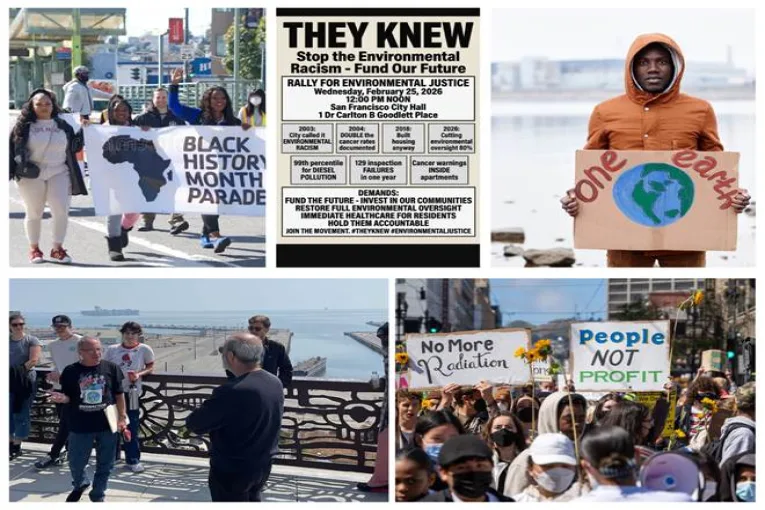
• In 2003, San Francisco’s Human Rights Commission formally acknowledged environmental racism in Bayview–Hunters Point.
• In 2004, a comprehensive health assessment documented elevated cancer rates, asthma prevalence, and concentrated toxic exposure.
• In 2018, federal prosecutions confirmed falsified radiological testing at the adjacent Hunters Point Naval Shipyard Superfund site.
• In 2025, Housing Authority inspection records documented repeated habitability failures at the redeveloped Alice Griffith apartments.
• In 2026, the City proposed an approximately 80 percent reduction in general-fund support for the San Francisco Department of Environment.
The question before the City is not whether pollution burden exists.
The question is whether oversight capacity will be strengthened — or reduced — at precisely the moment accountability is being demanded.
This is not rhetoric.
It is enforcement.
WHAT THE WATCHDOGS WARNED
For decades, one organization refused to look away.
The Committee to Bridge the Gap (CBG), a San Francisco–based nuclear policy watchdog, has spent years reviewing Navy remediation reports, radiological surveys, and regulatory filings related to the Hunters Point Naval Shipyard.
Long before federal prosecutors confirmed fraud involving the Navy’s cleanup contractor, CBG was raising technical concerns.
Not speculation.
Technical concerns.
Hunters Point Naval Shipyard was used after World War II to decontaminate ships exposed to nuclear weapons testing in the Pacific under Operation Crossroads. Historical records confirm that radioactive materials were handled at the site. Portions of the Shipyard were later designated for Superfund remediation under federal law.
CBG consistently questioned:
• Whether contamination was fully mapped
• Whether survey grids were comprehensively scanned
• Whether remediation data was independently verified
• Whether statistical averaging masked localized hot spots
Then came the federal prosecutions.
The U.S. Department of Justice confirmed that supervisors from Tetra Tech EC, Inc., the Navy’s lead radiological contractor, falsified soil testing data. Required scans were not always completed. Records were manipulated.
The convictions did not establish that every parcel was contaminated.
But they did confirm that portions of the verification process were compromised.
And when verification is compromised, public confidence erodes.
CBG has argued that in such circumstances, precaution — not acceleration — should guide redevelopment decisions. They have called for comprehensive retesting where fraud occurred, greater transparency, and health-protective standards rather than risk-minimization modeling.
Their central question remains relevant today:
Who verifies the verification?
Bayview–Hunters Point is not an empty development canvas.
It is a historically Black neighborhood that has endured disproportionate industrial burden for generations.
When redevelopment proceeds in proximity to a fraud-compromised Superfund site, regulatory diligence should increase — not decrease.
And yet we are debating whether to reduce environmental oversight capacity.
WHAT THE DEPARTMENT OF ENVIRONMENT ACTUALLY DOES
Environmental oversight is often framed narrowly as “climate policy.”
That is incomplete.
The San Francisco Department of Environment performs regulatory and coordination functions that directly affect frontline communities:
• Tracks emissions inventories and pollution data
• Coordinates CEQA Mitigation Monitoring and Reporting Programs (Public Resources Code § 21081.6)
• Supports enforcement coordination with the Bay Area Air Quality Management District (Health & Safety Code § 40000 et seq.)
• Assists in AB 617 Community Air Protection implementation
• Responds to environmental complaints
• Supports environmental justice initiatives
When staffing is reduced, these functions do not disappear.
They slow.
Complaint response backlogs increase.
Mitigation verification becomes harder.
Data coordination gaps widen.
In pollution-burdened neighborhoods, delay is not neutral.
Delay is exposure.
THE ALICE GRIFFITH RECORD
Inspection records for the Alice Griffith Phase I redevelopment document repeated failures in 2024–2025, including electrical hazards, fire safety violations, elevator failures, and pest-related concerns.
These findings are publicly documented.
When publicly subsidized housing experiences repeated compliance issues, oversight matters.
Enforcement coordination matters.
Transparency matters.
Oversight capacity is not theoretical in this context.
It is connected directly to resident safety.
AB 617 AND YOUTH MONITORING
Assembly Bill 617, passed in 2017, recognizes that cumulative pollution burden requires localized monitoring and community participation.
The Marie Harrison Community Foundation — led by Arieann Harrison, daughter of environmental justice leader Marie Harrison — is preparing to expand youth-led air monitoring initiatives in Bayview–Hunters Point.
This is not symbolic engagement.
Youth will be trained to deploy monitors, interpret particulate readings, and connect data to regulatory frameworks.
They will learn how to measure air.
They will learn how to measure accountability.
But community-generated data must connect to institutional enforcement pathways.
Monitoring without enforcement becomes documentation without consequence.
If oversight capacity shrinks while community monitoring expands, we create a structural contradiction.
SOLIDARITY ACROSS SAN FRANCISCO
This moment has also revealed something powerful.
Black-led environmental justice leadership in Bayview–Hunters Point is standing in solidarity with multiracial environmental organizations across San Francisco — including the Sierra Club, Greenaction for Health and Environmental Justice, and other climate and public health advocates.
There is strength in solidarity.
Environmental justice is not a niche concern.
It is a citywide responsibility.
Clean air in Bayview is connected to regulatory integrity everywhere.
This is not division.
It is convergence.
THE GENERATIONAL QUESTION
Environmental policy is generational policy.
The decisions made in City Hall today determine the conditions our children will inherit tomorrow.
When oversight is funded, exposure can decrease.
When exposure decreases, health outcomes improve.
When youth are trained to monitor their own air, transparency increases.
When transparency increases, accountability strengthens.
The legacy of Marie Harrison was never about protest alone.
It was about protection.
Protection of children.
Protection of community.
Protection of dignity.
If environmental racism was acknowledged in 2003…
If health disparities were documented in 2004…
If cleanup fraud was prosecuted in 2018…
If inspection failures are documented today…
Then why reduce oversight capacity now?
That is not an accusation.
It is a governance question.
FEBRUARY 25 — A CIVIC MOMENT
On Wednesday, February 25, 2026, at 12:00 p.m., residents and environmental advocates will gather on the steps of San Francisco City Hall.
From Hunters Point Hill to the Bayview flatlands.
From District 10 to every district.
Black residents who have carried this burden for decades.
Latino, Asian, Pacific Islander, and white neighbors.
Environmental advocates of every background.
Bring your voice.
Bring your documentation.
Bring your children.
Because the decisions made now will be measured in the lungs of tomorrow.
Mayor Daniel Lurie and the Board of Supervisors have an opportunity.
Not to defend the past.
But to correct course.
Environmental justice cannot survive as rhetoric.
It must survive as enforcement.
The residents of Bayview–Hunters Point are watching.
The youth learning to monitor their air are watching.
And history will record the choice.
For this article, here’s our song/video:
H.E.R. – I Can’t Breathe (Official Video)
SOURCE LIST – PART TWO
(All materials publicly accessible at time of publication)
1.) Environmental Racism: A Status Report & Recommendations (2003), San Francisco Human Rights Commission.
Official City report formally acknowledging environmental racism in Bayview–Hunters Point.
Access via San Francisco Human Rights Commission Archives
2.) The State of the Environment in Bayview Hunters Point (2004), Arc Ecology.
Community environmental health assessment documenting elevated cancer rates, asthma prevalence, and hazardous site concentration.
Access via Arc Ecology Publications
3.) Hunters Point Naval Shipyard Superfund Site Profile, U.S. Environmental Protection Agency (EPA).
Federal cleanup documentation under CERCLA.
View EPA Superfund Site Overview
4.) Former Supervisors for Navy Contractor Sentenced for Falsifying Radiological Data (2018), U.S. Department of Justice.
Federal prosecution summary involving Tetra Tech EC, Inc.
View Department of Justice Press Release
5.) Committee to Bridge the Gap (CBG) – Technical Reviews and Public Statements on Hunters Point Shipyard Cleanup.
Independent watchdog analysis of radiological remediation and oversight practices.
Access Committee to Bridge the Gap Materials
6.) California Public Resources Code § 21081.6 (CEQA Mitigation Monitoring and Reporting Program).
Statutory requirement mandating enforceable monitoring of environmental mitigation measures.
View CEQA Statutory Language
7.) California Health & Safety Code § 40000 et seq. (BAAQMD Authority).
Statutory authority establishing the Bay Area Air Quality Management District.
View Health & Safety Code Provisions
8.) Assembly Bill 617 (2017) – Community Air Protection Program, California Air Resources Board (CARB).
Framework for community-based air monitoring in pollution-burdened neighborhoods.
View AB 617 Community Air Protection Program
9.) CalEnviroScreen 4.0, California Environmental Protection Agency (CalEPA).
Statewide cumulative pollution burden screening tool.
Access CalEnviroScreen 4.0
10.) Proposition 65 Overview, California Office of Environmental Health Hazard Assessment (OEHHA).
Safe Drinking Water and Toxic Enforcement Act disclosure requirements.
View Proposition 65 Overview
11.) San Francisco Department of Environment – Official Responsibilities and Program Descriptions.
Agency functions including emissions tracking, CEQA coordination, complaint response, and environmental justice initiatives.
View Department of Environment Overview
12.) San Francisco Commission on the Environment – Public Meeting Records and Budget Materials (2026).
Public documentation concerning Department of Environment funding levels and staffing proposals.
Access Commission on the Environment Records
13.) San Francisco Housing Authority – Public Inspection Records
(Alice Griffith Phase I).
Documentation of inspection findings and compliance issues.
Access San Francisco Housing Authority Public Records
14.) Bay Area Air Quality Management District (BAAQMD) – Regulation 6 (Particulate Matter) and Regulation 11 (Hazardous Air Pollutants).
Regulatory framework governing dust control and airborne hazardous pollutants.
View BAAQMD Current Regulations
ABOUT THE AUTHOR
Malik Washington is a San Francisco-based journalist and co-founder of Destination Freedom Media Group, an independent nonprofit newsroom dedicated to accountability reporting at the intersection of civil rights, public integrity, disability justice, structural accountability within American institutions, and community survival. He has been a published journalist for over 14 years.
His work—published in partnership with the Davis Vanguard—focuses on government power, criminal justice, environmental justice, and the human consequences of policy decisions too often insulated from public scrutiny. Washington’s reporting amplifies the voices of impacted communities while insisting on documentary evidence, transparency, and the unvarnished truth—especially when institutions demand silence.
His work appears on platforms such as Muck Rack and Black Voice News, examining the intersection of justice, governance, and community.
You can reach him via email: mwashington2059@gmail.com or call him at (719) 715-9592.
Suggestions or leads on stories are always welcome.
Please follow us on:
Facebook: https://www.facebook.com/destfreedom13
Instagram: https://www.instagram.com/destinationfreedom13/
Follow the Vanguard on Social Media – X, Instagram and Facebook. Subscribe the Vanguard News letters. To make a tax-deductible donation, please visit davisvanguard.org/donate or give directly through ActBlue. Your support will ensure that the vital work of the Vanguard continues.
