
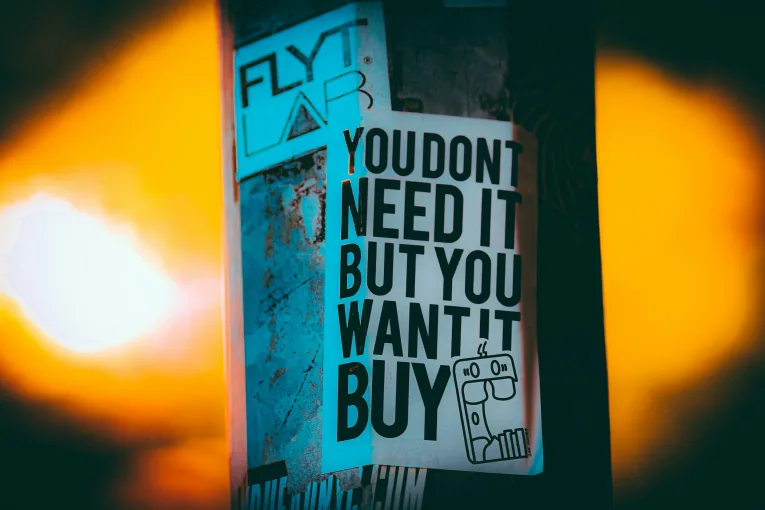
Time to be honest about the word “need.”
We’ve cheapened it into a meaningless whim to justify our own pathetic consumerism. You don’t need a new phone. You don’t need another streaming service. You don’t need fast-fashion pants that will disintegrate after three washes. You’ve been brainwashed by a multi-trillion-dollar marketing industrial complex into confusing desire with necessity, all to keep you on the hamster wheel, running faster and faster toward a finish line that doesn’t exist.
The entire system is a cage, and your participation is what keeps the door locked. You work to earn money to buy shit you don’t need to impress people you don’t even like. It’s a beautifully designed trap of manufactured dissatisfaction. Every advertisement you see is a tiny wrench, turning the gears of your own insecurity, convincing you that salvation is just one more purchase away. It’s a lie. The only way out is not to find a better cage, but to realize you were never meant to be in one in the first place.
And don’t for a second believe the corporate excuse for the inflation that’s been draining your bank account. For two years, we were fed a steady diet of lies about “supply chain issues” and “labor shortages.” It was a smokescreen. While you were panicking at the pump, the corporations you worship were posting record-breaking, eye-watering profits. They didn’t have to raise prices. They chose to. They saw a crisis and saw a golden opportunity to orchestrate the largest wealth transfer in modern history; from your pocket to theirs. They used a global pandemic as a cover story to price-gouge you into submission, and you thanked them for the privilege.
So forget “shopping local.” Forget “ethical consumption.” Trying to find a moral product in a system built on exploitation is like trying to find a clean spot in a sewer. It’s a fool’s errand. The most ethical product in the world is the one you do not buy.
This is the only language these monsters understand. They don’t care if you buy Brand A instead of Brand B.
They fucking own both.
But a customer who ceases to be a customer?
That is an existential threat. A radical reduction in your purchasing is not a boycott; it is a defection. You are deserting their army of consumers. Every dollar you don’t spend is a bullet they can’t use to buy another politician, another lobbyist, another minute of airtime to lie to you all over again.
This isn’t about sacrifice. It’s about liberation. Every item you don’t buy is hours of your life you get back. Time you don’t have to spend working to pay for it, maintaining it, storing it, and eventually throwing it away. It is a trade: you trade the fleeting, hollow thrill of a new possession for the permanent, profound freedom of your own time and your own mind.
They have sold you a vision of the good life that is crowded with possessions and empty of purpose. The real rebellion is in the quiet joy of missing out. It’s the liberation of having enough. It’s the profound peace that comes from realizing you already own everything you truly need.
Stop feeding the machine.
Starve the beast.
The casino only works if you keep pulling the lever.
Walk away.
Follow the Vanguard on Social Media – X, Instagram and Facebook. Subscribe the Vanguard News letters. To make a tax-deductible donation, please visit davisvanguard.org/donate or give directly through ActBlue. Your support will ensure that the vital work of the Vanguard continues.

“Stop feeding the machine.
Starve the beast.
The casino only works if you keep pulling the lever.”
I’m going out shopping for a new car today. I hope to get a great President’s Day deal.
“The casino only works if you keep pulling the lever.”
But how would reparations then be paid, if the casinos on reservations went out of business?
“The most ethical product in the world is the one you do not buy.”
Dang, I guess I’ll stop buying organic local produce at the farmer’s market and get a box of General Mills dry brown powder.
“Stop feeding the machine. Starve the beast. The casino only works if you keep pulling the lever. Walk away.”
Ok, I’ll starve the beast. Of course this also means starving to death. But that’s the price of practicing what we preach.
“So forget ‘shopping local.’ Forget ‘ethical consumption.’ Trying to find a moral product in a system built on exploitation is like trying to find a clean spot in a sewer. It’s a fool’s errand. The most ethical product in the world is the one you do not buy.”
No, don’t “forget” those things.
Let me tell you a story about a tomato.
Several years ago, a customer sat next to a plant breeder from Bulgaria whose company had developed a new tomato variety called Rugby.
It had been bred for disease resistance, has very high yields of fruit great for sauce and salad use, on compact plants. Grows well in a wide range of environments.
Customer mentioned it to me and I looked around for seed in this country. The North American importer was from Canada, but smaller seed brokers were selling it in the US.
One such seed broker is a 125-year-old family seed business in Pennsylvania. Another is a gentleman who’s been brokering seeds for decades. Great selection, excellent customer service.
We get the seeds from them.
I grew it, trialed it for two years as I always do with a new variety, and found it outstanding for this area, and began to recommend and sell it.
One of my employees starts and grows many of our vegetable plants. We’ve spent a lot of time determining the best potting soil and timing, and optimal container size, that allows us to produce crops of seedlings within 6 – 8 weeks to sell over the 10-week selling season for tomato starts.
We choose the soil and container size, we monitor for pests, we fertilize, we maintain greenhouse temperatures, we work to promote this plant to you, since you’ve likely never heard of it before.
So:
Bulgarian seed breeder with a long history of outstanding vegetable variety introductions.
Family-owned Pennsylvania seed broker, seed broker in Georgia.
Brokers for the plastic nursery pots; always looking for good alternatives, but this is a complicated issue.
High-quality planting soil from a regional soils/amendments producer in Suisun, using materials from the US and Canada to formulate their soils and fertilizers.
Advertisements in local media.
All so I can sell you a $5 tomato plant.
It’s a “moral product.” It’s not “built on exloitation.” It’s the end result of a lot of work by a lot of people.
Supply chain issues are very, very real. Tariffs are causing cost increases. Cost increases from our wholesalers are running 5 – 10% this year.
Labor shortages are affecting all ag-related or ag-adjacent businesses, including the wholesale nursery industry.
So I guess I should ask, why do you sell your books on Amazon?
“All so I can sell you a $5 tomato plant.”
And that’s the actual reason why you can’t pay your employees a “living wage” – those type of jobs aren’t intended to function that way. And if you raised your price to $10, your customers would then turn to ACE, Costco, or Home Depot (or would grow them from seed, themselves). And the seeds would become more expensive, as well.
At some point, we have to accept capitalism or dump it. And capitalism does work pretty well, in a lot of ways.
“So I guess I should ask, why do you sell your books on Amazon?”
That’s so rich. LOL
Hello Don,
You have furthered my point: buy the plant, not the fruit.
I published my first books with Amazon almost two years ago, coming off of the chaos of the pandemic. At that time, Amazon offered the best platform for a broke, partner still in school, newly graduated father of two small children to publish, distribute, and market books. Without it, I would not have been able to get my books out in any timely fashion, as my writing was seen as “too daring” for many agents, though many wished me to contact them back with more “calm” work.
So, the choice was to use the “oppressor” to call out the word of their own such oppression, or not have my work positively touch readers at all.
Don, do you think the oppressed must not still operate under the system of oppression?
I have since been branching out, and will eventually remove my books from there, but it still remains to be biggest seller in the world. What you are asking me to do is to remove the tiny budget that I do have to fight the very system that is paying me.
“What you are asking me to do is to remove the tiny budget that I do have to fight the very system that is paying me.”
Don didn’t ask you to do so – he was making a point.
But it does seem ironic to “fight the very system that is paying me”.
You have furthered my point: buy the plant, not the fruit.”
How is that any different, in regard to capitalism? (Also – it’s not “free” to grow those plants, once they’re in the ground. In the case of Davis or any other community, are you familiar with water bills, for example?)
Honestly, it’s probably cheaper (and a lot easier) to just buy organic tomatoes at the Co-Op.
The other issue (tried to mention at the last minute) is that one has to have a yard in the first place, to have a garden.
And Davis has pretty much “outlawed” those, in regard to new developments. (And is discouraging them for existing developments, due to its water bills.)
Then again, tomatoes are (at least) one of the easiest plants to grow around here – if one has a place to put them.
Can’t help but think of the video that Edward G. Robinson watched on his way out in Soylent Green, in regard to the “old days” when nature still existed.
Is it really that different than being a communist and yet working in a factory?
Can’t tell if that’s a question for me, but it’s underneath my comment at least.
If it is for me, I’d say that there’s a difference between working at a small, local nursery vs. working in a communist system (intended to fully compensate/offset one’s living expenses).
All I know is that “somebody” has to do “something” in order to survive. As for me, I’m ultimately going to depend on AI to work for me. (Plus, they’re making some pretty attractive female robots, these days. Yes, that’s a joke, though I think that the robots are less-concerned about gender than some actual women or men, these days.)
MS say, “What you are asking me to do is . . . ”
Good lord, man. What do your articles ask of everyone, every day? We can all justify why we don’t or can’t do X. Your ‘excuse’ is legit, your argument is not.