
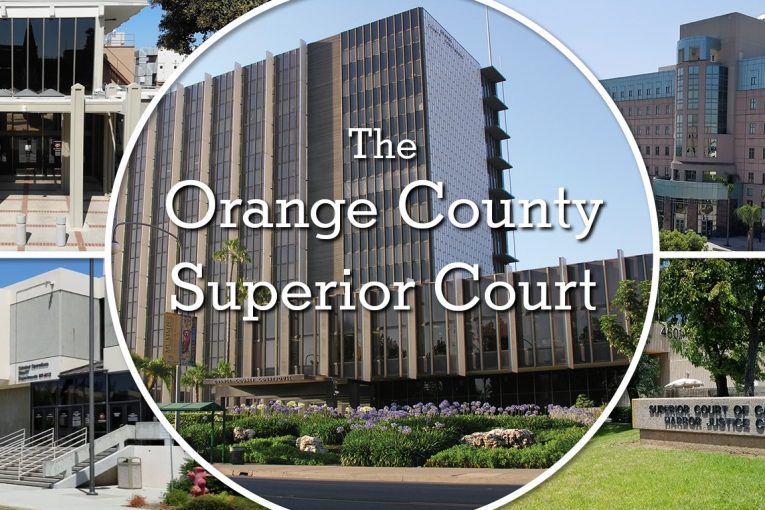
WESTMINSTER, Calif. — A jury in Orange County Superior Court began deliberations Monday after hearing closing arguments in a DUI trial centered on whether the accused was driving while mentally impaired and with an illegal blood alcohol content.
In Department 10 of the Westminster West Justice Center, Judge Randy W. Ladisky oversaw the closing arguments of defense and prosecution in the DUI trial on the morning of March 9.
Attorney William Duffy, the lawyer for the defense, argued that inconsistencies in the readings of the blood alcohol content test leave room for interpretation and, therefore, the jurors cannot determine, without a doubt, that the accused was certainly driving with a blood alcohol content above 0.08%.
Duffy used a bell curve chart to demonstrate the events of the police interaction. At 1:11 a.m., police turned on their lights and got behind the accused.
At 1:34 a.m., police conducted the first blood alcohol content test, finding that he had a BAC of 0.097%.
At 1:36 a.m., they conducted another test, finding a BAC of 0.082%.
Finally, at 2:29 a.m. at the police station, police took a blood sample from the accused, which resulted in a BAC reading of 0.097%.
Edmund Barley, the defense’s expert witness — and, according to his LinkedIn profile, a toxicology consultant and expert witness — testified that, for a person still in their absorptive phase, PAS test, Preliminary Alcohol Screening portable breathalyzer, results could be inaccurate.
During absorption, breath alcohol readings can sometimes be much higher than the person’s true blood alcohol level at the time of driving.
The accused “did not have 0.08% or more in his blood while driving,” Barley stated.
The defense further questioned how the first test reading of 0.097% could be accurate when the next test reading, only 10 minutes later, was significantly lower.
Further, Duffy argued that the law is violated when someone’s mental and physical condition is so impaired that they “can’t drive with the caution of a sober person.”
The defense asked the jury to decide, “Is he [the accused] so impaired” that he deserves this charge?
Duffy argued that, in light of the body cam footage of the field test, there is no evidence that the accused was so impaired that he could not drive the vehicle.
The defense heavily rested its case on the role of reasonable doubt in finding someone guilty in a court of law.
Duffy told the jury, “If you believe it’s reasonably possible he [the accused] had a .79% BAC while driving — then you have to find him not guilty if you want to follow the law.”
Duffy stressed that not guilty does not equate to innocence and is not an endorsement of the accused’s choices.
Duffy provided another chart to demonstrate his point.
“I do not think so” means you must find the accused not guilty, while “undecided,” “pretty sure,” “probably,” and “almost convinced” also mean you must find the accused not guilty in Duffy’s view.
The defense called into question the credibility of the prosecution’s witnesses, like the officer, who could not remember certain details, and the calibration of the PAS test.
The defense again reiterated that it cannot be proved that the accused was driving with a BAC of 0.08%, and that the inconsistencies in the readings mean there are other reasonable possibilities.
The prosecution’s closing arguments were much more concise.
The Deputy District Attorney, Vincent Gengan, claimed Duffy’s bell curve and reasonable doubt charts are not real evidence.
He also refuted Duffy by arguing that there is “nothing in science that is a certainty.”
Gengan cited the body cam footage and the reports of the arresting officer, in which the accused said that he was a 2/10 drunk and had two drinks between 10:30 and 11:30 p.m.
The prosecution argued that there was indeed evidence that the accused was drunk, as he forgot instructions during the field sobriety test and forgot to walk back after completing the turn.
The prosecution argued that this was evidence to demonstrate how the accused was physically and mentally impaired.
The people also questioned the credibility of the defense’s expert witness, Edmund Barley, alleging that Barley did not complete accurate calculations supporting his statements on the PAS test.
Finally, the prosecution refuted the defense’s point that any physical impairments seen during the field test could be chalked up to a cold or herniated disc.
Judge Ladisky read the jury their instructions, and the accused’s fate will be determined after lunch.
Follow the Vanguard on Social Media – X, Instagram and Facebook. Subscribe the Vanguard News letters. To make a tax-deductible donation, please visit davisvanguard.org/donate or give directly through ActBlue. Your support will ensure that the vital work of the Vanguard continues.
