
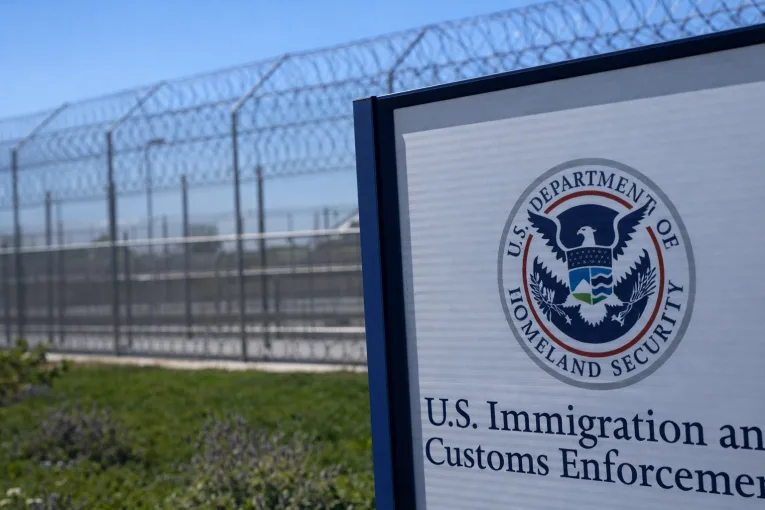
NEW YORK — As the Department of Homeland Security expands its regulatory authority and immigration officers in Immigration and Customs Enforcement and U.S. Customs and Border Protection wield growing power, critics say the public is increasingly disillusioned with the Trump administration’s opposition to prohibiting ICE from conducting home entries without a judicial warrant.
The administration claims that this is the only problem to be neutralized. However, because there is no internal oversight or supervisory approval, critics argue Congress has allowed immigration officers to operate without sufficient restraint, raising concerns about violations of the Fourth Amendment’s protection against unreasonable searches and seizures.
Current DHS regulations permit ICE agents to issue arrest warrants under 8 U.S.C. § 1226. Every immigration officer in ICE and CBP who has completed basic training can exercise this power while carrying a firearm.
However, the authority does not require additional oversight, which critics say reinforces the assumption that the regulatory scheme is effectively self-validating.
While district courts have rejected the argument that ICE can use administrative warrants as substitutes for judicial ones, courts continue to recognize judicial warrants as the standard requirement.
Critics argue that the system ultimately fails the public. They say the broad discretion granted to officers can violate the rights of lawful permanent residents and immigrants with legal status.
Even when people are wrongfully detained, critics note that the psychological harm caused by detention cannot easily be undone.
Within the constitutional framework of the United States, the principle of probable cause is intended to protect people from arbitrary detention by immigration agents.
In removal proceedings, however, the suppression of evidence — the exclusion of evidence obtained through unlawful detention — is generally unavailable.
The foundation for the “reasonable suspicion” standard arose in United States v. Brignoni-Ponce (1975), in which the Supreme Court rejected the practice of conducting stops up to 100 miles from the border and questioning individuals about citizenship and immigration status without probable cause.
The court warned that allowing such stops without suspicion would undermine constitutional protections.
“To approve roving patrol stops of all vehicles in the border area, without any suspicion that a particular vehicle is carrying illegal immigrants, would subject the residents of these and other areas to potentially unlimited interference with their use of the highways, solely at the discretion of Border Patrol officers,” the court wrote.
The content of ICE’s “Warrant for Arrest of Alien,” known as Form I-200, is not specified in regulation or statute. The form allows agents to determine on their own whether probable cause exists for removal.
Critics say that system leaves significant discretion in the hands of lower-level officers and raises questions about whether those officers are adequately positioned to make such determinations.
Advocates also say ICE often withholds information related to these warrants, prompting attempts to obtain records through the Freedom of Information Act.
Under 8 U.S.C. § 1226, the statute states that “an alien may be arrested and detained pending a decision on whether the alien is to be removed from the United States.”
As a result, DHS can arrest and detain individuals it believes to be noncitizens, based on issues ranging from lack of documentation to alleged criminal activity.
Critics argue the lack of an independent review process creates contradictions within the system, which is meant to protect the rights of U.S. citizens and immigrants who are not legally subject to arrest.
In other national security contexts, courts have required stricter internal procedures when the government exercises authority over foreign nationals and when post-deprivation remedies are limited.
In those cases, government authority to conduct warrantless surveillance is generally tied to safeguards meant to protect the rights of U.S. citizens.
Section 708 of the Foreign Intelligence Surveillance Act requires the government to implement procedures that prevent U.S. citizens from being mistakenly targeted and to minimize the collection of personal information.
The U.S. Foreign Intelligence Surveillance Court has stated that constitutional analysis depends on whether safeguards adequately protect individual privacy.
“If the protections that are in place for individual privacy interests are sufficient in light of the governmental interest at stake, the constitutional scales will tilt in favor of upholding the government’s actions,” the court said. “If, however, those protections are insufficient to alleviate the risks of government error and abuse, the scales will tip toward a finding of unconstitutionality.”
Executive branch procedures under Executive Order 12333 also require high-level approval to protect privacy interests and ensure compliance with the Fourth Amendment.
Critics say DHS arrest practices depart from those safeguards, creating risks of prolonged detention, mistakes and harm caused by inadequately trained officers.
In Abel v. United States (1960), the Supreme Court noted the “overwhelming historical legislative recognition of the propriety of administrative arrest for deportable aliens.”
However, critics argue that modern enforcement practices extend that authority beyond what courts originally contemplated.
Chris Hardee, a former chief for law and policy in the Justice Department’s National Security Division, has suggested reforms to the administrative arrest system.
Hardee proposes transferring warrant authority to an immigration judge or senior official who would review requests before warrants are issued to lower-level agents.
He also recommends establishing a minimum training requirement for agents authorized to carry out arrests.
Hardee further argues that factual findings supporting probable cause should be documented through formal attestation by the official requesting the warrant.
He also recommends that DHS report incidents involving misidentification, errors in executing warrants and other incidents that “implicate the rights of individuals not lawfully subject to arrest.”
Those reports, he said, should be sent to DHS’s Office of General Counsel, the Office for Civil Rights and Civil Liberties and relevant congressional committees, along with the issuance of public regulations.
Finally, Hardee recommends that congressional committees be notified of any legal interpretations related to DHS arrest authority.
In Almeida-Sanchez v. United States (1973), the Supreme Court emphasized the importance of maintaining constitutional safeguards.
“It is precisely the predictability of these pressures that counsels a resolute loyalty to constitutional safeguards,” the court wrote.
Follow the Vanguard on Social Media – X, Instagram and Facebook. Subscribe the Vanguard News letters. To make a tax-deductible donation, please visit davisvanguard.org/donate or give directly through ActBlue. Your support will ensure that the vital work of the Vanguard continues.
