
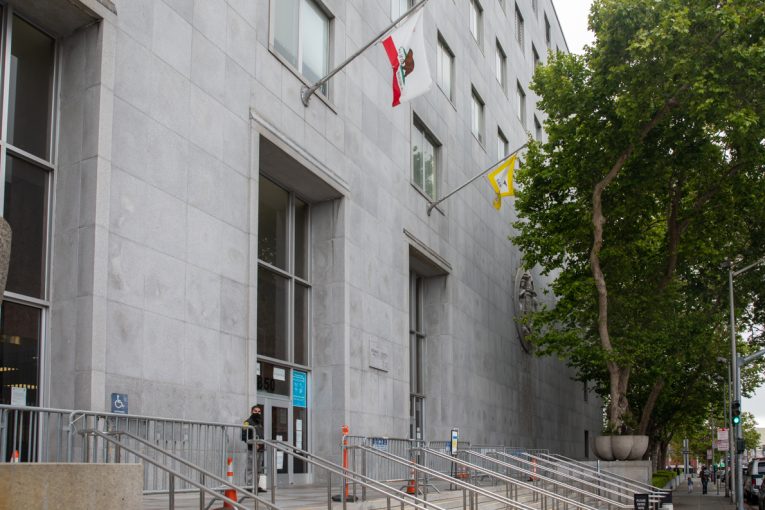
SAN FRANCISCO — Closing arguments in a San Francisco Superior Court trial centered on whether the accused intended to sell narcotics and whether he knowingly fled the scene of an alleged hit-and-run, as prosecutors and defense attorneys offered sharply different interpretations of the evidence and witness testimony during proceedings July 15 in Department 21.
Deputy District Attorney Andre Guiulfo and Deputy Public Defender Deborah Awolope presented evidence and witness testimony related to allegations of a hit-and-run and possession of narcotics for sale.
As outlined in Guiulfo’s closing argument, the accused was involved in two incidents. First, on June 11, 2025, the accused allegedly struck a homeless man who was lying on a mattress in the street and then drove away. At the time of his arrest for the alleged hit-and-run, officers found narcotics and nearly $2,000 on the accused. After being released from custody, the accused was arrested again on July 21, 2025, for allegedly selling methamphetamine and cocaine base in San Francisco’s Tenderloin district.
According to Guiulfo, the case was “about [the accused], leaving a man in the middle of the street to protect his drug stash,” in order to “avoid having his drugs, which he intended to sell, taken by the police.”
In contrast, Awolope argued during her closing argument that the accused did not flee the scene because he possessed narcotics but instead because he was “already on his way out.”
Guiulfo continued by outlining what he described as the “undisputed facts” of the case. According to Department of Motor Vehicles records, the accused owned the Chevy Tahoe seen in surveillance footage of the alleged hit-and-run. During an on-scene interview with arresting officers, the accused confirmed he was the only person who had driven the vehicle that day. During both incidents, the accused was found with methamphetamine and cocaine base on his person.
Guiulfo presented Judge Teresa Caffese and the jury with video of the victim’s emergency treatment in which the victim said, “it’s my right leg” and “everything hurts up there.” Guiulfo also argued the victim’s “pain is authenticated” by medical records documenting “pain, abrasions, and swelling in the right leg.”
Guiulfo then turned to what he described as the “disputed facts” of the case, arguing that the purpose of the narcotics — possession for sale versus personal use — was a critical distinction.
Guiulfo emphasized the quantity and variety of narcotics found in the accused’s possession, as well as the absence of drug-use paraphernalia found during either arrest.
According to Officers Hargreaves and Thomas Smith, whom Guiulfo described as “seasoned narcotics officers,” the “regular” amount of methamphetamine and cocaine base used for personal consumption is about 0.2 to 0.5 grams per use. A “heavy user,” they testified, would consume up to 2 to 3 grams at one time.
Guiulfo noted the accused possessed 10.9 grams of methamphetamine and 3.1 grams of cocaine base during the first incident, and 7.1 grams of methamphetamine and 3.5 grams of cocaine base during the second incident.
Guiulfo argued those amounts exceeded the “regular” quantities described by the officers, saying they were “not consistent with a user” but would “make sense if [the accused] were selling.”
Guiulfo further argued that, during both incidents, there were “no signs of any tools used to ingest these narcotics.” He added that arresting officers found: “No pipes, just drugs, exactly what you would expect from a seller,” suggesting the accused possessed the narcotics for sale rather than personal consumption.
Guiulfo also highlighted the accused’s behavior after the collision while presenting surveillance video of the incident. Guiulfo said there was a “slight pause, deliberation” after the collision while the accused was “thinking about what’s gonna happen next.”
Guiulfo ultimately argued the accused “didn’t want to lose his stash” of drugs during an encounter with police following the collision.
During the second arrest, Officer Hargreaves testified he observed a hand-to-hand narcotics transaction involving the accused in the Tenderloin, nearly the same location as the first arrest.
“That’s [the accused’s] spot to sell drugs. This isn’t an accident or a mistake, this is a clear choice,” Guiulfo said.
Guiulfo also addressed what he characterized as potential sources of reasonable doubt, focusing primarily on the possibility that the accused possessed the narcotics for personal use.
To accept that explanation, Guiulfo argued, jurors would have to believe three things. First, that the accused was a “super human drug user,” because the amount found exceeded what officers testified would be consumed in one use. Second, that the accused was a bulk buyer, even though Guiulfo argued “it makes no sense for someone to buy multiple days of narcotics.” Third, that it was “just a coincidence,” because at the time of his arrest, the accused “didn’t show signs of being under the influence and didn’t have anything to use drugs with.”
“[The accused] was not a victim of drugs, there is no evidence that he consumed drugs. [The accused] was ready and willing to do anything, including leave a man on the street, to protect his stash,” Guiulfo said.
Awolope began her closing argument by reminding jurors of the legal standards of the presumption of innocence, the burden of proof and proof beyond a reasonable doubt. She told jurors they must presume the accused innocent unless the prosecution proved guilt beyond a reasonable doubt.
“You only need one reasonable doubt to find [the accused] not guilty. All it takes is one,” Awolope said.
Awolope presented video of the alleged hit-and-run, arguing the accused did not flee because he possessed narcotics but because he was “already on his way out.”
In the video, the accused is seen waving goodbye to unidentified individuals before getting into his vehicle. As he pulled forward to back away from the curb, the vehicle drove over the mattress, pushing the victim off it. An unidentified individual wearing a gray hoodie then directed the accused to stop, reverse and pull away.
Awolope argued the accused was “relying on the guy in the gray hoodie” for direction, also pointing to the “thumbs up” the unidentified individual gave the accused before he drove away.
Awolope also presented a close-up video of the collision. She argued that although the vehicle drove over the mattress, the victim was “pushed over,” “both legs are not underneath the tire,” and the victim was not “rolled over.”
The victim is also seen lying on his left side on the mattress. Awolope noted it was the victim’s “left side that is getting pushed,” despite medical records and statements indicating the victim’s right side was injured.
In video from the on-scene interview with arresting officers, the accused said, “I didn’t hit him, I hit the mattress,” and “I pulled back, the guy told me.”
The accused also stated, “There’s a dude that already flipped him off the mattress.” Awolope argued the victim’s abrasion may have resulted from an earlier incident rather than from the accused’s vehicle.
The victim’s medical records showed “no bone fractures,” only swelling, redness and tenderness. The victim had also visited the emergency room on May 15, 2025, before the incident. Awolope argued, “He’s already having issues, he’s already experiencing pain.” Emergency Medical Technician Sean Delise also testified that, when he treated the victim, he “didn’t know the cause of the abrasions.”
Awolope also challenged the prosecution’s narcotics evidence, noting that officers found a razor blade and a lighter on the accused, even though Guiulfo “said there was no paraphernalia.” Awolope argued a razor blade could be used to divide narcotics and a lighter could be used to smoke them for personal use.
Awolope also referenced testimony from defense drug expert Kathy O’Brient. O’Brient testified it is “common…to have large quantities of substances” because people “get the best deal the more they buy.” Awolope argued that, based on O’Brient’s testimony about San Francisco’s drug culture, it was reasonable to conclude the accused possessed larger quantities of narcotics for personal use.
Awolope concluded by urging jurors to apply the law governing circumstantial evidence, arguing that when two reasonable explanations exist — one pointing to innocence and the other to guilt — jurors must choose the interpretation favoring innocence.
“That is what the law requires,” Awolope said.
Jurors were scheduled to begin deliberations on July 16, 2026. Sentencing will follow if the accused is convicted.
To comment please go to one of these social media platforms:
Facebook: https://www.facebook.com/DavisVanguard
LinkedIn: https://www.linkedin.com/company/peoples-vanguard-of-davis-inc/
Instagram: https://www.instagram.com/davisvanguard/
X: https://x.com/davisvanguard
Bluesky: https://bsky.app/profile/vanguardnewsgroup.bsky.social
Subscribe to the Vanguard News letters. To make a tax-deductible donation, please visit davisvanguard.org/donate or give directly through ActBlue. Your support will ensure that the vital work of the Vanguard continues.
