
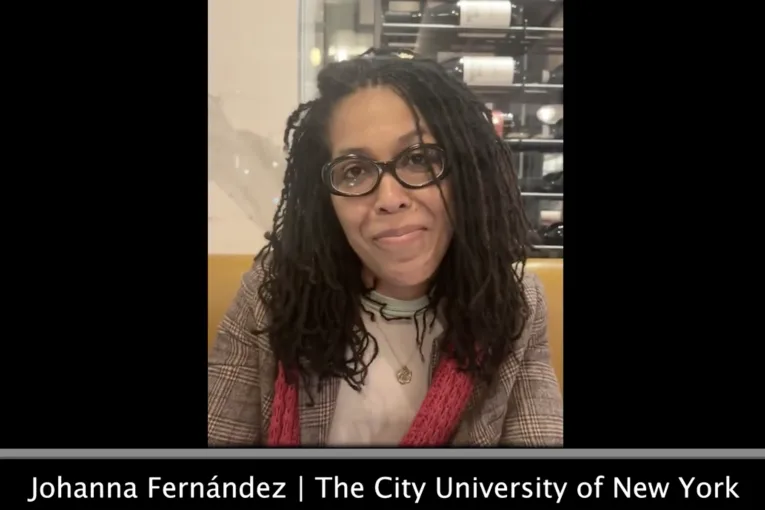
She was love, intellect and solidarity. Selflessly, Johanna Fernández allowed me—a strange voice ruminating from a California cell–to crash land into her cell phone, climb into her inbox and pepper her with never-ending questions about police power, government surveillance and resistance. She treated me not as an unlettered outcast, but rather, a “colleague” worthy of “testing” the promises of so-called freedom, probing the canonical order of all things carceral, and “daring” to contribute to it. The many books she so generously sent me have, since her passing, quickly morphed into a literary watchtower–a different sort of panopticon—reminding me of just how heavy an idea can become despite the thin page it textually rests upon. The titles stalk me now, the way first watch flashlight beams move through the cell every hour, like sage reminders urging me to reread everything again, and again, so that I might squeeze from them something I have missed, like how I miss her.
Not having had a chance to say goodbye, has left me drenched in a guilt that urges me to devour everything she ever wrote, replay every word said and make optimal use of what she shared with me.
“This is a stunning, devastating and irreplaceable loss to our movement and the historical profession,” said Elizabeth Hinton, Class of 1954 Professor of History, Black Studies, and Law at Yale University, who described Johanna as “a true justice warrior, who understood the relationship between the micro and the macro better than any other. She leaves behind a tremendous legacy, both in battling the state and eventually helping to declassify more than a million documents from the NYPD’s surveillance of Black radicals and the Left in the 60s and 70s, but also her work and unwavering support for political prisoners and abolition. On top of her brilliant work, Johanna will always be remembered for her kindness and generosity.”
Of course, I was fortunate to know Johanna at all, owing to Elizabeth having taken my request to speak to her into a historical conference whereat folks like Heather Ann Thompson, Donna Murch, and Johanna would be attending. I was soon viewing a video filmed by Elizabeth, depicting Johanna seated in a well-lit booth within the hotel’s restaurant, praising our journalism work at Witness. She called it “kick-ass,” saying “this is what we need, inside and out,” and offering us “solidarity and love.”
Kindness and generosity.
Johanna had given her cell number to Elizabeth, along with an invitation for me to call—which I did quickly—and within the first sixty seconds of our first introductory phoner, as another call hit her line, she said “here is Mumia calling now.” A moment later, Mumia Abu-Jamal came onto the line, greeted me smoothly, referred to me as “Brother Ghost,” and without missing a beat, proceeded to deliver a most surreal discourse about the trappings of fascism. Mine was a fluid indoctrination, simply because Johanna had made it so; as well, Mumia, whose phone time is limited compared to mine, and has many folks vying for his attention, opted to share his time with me. Their hand-in-glove willingness to give me audience, center my asks, and pour teachings into me was a disarmingly sprite blend of affirmation and humility.
After that first encounter with Mumia, Johanna told me “our nation is clueless about the barbarism that marks its essential functions, and the insurgent teaching work you use journalism to perform from within, is the sort of social antagonism we will always support, because it can—if you’re radically principled—transform society from the bottom in ways not much else can from where you are.” To that end, she conveyed our requests, presented our questions, recorded Mumia for multiple formats of responsive messaging and audio podcast content supporting our work, and conveyed that material to our producer Kristine Guillaume.
Today, as I sat at a table by myself, staring at Johanna’s work staring back at me from my college laptop, and replaying all of our talks, I struggled to chart a writing path that best captures her, doesn’t simply rattle off her CV, preserves the trust we built, and doesn’t place too much of me into it. But there I was, cocooned by a familiar sadness, my whole body quaking quietly within the eye of a weekend prison dayroom hurricane—torrents of sound slicing into my usually distraction-proof ear-plug-enabled writer’s safe zone head space—waves of dominoes slapping, trumps being called out by animated players of spades, two big screen TVs blaring WNBA games, and the constant white noise of prison talk braggadocio. The screen went blurry because my eyes had welled up with a sudden rush of tears that I could not prevent from forming, but did not allow to spill out onto my face. I didn’t wipe them away. I just sat still, staring into the blur, until my eyes reclaimed their fluid.
All I could think about, was how Mumia, who, by losing Johanna, had lost more than a confidant, a writing collaborator, and the custodian of his life’s work, was likely soaked in a grief very few progenitors of freedom work can relate to. The more work one generates—the more prolific the creator—the more critical the caretaker is to one’s sanity. Johanna was the keeper of Mumia’s flame—his intellectual ride-or-die struggle solidarity ally—his organizing comrade in all things. I felt his pain, took it on as my own, and contemplated the cumulative loss that builds when another person we outlive, leaves us. I thought about how many times he’d dialed that same 917 number I had been given, then I cringed at the thought of her never answering it again. Prison takes from us the folks who sustain us, and then torments us with the concretized muscle memory of dialing the numbers we most covet, but will never get to use again.
A lifer’s phone book becomes a silenced eulogy.
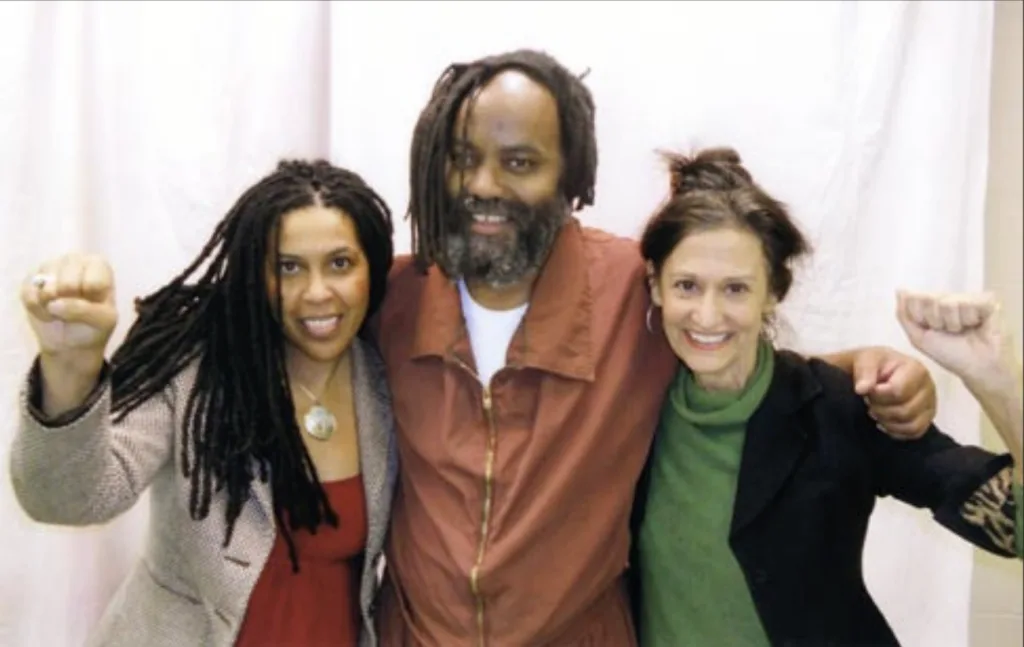
The Baruch College community at CUNY will proudly remember Johanna as the History professor whose work, The Young Lords: A Radical History, received the New York Society Library’s New York City Book award, and three Organization of American Historians awards: the prestigious Frederick Jackson Turner Award (best first history book), the Liberty Legacy Foundation Award (best civil rights book), and the Merle Curti Award for Best Social History. Her 2014 Freedom of Information Law lawsuit against the NYPD recovered the “lost” Handschu files–the largest repository of police surveillance records in the country—comprising over one million files of New Yorkers compiled by the NYPD between 1954-72, including those of Malcolm X.
As the editor of Writing on the Wall: Selected Prison Writings of Mumia Abu-Jamal and writer and producer of the film, Justice on Trial: The Case of Mumia Abu-Jamal, Johanna brought a historian’s care to her literary and cinematic treatment of political prisoners and radical movements. Awarded the Fulbright Scholars grant to the Middle East and North Africa, and a National Endowment for the Humanities Fellowship in the Scholars-in-Residence program at the Schomburg Center in Harlem, she directed and curated ¡Presente! The Young Lords in New York, and exhibition in three NYC museums, and hosted A New Day, WBAI’s morning show at 99.5 FM in New York.
Conquering all media formats, Johanna’s capacity for conveying knowledge, and artfully telling the stories of people confronting power, had no ceiling. Be it reaching across walls to facilitate Mumia’s work, or shapeshifting into a human land bridge in order to connect distanced captives through the digital ether, Johanna was an equal opportunity ally, selflessly committed to being of service to folks who lacked the agency to overcome the counterinsurgency by themselves.
Johanna, I will forever remember your endearing willingness to help me; and tonight, while muffled by the shower, I will cry for you.
Suggested reading:
Mumia Abu-Jamal and Johanna Fernández, eds., “The Roots of Mass Incarceration in the US: Locking Up Black Dissidents and Punishing the Poor,” special issue, Socialism and Democracy 28, no. 3 (November 2014).
