
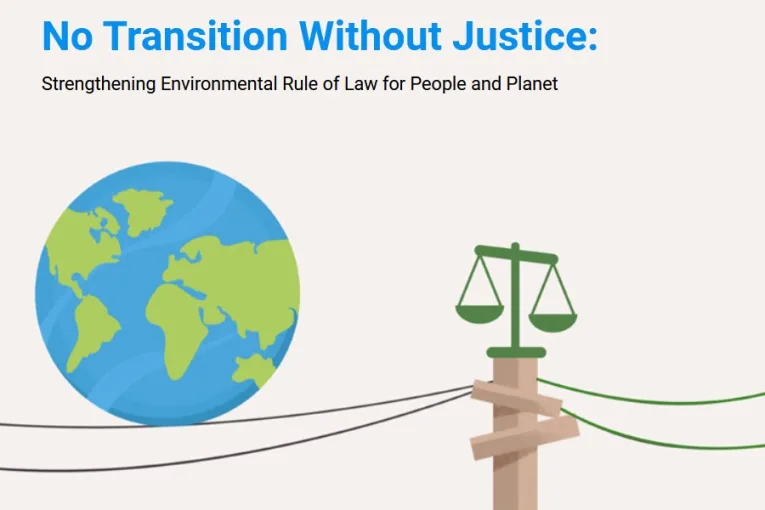
NAIROBI, Kenya — The global transition away from fossil fuels risks deepening existing inequalities and creating new injustices if governments pursue environmental goals without protecting workers, vulnerable communities and human rights, according to a new report from the United Nations Environment Programme.
According to UNEP’s report, “No Transition Without Justice: Strengthening Environmental Rule of Law for People and Planet,” the approach stems from the idea of a “just transition,” which centers sustainability on fair and inclusive practices. The report argues that these human rights norms are often ignored as environmental policies neglect social and economic impacts, worsening inequality and creating new injustices.
UNEP defines a just transition as a shift toward more environmentally sustainable communities while ensuring no individual is left behind. This change especially protects vulnerable communities and workers from unequal environmental burdens and benefits.
According to the report, a transition is unjust if communities are excluded from the decision-making process, if speed is prioritized over fairness and if environmental goals are pursued at the cost of social and economic consequences.
Instead, UNEP argues that the most effective transition must contain a balance between environmental sustainability and social justice.
The origins of this movement date to the 1970s, as the U.S. labor movement gained momentum and labor unions worked toward gaining greater support from the government. As environmental regulations were feared to eliminate jobs in certain industries, unions expected governments to provide financial assistance as well as generate new employment opportunities.
The report especially highlights Indigenous communities, low-income households, women and workers in carbon-intensive industries because they are among the most vulnerable during the transition to cleaner energy. According to UNEP, policies that fail to include these groups in decision-making or provide economic protections risk reinforcing existing inequalities rather than reducing them.
The report goes on to explain how, without proper safeguards, these transitions can risk repeating patterns of forced displacement and community fragmentation within these vulnerable populations. A genuine and meaningful transition requires direct participation through Indigenous-led initiatives to ensure equal benefit-sharing.
Over time, this idea expanded beyond labor rights. International organizations such as the International Labour Organization, United Nations Framework Convention on Climate Change and United Nations began recognizing that climate policies must also protect communities, reduce poverty, uphold human rights and promote equality.
The report also notes that by 2024, dozens of countries had incorporated just transition language into their national climate commitments under the Paris Agreement.
A central argument of the report is that climate action can inadvertently create even greater social problems. For example, the closure of coal mines to reduce greenhouse gases can end up devastating economies that depend on mining.
Rising energy costs through transitions may also disproportionately place a burden on low-income families.
However, UNEP argues that these consequences do not mean society should abandon climate action but rather plan transitions attentively in order to mitigate harm.
UNEP also notes that a just transition requires governments to actively address existing inequalities rather than assume environmental progress will benefit everyone equally.
The report states that policies should include workforce retraining, social protections and meaningful community engagement to ensure vulnerable populations are not left to bear the economic costs of climate action. According to UNEP, these measures help create a transition that is both environmentally sustainable and socially equitable.
The report concludes that climate action and social justice must not be kept separate, as environmental action only succeeds when it equally protects the communities affected. According to UNEP, this ultimately builds long-term public support for the global shift toward a more sustainable future.
To comment please go to one of these social media platforms:
Facebook: https://www.facebook.com/DavisVanguard
LinkedIn: https://www.linkedin.com/company/peoples-vanguard-of-davis-inc/
Instagram: https://www.instagram.com/davisvanguard/
X: https://x.com/davisvanguard
Bluesky: https://bsky.app/profile/vanguardnewsgroup.bsky.social
Subscribe to the Vanguard News letters. To make a tax-deductible donation, please visit davisvanguard.org/donate or give directly through ActBlue. Your support will ensure that the vital work of the Vanguard continues.
