
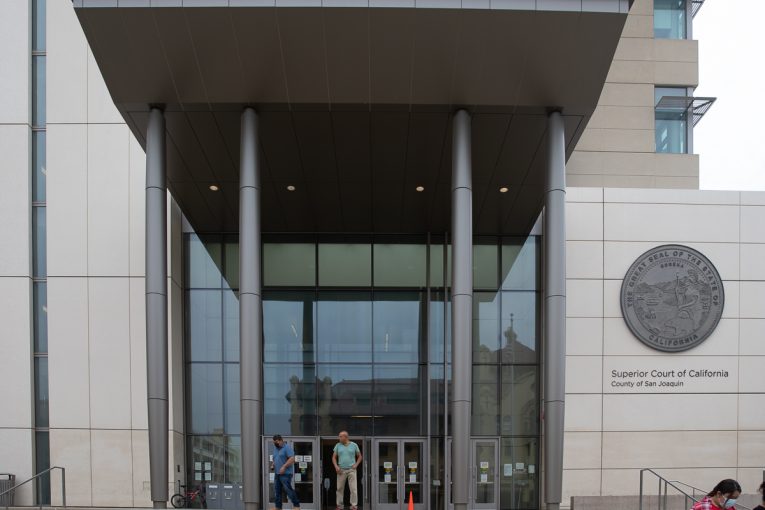
FRENCH CAMP, Calif. — An accused individual held in pretrial custody at the San Joaquin County Jail alleges his constitutional rights have been violated by the courts and jail staff, including through surveillance conducted by jail staff.
Piersin McCawley has been in custody at the county jail since February 2024, pending trial. Court records show he has entered pleas of not guilty.
According to McCawley, his rights have been violated on multiple occasions throughout the judicial process, including in the courtroom and at the jail. McCawley wrote to the Vanguard detailing these instances.
McCawley first alleged that during a preliminary hearing in his case, “the court wrongfully denied [his] right to represent [himself] under Faretta v. California.” He stated that on two occasions, a judge found him competent to represent himself.
According to court records, a Marsden motion, which allows a defendant to request to be relieved of their court-appointed attorney, was heard April 21, 2025. A second Marsden motion was heard March 24.
McCawley stated that he represented himself from April 2025 to January 2026. However, he is currently represented by an attorney.
Additionally, McCawley described “a severe act of judicial misconduct.”
According to McCawley, his attorney requested a private hearing to disclose the contents of a defense package, but the contents of the package were read aloud by the judge in open court. McCawley asserted that the disclosure of the records gave the prosecution an “unfair advantage.”
In his letter to the Vanguard, McCawley goes on to state, “the prosecutor and the jail are actively continuing to violate my Sixth Amendment rights by operating an underground surveillance pipeline designed to intercept my confidential legal mail and forward it directly to the District Attorney’s Office.”
McCawley referenced a sergeant at the jail who admitted to being trained to open and forward legal mail, an accusation made to the Vanguard by another accused individual in custody.
Mail from the Northern California Innocence Project was delivered to him “completely sliced open,” said McCawley. He stated that “the envelope was clearly and visibly stamped ‘Confidential Legal Mail’ in the bottom left-hand corner.”
When he later confronted a sergeant about receiving the opened mail, McCawley said the sergeant “confirmed the envelope was tampered with using a tool floor deputies do not have, but defended the action by claiming jail policy permits reading legal mail to check for ‘escape plans.’”
On the San Joaquin County Sheriff’s website, it is stated that legal mail is “confidential and checked only in the inmate’s presence.”
In addition to opening and sending legal mail, McCawley claims “the jail intentionally erases the paper trail.” He cites the mailroom having no records of the previously mentioned legal mail being processed and a lack of a tracking record.
McCawley hired a professional process server who said legal mail from McCawley arrived already opened and then resealed.
Those incarcerated at San Joaquin County Jail communicate via Securus, a telecommunications company. Securus has previously been sued for recording confidential calls between attorneys and clients in Romero, et al. v. Securus Technologies, Inc., which McCawley raised as a concern.
McCawley feels that he does not have the “ability to safely communicate or prepare trial strategies with [his] attorney, constituting an independent and severe violation of [his] Sixth Amendment rights.”
Furthermore, McCawley describes a “blockade” when dealing with the jail grievance process.
According to a statement by McCawley, he filed a “formal Level 1 Grievance regarding the mail intrusion,” which was given to an officer, and the following day, the officer notified him that the grievance had been forwarded to the mailroom.
A day later, McCawley said he received an official response from the mailroom. According to him, “the mailroom stated in writing that there was ‘no record indicating that the correspondence in question was received or processed by the mailroom as legal mail.’”
McCawley said he immediately filed a Level 2 grievance, which was denied. In response, McCawley filed a Level 3 grievance, which he said was not responded to within the 15-business-day requirement.
According to McCawley, he confronted his housing unit officer about getting a Level 4 grievance form that would be sent directly to a captain, but the interaction became hostile.
He stated the “blockade” on his grievance lasted approximately 95 minutes.
In order to respect attorney-client privilege, McCawley believes that “the only lawful constitutional remedy is a complete dismissal of the charges with prejudice.”
His next court date is Oct. 19 for trial setting.
To comment please go to one of these social media platforms:
Facebook: https://www.facebook.com/DavisVanguard
LinkedIn: https://www.linkedin.com/company/peoples-vanguard-of-davis-inc/
Instagram: https://www.instagram.com/davisvanguard/
X: https://x.com/davisvanguard
Bluesky: https://bsky.app/profile/vanguardnewsgroup.bsky.social
Subscribe to the Vanguard News letters. To make a tax-deductible donation, please visit davisvanguard.org/donate or give directly through ActBlue. Your support will ensure that the vital work of the Vanguard continues.
