
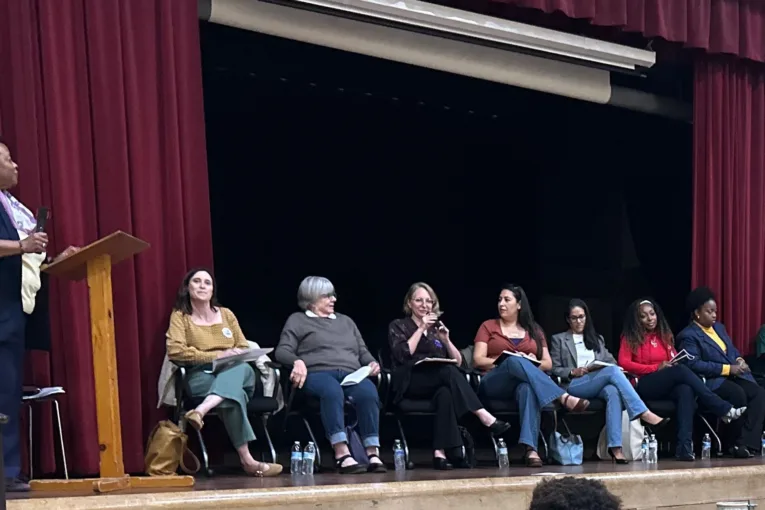
OAKLAND, Calif. — As Oakland Unified School District faces mounting financial pressures and families struggle to find affordable child care, candidates for three school board seats gathered at a forum organized by Parent Voices Oakland to address the future of early childhood education, school closures and access to services for some of the district’s youngest students.
The Oct. 9 forum at the Parker Community Resource Center brought together candidates competing for seats in Districts 2, 4 and 6 ahead of the Nov. 3 election, with questions focused on transitional kindergarten, special education, before- and after-school care, parent engagement and the district’s continuing budget problems.
For Parent Voices Oakland, which organized its first school board candidate forum, the event reflected the growing connection between public education and a child care system that many working families depend on.
Annie Banks, an organizer with Parent Voices Oakland, said in an interview with the Vanguard that the expansion of transitional kindergarten has created new opportunities for families while disrupting existing child care providers.
“Our goal is universal childcare, fully universal,” Banks said. “We know that parents are really struggling, and we also know that TK has been really disruptive to the childcare ecosystem.”
Banks said the organization wanted parents to have more information about candidates’ positions at a time when younger children are increasingly entering the public school system.
“We really wanted to give parents more information about their choices in this race because we feel like it’s really important that they’re informed, especially now that we are having three and four-year-olds going to public school,” she said.
The forum included District 2 incumbent Jennifer Brouhard and challenger Arielle Fleisher; District 4 incumbent Mike Hutchinson and challengers Kathryn Camp and Sylvia Pfeiffer Williams; and District 6 incumbent Valarie Bachelor and challengers LeAna Powell and Alexandra Williams.
Banks said every candidate invited to the forum attended, something she considered particularly significant given the organization’s focus on child care and early education.
“I think it was clear that people understand that TK is changing things and that talking about the connection with childcare is very important,” she said.
One of the central questions involved the expansion of transitional kindergarten and the difficulty families face securing placements near their homes.
The moderator noted that schools in Districts 2 and 4 have experienced substantial waiting lists, while some campuses in Districts 6 and 7 have available seats.
Hutchinson, the District 4 incumbent, said the expansion of transitional kindergarten has been supported by additional state funding but has also created problems for existing child care programs.
“One of the things coming into it is I wish OUSD would have done a better job of negotiating with Head Start and the other providers that already existed in Oakland because a lot of our TK programs also destabilize some of the programs that we traditionally had,” Hutchinson said.
He explained that some District 4 campuses lack sufficient classroom space to accommodate transitional kindergarten students, leading the district to establish TK hubs at other locations.
Hutchinson called for a comprehensive districtwide strategic plan that would integrate early childhood programs into broader school planning.
Other candidates questioned whether the hubs should remain a long-term solution, particularly when families must travel outside their neighborhoods or cannot access after-school care.
Banks said those logistical problems can determine whether transitional kindergarten is a realistic option for working parents.
“My daughter’s in TK and she’s 8:30 to 2:30,” she said, explaining that schedules vary by school.
“So for parents, especially for families who need it most, is that actually, what are the outcomes of this experiment? Is it helping the families who are in the deepest need or like you’re saying, are there still pretty significant barriers, like the lack of coverage for a workday?”
The availability of care before and after school emerged as another major concern.
One candidate argued that before- and after-school care should be guaranteed for every student, noting that many parents cannot leave work when the regular school day ends.
The candidate also suggested exploring ways to incorporate existing child care workers into the expanded public school system, including opportunities to become transitional kindergarten teachers or after-school providers.
Banks said those questions are especially important because the expansion of free transitional kindergarten has affected the financial stability of community child care providers.
“For a lot of childcare providers who feel really left out of that conversation, because for many of them, those children, they would’ve been caring for them and now they’re going to TK, which causes all kinds of challenges in terms of their business model,” Banks said.
She said providers also develop close relationships with the children they serve and should be included in decisions about how early childhood education is expanded.
The forum also addressed access to special education services for younger students, including children entering transitional kindergarten with individualized education programs.
One candidate, drawing on personal experience navigating special education services for her children, called for preserving literacy specialists and expanding access to speech-language pathologists.
Another candidate, who described experience teaching special education and dual-language programs, said services should be tailored to individual children, including consideration of whether instruction should be provided in their home language.
Banks said Parent Voices Oakland has examined gaps in care for children with disabilities throughout Alameda County and wanted candidates to address those disparities.
She also identified disproportionate suspension rates among Black students with disabilities as an issue raised by advocates working with the district’s special education community.
Transportation, language access and the availability of appropriate facilities were among the other concerns raised during the discussion.
Candidates were asked how the district could accommodate four-year-olds in buildings that were not originally designed for transitional kindergarten, including the need for suitable restrooms, outdoor spaces and classrooms.
The discussion also turned to families who have difficulty navigating online enrollment systems or who speak languages other than English.
One question noted that 143 children who applied for transitional kindergarten during the 2023-24 school year did not ultimately enroll, raising concerns about barriers that prevent eligible families from accessing available programs.
The district’s financial problems produced some of the forum’s sharpest differences among candidates.
Candidates were asked whether school closures should be considered as OUSD confronts budget reductions and whether consolidating campuses would generate meaningful savings.
One candidate cited a $90 million overspending figure from the previous year, along with anticipated midyear reductions and additional cuts over the following three years, and called for an open community discussion about the district’s options.
Other candidates rejected school closures, arguing that closing neighborhood campuses would disrupt families and could undermine access to education without producing the anticipated financial benefits.
“School closures does not save money for the school district,” one candidate said. “We need to look in other places to save money.”
Another candidate argued that consolidations and mergers should remain under consideration as part of a long-term strategy to improve educational quality and allocate resources more effectively.
That candidate said some shared-campus consolidations could eventually produce operational savings, although not necessarily in the short term.
Hutchinson pointed to his history of opposing earlier school closure plans and called for a yearlong community planning process to determine how district facilities should be used.
The competing positions reflected a broader disagreement over whether the district should preserve its existing network of neighborhood schools or consider structural changes as it addresses financial pressures.
Banks said the prospect of additional cuts and closures has generated considerable anxiety among parents.
“I think everyone heard about the deficit and honestly, people are nervous,” she said. “Parents are nervous about school closures. That continues to be a big issue for parents and definitely was a question at the forum.”
Candidates also discussed whether the district provides parents with sufficient opportunities to participate in decisions that affect their children’s education.
The moderator noted that school board meetings can extend well past midnight and that agendas are sometimes available only the minimum 72 hours required by state law.
Camp, a District 4 candidate and PTA president, said families need more time to review important proposals and that consequential agenda items should be considered earlier in meetings.
Other candidates proposed newsletters, regular school visits, multilingual communication, parent conferences and informal gatherings where families could speak directly with school board representatives.
Several candidates also criticized the number of different electronic platforms parents must navigate to receive information or enroll their children.
Questions from families addressed school safety, bullying, immigration enforcement, charter schools and the ability of families experiencing homelessness to enroll children without a permanent address.
During one exchange, candidates disagreed over the district’s relationship with charter schools, including whether charter campuses should be encouraged to join OUSD or whether the district should focus on attracting families back to its traditional public schools.
The discussion briefly became contentious when candidates sought to respond to criticism about school board responsiveness, prompting the moderator to remind participants that the event was not intended to be a debate.
For Banks, the broader significance of the forum was the opportunity to connect school governance with the child care needs of families who may not ordinarily participate in school board elections.
She pointed to the release of funding from Alameda County’s Measure C, which Parent Voices Oakland supported, as another reason early childhood education deserves greater attention from school board members.
Banks said litigation delayed implementation of the measure for nearly five years, but funding is now becoming available, including dedicated support for Oakland Head Start programs.
She said the availability of new funding and the expansion of transitional kindergarten create opportunities to improve early education, provided policymakers address the effects on existing providers and families who still cannot obtain the care they need.
The organization also wants more information about whether transitional kindergarten is delivering its intended benefits, including data on access, enrollment and outcomes for children.
Banks said the forum demonstrated that candidates recognized the importance of connecting the public school system with the early childhood programs that serve families before their children reach kindergarten.
“Often it feels like school just sort of picks up without any connection to early childhood education,” she said. “And so this was powerful to be in conversation with the candidates about how those two things can be more connected.”
To comment please go to one of these social media platforms:
Facebook: https://www.facebook.com/DavisVanguard
LinkedIn: https://www.linkedin.com/company/peoples-vanguard-of-davis-inc/
Instagram: https://www.instagram.com/davisvanguard/
X: https://x.com/davisvanguard
Bluesky: https://bsky.app/profile/vanguardnewsgroup.bsky.social
Subscribe to the Vanguard News letters. To make a tax-deductible donation, please visit davisvanguard.org/donate or give directly through ActBlue. Your support will ensure that the vital work of the Vanguard continues.
