
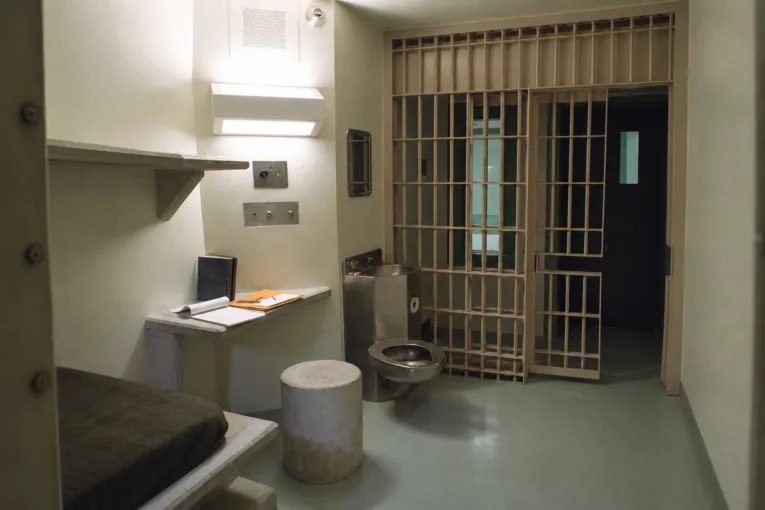
The U.S. Department of Justice and Federal Bureau of Prisons define restrictive housing as “any housing condition that involves removal from the general incarcerated population and placement in a locked room or cell, whether alone or with another incarcerated person, for the vast majority of the day, typically 22 hours or more.”
My name is Ellis Mosher. I am housed in the Federal Bureau of Prisons’ only “Supermax” prison, the U.S. Penitentiary Administrative Maximum, or ADX, located in a remote area of Florence, Colorado. The ADX has been described by one journalist as a “black site on American soil” and a “clean version of hell” by former ADX Warden Robert Hood.
Here, no one makes any pretensions about rehabilitation. In the ADX Control Unit, we are kept in solitary confinement for 24 hours per day, three days a week, and 22 hours a day for the other four days.
There is no congregate dining, no congregate exercise, no work opportunities, and no congregate religious services. I am allowed out for a two-hour exercise period (with no access to a toilet or water) four days per week.
I am always alone in a concrete yard the size of a small parking space with 20-foot-high walls and metal screens overhead. Whenever we are not separated from staff by bars, we are handcuffed behind the back, shackled, and escorted by three guards armed with spreader bludgeons.
Visitation rights are severely restricted, and no contact visits are ever allowed. Here, we can never touch our loved ones who come to visit.
During visitation, we must conduct our conversations through plexiglass and over a monitored phone with a camera overhead. To add to the painful conditions, we are handcuffed, belly-chained, “tack/jack boxed,” and shackled during these no-contact visits.
Few visitors make the journey just to endure such painful conditions. Prisoners sometimes ask loved ones not to visit in order to avoid the humiliation — including swollen wrists from the restraints — that comes with the situation.
To further discourage communication with their loved ones, ADX Control Unit prisoners are only permitted to make two 15-minute phone calls per month, they have no access to email, and snail mail is often delayed for several weeks or longer.
This place intensifies the repressive techniques of isolation and sensory deprivation. The cells are small, only allowing five steps in one direction.
The window of the cell is a slit 3 inches wide and 3 feet long facing a 20-foot wall. There is no view to look at and the sky is only partially visible. As a result, there is very little natural light.
The furniture — a bed, a table, and a stool — is made from brownish concrete built into white walls with green trim. On each bed are six iron rings used to torture and abuse prisoners.
The cells are sealed off with two steel doors, one barred and the other solid steel. The steel cage and cement are designed to prohibit communication with others, but people don’t realize the value of human connection until it is denied.
Strangely, neither the U.S. Department of Justice nor the Federal Bureau of Prisons recognizes the terms isolation or solitary confinement; only restrictive housing. Both agencies do acknowledge that placing mentally ill and suicidal prisoners in prolonged restrictive housing poses a substantial risk of harm, and suicide is a very likely outcome.
Sadly, these facts were detailed in a 143-page class-action complaint filed in 2012 against the ADX: Harold Cunningham v. Federal Bureau of Prisons. More recently, these facts were highlighted in a DOJ/Office of the Inspector General report titled “Evaluation of Issues Surrounding Inmate Deaths in Federal Bureau of Prison Institutions” dated February 2024.
From June 17, 1999, to Jan. 5, 2023, there have been at least 13 documented prisoner suicides that have occurred at the ADX, and they are:
- Wilson, Kevin Lee #57468-097, 6/17/1999
- Britt, Gregory #12546-083, 12/9/1999
- Klaker, Lawrence #37144-019, 11/18/2002
- Vanderstappen, Lance #11099-081, 4/17/2006
- Friesson, John #99917-555, 5/27/2008
- Davidson, Eddie #35082-013, 7/24/2008
- Vega, Jose #45189-053, 5/1/2010
- Knott, Robert Gerald #17508-086, 9/7/2013
- Higginbotham, Boyd #11044-040, 12/25/2015
- McMahan, Jamie #05327-030, 11/13/2017
- Sigler Micheal #06271-035, 8/31/2018
- Hertzog, Andre #16875-041, 8/5/2020
- Ashley, Frederick #66170-065, 1/5/2023
Despite prisoner suicides, numerous attempted suicides, and self-mutilations, the Federal Bureau of Prisons still maintains a practice of holding men with known mental illness who are suicidal in unsafe conditions at the ADX in prolonged restrictive housing and sensory deprivation.
I have the following documented mental health history: In 1986, I received mental health treatment for one year at Neuse Mental Health Clinic in North Carolina for Adjustment Disorder with mixed disturbances of emotions and conduct.
In 1995, I was placed on suicide watch at the Allen Correctional Center in Louisiana for severe depression and suicidal ideation. In 1996, federal court Judge J. Frederick Motz recommended to the Federal Bureau of Prisons that I be housed in their Butner Medical Facility in North Carolina for psychiatric treatment. The judge’s recommendation was ignored.
While incarcerated, I have been given multiple diagnoses including Post Traumatic Stress Syndrome/Disorder, Mixed Personality Disorder, Antisocial Personality Disorder (A.S.P.D.), possible Fetal Alcohol Syndrome, Adjustment Disorder with mixed anxiety and depressed mood, Anxiety Disorder, Depressive Disorder, Mood Disorder with psychotic features (Bipolar type), Depression with possible psychosis, and Schizoaffective Disorder (Bipolar type).
I experience several mental health symptoms that disrupt my daily activities, such as racing thoughts, severe depression, intense suicidal thoughts, mood swings, agitation, irritability, and I hear voices telling me to kill myself.
I have an increased risk for suicide as indicated by my documented history of suicide attempts via overdose, asphyxiations, and hunger/water strikes. I have been assessed for increased suicide risk over 85 times.
However, according to ADX psychology staff (Dr. Shields, Dr. Kornder, Dr. Jay, Dr. Lares, Dr. Mach, and Dr. Coulter) chronic suicidal ideation, chronic suicide risk, chronic depression, suicide attempts, and psychosis are not serious.
The above-named clinicians often encourage suicide, claiming it is less expensive than treatment or transferring mentally ill or suicidal prisoners to a mental health facility. The Federal Bureau of Prisons has been under budgetary constraints and suicide is a preferred method of treatment — according to ADX psychology staff.
Placement at the ADX in prolonged isolation and sensory deprivation poses substantial risk of harm to my mental health and has actually caused substantial harm.
Specifically, I suffered from mental illnesses before my transfer to the ADX — as documented in records — but the symptoms of my mental illnesses have worsened and continue to worsen in these conditions, as evidenced by my increased suicidal ideation, depression, mood swings, and auditory hallucinations.
Various Federal Bureau of Prisons and ADX-generated documents support that prolonged restrictive housing is psychologically damaging to my mental health. For example, but not limited to:
A memorandum for the North Central Regional Office Director dated Nov. 29, 2021, states in part, “He [inmate Mosher] requires more intensive mental health services than are currently available to him at the ADX, and daily group treatment and access to treatment staff would continue to move inmate Mosher toward emotional stability and freedom from suicidal ideation.”
A Mental Health Summary dated Feb. 16, 2022, generated by former ADX psychologist Dr. Garber states in part, “He [inmate Mosher] does not cope well with social isolation and this is increasingly observable during lockdowns. His opportunities to leave his cell while at the ADX are limited, and during lockdowns, they are temporarily eliminated. He becomes much more agitated, irritable, anhedonic, depressed, and his access to distress tolerance skills have become impaired.”
A memorandum from Andre Metevousian, Regional Director from Regional Counsel Mary Noland dated April 28, 2023, states in part, “Inmate Mosher has been diagnosed with a Serious Mental Illness, and he does have mental health concerns related to his placement at the ADX.”
A Psych Advisory List report dated Jan. 16, 2025, generated by ADX psychologist Dr. Kornder, states in part, “Inmate Mosher has a history of suicide attempts and Chronic Suicide Risk: Yes.”
The Federal Bureau of Prisons Program Statement regarding the “Treatment and Care of Inmates with Mental Illnesses,” dated Feb. 18, 2025, defines mental illness as a syndrome characterized by a clinically significant disturbance in an individual’s cognition, emotion regulation, or behavior that reflects a dysfunction in the psychological, biological, or developmental processes underlying mental functioning. Mental disorders are usually associated with significant distress or disability in social, occupational, or important activities.
Classification of an incarcerated person as seriously mentally ill requires consideration of his/her diagnoses, the severity and duration of his/her symptoms, the degree of functional impairment associated with the illnesses, and his/her treatment history and current treatment needs.
Schizophrenia spectrum and other psychotic disorders, bipolar and related disorders, and major depressive disorders are generally classified as serious mental illnesses. Other diagnoses including major neurocognitive disorders, and personality disorders are often classified as serious mental illnesses, especially if the condition is sufficiently severe, persistent, and disabling.
Per the ADX psychiatrist, Dr. Rivera, after conducting a psychiatric evaluation on me in November 2024 and evaluating me again on March 31, 2025, I have a current diagnosis of Unspecified Depressive Disorder with psychotic features (Bipolar type).
While I have never been provided with a psychological evaluation by ADX psychological staff, ADX psychologist Dr. Kornder opined that I also suffer from Antisocial Personality Disorder with borderline traits.
I am receiving constitutionally inadequate mental health treatment at the ADX in violation of federal law, Eighth Amendment, C.F.R. B.O.P Program Statement #5310.16, and settlement terms of Harold Cunningham v. Federal Bureau of Prisons.
All the while, I continue to suffer, and my mental health symptoms worsen. I have repeatedly requested to be removed from the ADX and placed in a mental health unit to address my heightened/chronic risk of suicide, but my requests have been denied.
Again, suicide is the preferred and cheaper alternative to treatment or transfer to a mental health unit.
It is important to note that the DOJ/Office of the Inspector General investigated the Federal Bureau of Prisons and identified the following deficiencies: inmate assessment issues such as failure to complete accurate Suicide Risk Assessments as well as inadequacies in diagnoses, issues related to Mental Health Care Level designations and treatment of inmates, including the assignment of potentially inappropriate M.H.C.L.s and B.O.P. failures to accurately document M.H.C.L. information, staff failing to sufficiently complete rounds, communication issues between departments such as psychology and psychiatry, and deficiencies in records that are maintained in B.O.P. electronic data systems that house mental health data.
The above deficiencies, which continue to occur at the ADX, coupled with unethical conduct by the aforementioned ADX psychology staff, create conditions where prisoners’ suicidal ideations worsen, and they become more likely to die by suicide, especially in a restrictive housing placement.
I need help contacting the ombudsman at the U.S. Department of Justice to file a complaint and request an investigation under the “Federal Prison Oversight Act,” 5 USC 413, or the “Civil Rights of Institutionalized Persons Act,” 42 USC 1997.
The Federal Bureau of Prisons and ADX officials refused to genuinely investigate their staff for misconduct. The Office of the Inspector General will occasionally forward prisoner complaints to the B.O.P. Office of Internal Affairs for review.
They too decline to investigate ADX staff for misconduct. The DOJ ombudsman is authorized to investigate these matters under the “Federal Prison Oversight Act.”
I would like to shine a light on the darkness of the ADX — a pit of despair.
In closing, by using the Freedom of Information Act and Public Records Act, I have obtained copies of documents referenced in this correspondence: mental health records, psychiatry files, memorandums, B.O.P. Program statements, Inspector General reports, and more.
Therefore, I can demonstrate with documents that I am telling the truth. Not surprisingly, ADX officials — namely S.I.S. staff — have been rejecting and denying me access to reports where the O.I.G. investigated the Federal Bureau of Prisons and discovered vast misconduct by staff, including S.I.S. staff who are the ones responsible for investigations.
To comment please go to one of these social media platforms:
Facebook: https://www.facebook.com/DavisVanguard
LinkedIn: https://www.linkedin.com/company/peoples-vanguard-of-davis-inc/
Instagram: https://www.instagram.com/davisvanguard/
X: https://x.com/davisvanguard
Bluesky: https://bsky.app/profile/vanguardnewsgroup.bsky.social
Subscribe to the Vanguard News letters. To make a tax-deductible donation, please visit davisvanguard.org/donate or give directly through ActBlue. Your support will ensure that the vital work of the Vanguard continues.
