
By Vanguard Staff
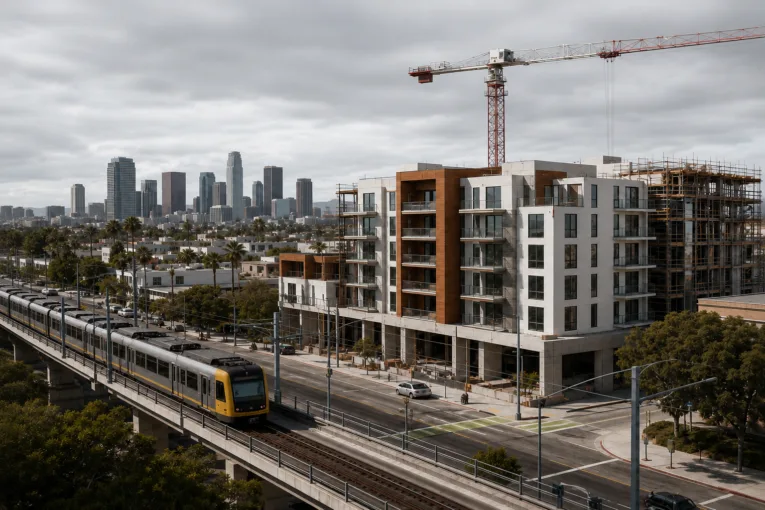
SACRAMENTO, Calif. — California lawmakers have approved legislation designed to dramatically increase the potential for high-rise housing near major transit hubs in the state’s largest cities, establishing minimum height and density standards while providing streamlined approval for qualifying residential developments.
Assembly Bill 2074, authored by Assemblymember Matt Haney, D-San Francisco, would require seven of California’s largest transit-rich cities — Los Angeles, San Diego, San Jose, San Francisco, Sacramento, Oakland and Long Beach — to designate regional transit hub districts where significantly taller and denser residential development would be allowed.
The measure, known as the Downtown Revitalization Act, passed the Senate unanimously, 40-0, on Aug. 28 before the Assembly concurred in Senate amendments Aug. 30. The bill now heads to Gov. Gavin Newsom for consideration.
The legislation is co-sponsored by California YIMBY and the State Building and Construction Trades Council of California.
“The pandemic is over, but many of our largest cities are still struggling to bring vitality back to their downtown neighborhoods,” said Brian Hanlon, CEO of California YIMBY. “AB 2074 will expedite the construction of tall residential buildings, alongside existing commercial buildings. Thanks to Asm. Matt Haney for his leadership on helping California’s largest cities recover with more homes.”
Under AB 2074, a “major transit city” is defined as a city with a population of at least 400,000, based on the most recent decennial census, that contains at least two qualifying transit-oriented development stops.
That definition encompasses Los Angeles, San Diego, San Jose, San Francisco, Sacramento, Oakland and Long Beach.
The bill requires qualifying cities to establish regional transit hub districts containing major transit infrastructure. A regional transit hub district must be contiguous, cover at least one-quarter of a square mile and contain at least one qualifying transit-oriented development stop.
Within those districts, cities generally could not establish maximum building heights below 150 feet for qualifying downtown housing developments.
At least 25% of the aggregate area of the city’s regional transit hub districts would have to permit maximum building heights of at least 450 feet.
The legislation also establishes minimum development intensity standards beyond building height.
Cities could not impose a maximum floor-area ratio below six, while at least 25% of the aggregate district area would have to permit a floor-area ratio of at least 12.
Cities also could not establish maximum residential densities below 200 dwelling units per acre for qualifying developments. At least 25% of the aggregate area of the regional transit hub districts would have to have no maximum residential density limit.
Local governments could continue imposing other objective zoning, subdivision and design review standards as long as those standards are consistent with AB 2074.
Projects seeking the law’s benefits would have to meet additional requirements, including a minimum density of 60 dwelling units per acre.
They would also be required to include housing affordable to lower-income households at levels specified under existing state housing law and comply with specified site eligibility requirements intended in part to protect existing housing and vulnerable residents from displacement.
Qualifying developments could not demolish individually landmarked properties listed on local, state or federal historic registers.
Projects would also have to comply with applicable airport height, noise and safety standards.
AB 2074 incorporates construction labor standards from existing California housing law for projects seeking streamlined approval.
The legislation’s supporters argue the combination of high-density zoning, streamlined permitting and labor protections could make downtown residential construction more feasible while creating construction jobs and bringing more residents into commercial districts that have struggled since the COVID-19 pandemic.
Haney has argued that the state’s downtown economic problems and housing shortage can be addressed together by converting traditionally office-oriented central business districts into neighborhoods containing substantially more housing.
“California’s downtowns are still struggling to recover, while our housing shortage continues to grow,” Haney said in an April statement explaining the legislation. “That is why I am proud to introduce AB 2074, the Downtown Revitalization Act, a proposal to tackle both challenges at once by bringing new housing and good-paying jobs into the heart of our cities.”
Haney said the legislation is intended to provide a clearer path for high-rise residential and mixed-use projects near transit while reducing regulatory uncertainty that can delay construction.
“This bill reflects a growing consensus that we can build the homes we need while supporting quality jobs,” Haney said. “By revitalizing our downtowns, we can strengthen local economies, create new opportunities for workers, and make our cities more livable for everyone.”
The proposal comes amid continuing concerns about the economic health of downtown districts following the shift toward remote and hybrid work.
California YIMBY’s fact sheet for the legislation argues that downtown districts occupy an average of only about 3% of city land but generate approximately 16% of property tax revenue, 42% of hotel tax revenue and 12% of sales tax revenue.
The organization also argues that high construction costs, interest rates and financing difficulties have prevented many already-approved multifamily developments from moving forward.
Earlier versions of AB 2074 proposed creating a Downtown Revitalization Loan Fund that would have provided low-interest state-backed loans covering as much as 30% of eligible project costs.
That provision was removed as the bill moved through the Legislature.
The version approved by lawmakers instead directs the California Housing Finance Agency to conduct a study of housing construction lending and financing programs.
The study is required to examine existing construction loan programs inside and outside California and make recommendations about how a state construction loan program could facilitate multifamily rental and for-sale housing.
The legislation directs CalHFA to consider financing for developments serving lower-, moderate- and above-moderate-income households, as well as mixed-income developments.
The study must also consider projects of different scales, ranging from missing-middle housing to large high-rise developments meeting affordability and labor standards, as well as developments in different regions of California.
The financing provision addresses one of the central obstacles confronting high-rise residential development: Even when local zoning permits tall buildings, construction costs and financing requirements can make projects economically infeasible.
The legislation also faced concerns during the committee process from affordable housing organizations.
An earlier Assembly committee analysis reported that the California Housing Consortium opposed the measure at that stage, arguing that limited state funding should prioritize housing affordable to lower-income Californians rather than subsidizing predominantly market-rate high-rise development.
Housing California also appeared before the Senate Housing Committee in June with an oppose-unless-amended position while acknowledging amendments being considered by lawmakers.
Despite those earlier concerns, AB 2074 ultimately advanced through the Senate without a dissenting vote.
The Assembly initially approved the measure May 28 before the Senate amended it. The Senate approved the amended legislation 40-0 on Aug. 28, and the Assembly subsequently voted to concur in the Senate amendments, sending the measure to the governor.
Supporters contend the measure could help shift the function of downtown districts from areas dominated by offices and daytime commuters toward mixed-use neighborhoods occupied throughout the day.
During a Senate Local Government Committee hearing, Sacramento City Councilmember Phil Pluckebaum argued that increased downtown housing could help cities recover from changing patterns of work and commercial activity.
“It’s no secret that changing work and land use patterns have hit downtowns hard,” Pluckebaum said. “However, we also know that bringing housing within walking distance of transit, business, and job opportunities is a great way to bring life back to our downtowns.”
AB 2074 would represent another major state intervention into traditionally local land-use authority, following a series of California laws aimed at increasing housing production by establishing statewide zoning rules and limiting discretionary review of qualifying projects.
If signed by Newsom, the legislation would establish statewide minimum development standards for some of the most transit-accessible and economically significant areas of California’s largest cities, while leaving cities authority to impose compatible objective development standards.
The bill’s ultimate impact, however, will depend not only on zoning and permitting but also on whether developers can secure financing for high-rise projects amid persistently high construction costs.
To comment please go to one of these social media platforms:
Facebook: https://www.facebook.com/DavisVanguard
LinkedIn: https://www.linkedin.com/company/peoples-vanguard-of-davis-inc/
Instagram: https://www.instagram.com/davisvanguard/
X: https://x.com/davisvanguard
Bluesky: https://bsky.app/profile/vanguardnewsgroup.bsky.social
Subscribe to the Vanguard News letters. To make a tax-deductible donation, please visit davisvanguard.org/donate or give directly through ActBlue. Your support will ensure that the vital work of the Vanguard continues.
